
Chatbot Market Outlook: Generative AI Adoption, Virtual Assistants & Forecast 2026–2034
The global chatbot market size was valued at USD 6.95 Billion in 2024. Looking forward, IMARC Group estimates the market to reach USD 44.49 Billion by 2033, exhibiting a CAGR of 20.40% from 2025-2033. North America currently dominates the market. The chatbot market share is driven by advanced technology infrastructure, increasing internet penetration, and rising demand for customer engagement solutions.

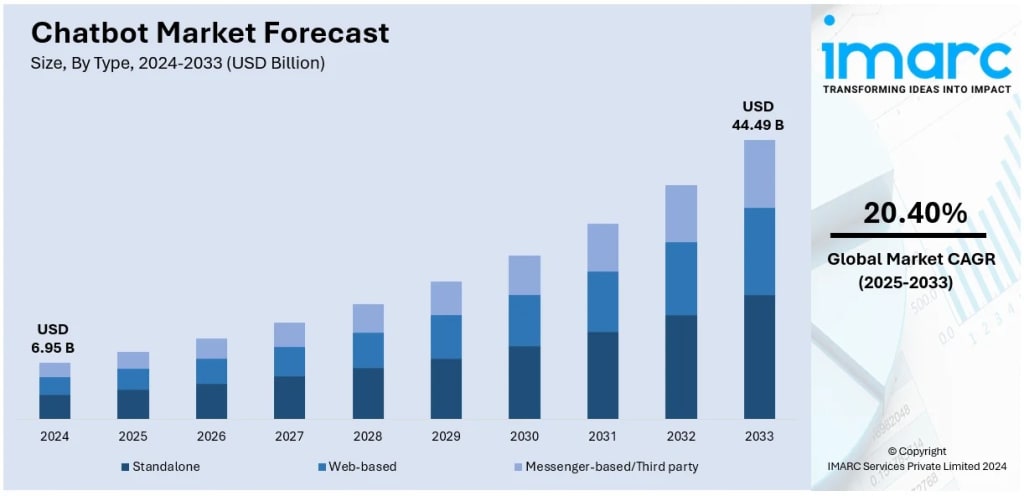
Chatbots have come a long way from the clunky, scripted pop-ups that used to frustrate website visitors a decade ago. Today's AI-powered conversational agents can handle complex customer queries, process payments, triage medical symptoms, guide shoppers through a full purchase journey, and do it all without a human in the loop. Businesses are catching on fast — and the investment numbers reflect it. According to IMARC Group, the global chatbot market size was valued at USD 6.95 Billion in 2024. Looking forward, IMARC Group estimates the market to reach USD 44.49 Billion by 2033, exhibiting a CAGR of 20.40% during 2025–2033. North America currently dominates the market, accounting for a share of 30.9% in 2024.
The market is broad and well-segmented. By type, standalone chatbots lead the pack — they work independently without requiring platform integration, making them a practical first step for businesses of all sizes. On the product side, marketing chatbots hold significant share, reflecting just how much companies are leaning on automation to drive sales and engagement. By application, bots for service dominate, handling everything from FAQs to order tracking at scale. E-commerce leads across verticals, where chatbots run 24/7 support operations that would otherwise require large, expensive customer service teams. Large enterprises are the primary adopters today, though small and mid-sized businesses are closing that gap quickly.
Get a Sample Report for Actionable Market Insights
Chatbot Market Growth Drivers:
• Relentless Pressure to Deliver Instant, Round-the-Clock Customer Support
Customer expectations have shifted dramatically — people now expect immediate responses whenever they reach out, whether it is 2 PM or 2 AM. Industry surveys show that 90% of customers cite immediate response as a critical factor when seeking customer service. Traditional support teams simply cannot meet this demand economically. A chatbot, by contrast, handles thousands of simultaneous conversations without queues, overtime, or burnout. Tata AIA Life Insurance in India demonstrated this at scale — around 3,000 customers completed policy renewal payments totalling INR 40 million directly through WhatsApp, without any human agent involvement whatsoever.
• AI and NLP Breakthroughs Making Chatbots Genuinely Useful Across Industries
Early chatbots were little more than decision trees dressed up with a chat interface. What has changed the game is the rapid maturation of natural language processing and large language models, which allow chatbots to understand context, handle nuanced queries, and hold multi-turn conversations that feel natural. The US government's annual budget earmarked USD 2 billion for R&D in AI and related technologies, with chatbot development directly benefiting from that ecosystem. The US National Science Foundation followed with a USD 140 million investment across seven dedicated AI Research Institutes, further accelerating the NLP capabilities that modern chatbots depend on.
• Healthcare Sector Unlocking Billions in Savings Through Chatbot Automation
Healthcare is one of the most compelling growth stories in this market — and the numbers are hard to ignore. Industry analysis projects that chatbots could save the healthcare sector up to USD 3.7 billion by automating appointment scheduling, symptom triage, and administrative workflows that currently consume significant front-desk staff time. A survey found that 74% of patients are comfortable using a chatbot for simpler queries, removing a major adoption barrier. Artificial Solutions signed an integration deal with MedHelp Care to embed its Teneo voice chatbot into telephone support services, directly reducing wait times and freeing nurses for higher-complexity patient interactions.
Chatbot Market Trends:
• Messaging Platform Integration Turning Everyday Apps Into Business Channels
One of the most significant shifts in this market is that chatbots are no longer confined to company websites. They are embedded inside the apps people already use every day — WhatsApp, Facebook Messenger, WeChat — reaching billions of users on familiar, trusted platforms. Industry data recorded 473 billion mobile interactions and a 91% increase in conversational messaging in a single year, underscoring just how fast this channel is scaling. For businesses, this is a genuine opportunity to meet customers exactly where they are, rather than redirecting them to a separate support portal. The commerce and payment capabilities built into these platforms make the channel even more valuable.
• E-Commerce Deploying Chatbots as Full-Service Shopping Assistants
In e-commerce, chatbots have evolved well beyond answering FAQs — they now guide shoppers from discovery through checkout and handle post-purchase support including returns and order tracking. Amazon India's launch of Rufus, a generative AI shopping assistant embedded directly in the Amazon app, is a strong signal of where this is heading. Rufus uses natural language to answer product questions, provide personalised recommendations, and compare options in real time. Meesho complemented this trend by launching a multilingual AI voice bot supporting Hindi and English — purpose-built for tier 2 city users on basic smartphones, demonstrating that chatbot commerce is expanding well beyond premium urban consumers.
• OpenAI's GPT Store Opening a New Ecosystem of Specialised Commercial Chatbots
OpenAI's launch of the GPT Store marked a structural shift in how chatbot solutions reach the market. Rather than every business building a custom bot from scratch, organisations can now access and deploy purpose-built conversational agents created by a global developer community — covering everything from specialised legal research to tutoring, HR onboarding, and financial guidance. The store is modelled on the app store concept, allowing creators to monetise their bots commercially. For enterprises, this dramatically lowers the cost and time to deploy high-quality, domain-specific chatbots. It also signals that the chatbot market is maturing from a custom development-led model into a scalable platform economy.
Recent News and Developments in the Chatbot Market
• November 2024: Meesho launched a multilingual AI voice bot supporting Hindi and English, designed specifically for use on basic smartphones and in noisy environments. The bot targets the company's tier 2 city customer base, with plans to expand capabilities to include six additional regional Indian languages.
• September 2024: Amazon India introduced Rufus, a generative AI-powered shopping assistant embedded within the Amazon app. The bot handles natural language product queries, personalised recommendations, and comparisons — and is complemented by AI-generated review highlights that summarise customer feedback for faster purchase decisions.
• January 2024: OpenAI launched the GPT Store, a marketplace where users and developers can share and monetise custom versions of ChatGPT. Initially available to paid subscribers, the platform features bots built for specific tasks — from teaching mathematics to generating recipes — following the commercial model established by Apple and Google app stores.
• April 2024: Artificial Solutions signed an integration agreement with MedHelp Care to deploy its Teneo AI-based voice chatbot into MedHelp's telephone support service. The integration is designed to reduce patient wait times, elevate service quality, and free nursing staff from routine call handling to focus on complex clinical advisory tasks.
• January 2025: The US National Science Foundation announced a USD 140 million investment to establish seven National Artificial Intelligence Research Institutes. The programme aims to strengthen the domestic AI workforce and advance the foundational technologies — including NLP and ML — that underpin next-generation chatbot platforms across healthcare, finance, and customer service.
Note: If you require specific details, data, or insights that are not currently included in the scope of this report, we are happy to accommodate your request. As part of our customization service, we will gather and provide the additional information you need, tailored to your specific requirements. Please let us know your exact needs, and we will ensure the report is updated accordingly to meet your expectations.
About the Creator
Rahul Pal
Market research professional with expertise in analyzing trends, consumer behavior, and market dynamics. Skilled in delivering actionable insights to support strategic decision-making and drive business growth across diverse industries.
Multi Directional Forklift: The Future of Flexible Warehouse Handling
Modern warehouses and logistics centers rely heavily on efficient material‑handling equipment. Among the many machines used in warehouses, the Multi Directional Forklift stands out as one of the most versatile solutions for handling complex loads in tight spaces. As storage facilities become more compact and demand faster operations, businesses are increasingly adopting advanced forklifts that maximize space, safety, and productivity.
By charliesamuel7 days ago in 01
ICO Marketing Explained: A Beginner’s Roadmap for 2026
The blockchain industry continues to evolve rapidly, and Initial Coin Offerings (ICOs) remain one of the most powerful fundraising mechanisms for blockchain startups and Web3 projects. Even though the crypto market has matured significantly over the past decade, ICOs in 2026 are experiencing a resurgence due to improved regulatory clarity, stronger investor protection frameworks, and advanced marketing technologies that help projects reach a global audience. However, launching a successful ICO is not just about developing a great blockchain product; it requires a well-structured marketing strategy that builds trust, generates awareness, and attracts the right investors. ICO marketing has transformed dramatically compared to the early days of crypto fundraising. In the past, many projects relied on hype and aggressive promotion to raise funds, but today's investors are far more informed and cautious. They expect transparency, detailed roadmaps, credible teams, and strong community engagement before investing in a token sale. As a result, ICO marketing in 2026 focuses on strategic storytelling, community building, influencer collaborations, data-driven campaigns, and regulatory compliance.
By Jack santo3 days ago in 01




Comments
There are no comments for this story
Be the first to respond and start the conversation.