
Logistics Automation Market Outlook: Smart Warehousing, AI Integration & Forecast 2026-2034
Increasing investments in robotics, artificial intelligence, and Industry 4.0 technologies are accelerating transformation across global supply chains in the Logistics Automation Market.

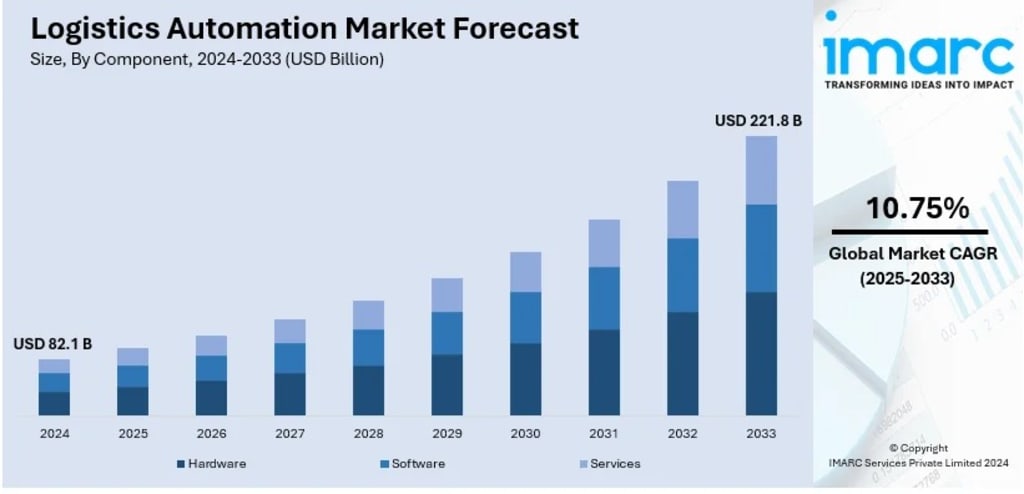
The way goods move from factory floors to front doors is being fundamentally rewired. E-commerce growth, persistent labor shortages, and the relentless pressure to deliver faster and with fewer errors have pushed logistics automation from a competitive advantage to a business necessity. Robotics, AI-powered route optimization, autonomous mobile robots, and smart warehouse platforms are no longer experimental — they are core infrastructure for any serious supply chain operation. According to IMARC Group's latest data, the global logistics automation market size was valued at USD 82.1 Billion in 2024. Looking forward, IMARC Group estimates the market to reach USD 221.8 Billion by 2033, exhibiting a CAGR of 10.75% during 2025–2033. Europe currently dominates the market, holding a market share of over 38.5% in 2024.
Hardware — spanning mobile robots (AGVs and AMRs), automated storage and retrieval systems, conveyor networks, and AIDC technologies — leads the market with a 54.2% share, reflecting where the bulk of capital investment is flowing. Warehouse and storage management commands 66.8% of demand by function, driven by the urgent need to handle ballooning e-commerce order volumes without proportional increases in headcount. Retail and e-commerce is the dominant industry vertical at 29.7% share, and large enterprises account for 75.4% of the market — though mid-market automation is accelerating rapidly as technology costs fall and deployment timelines shrink. The global warehousing and storage market itself hit USD 523.8 Billion in 2024, underlining the sheer scale of the infrastructure these automation solutions must serve.
Get a Sample Report for Actionable Market Insights
Logistics Automation Market Growth Drivers:
• E-Commerce Explosion Demanding Faster, More Accurate Fulfillment
Online shopping volumes have fundamentally outpaced what manual warehouse operations can handle. Amazon's North American segment alone posted USD 315.9 Billion in sales, and similar growth trajectories are playing out across every major market. To keep pace, companies are deploying robotic picking, automated sorting, and AI-powered inventory systems that can process tens of thousands of order lines daily without the error rates or speed constraints of human-only operations. Renault's fully automated logistics center in Villeroy — powered by Exotec Skypod robots — cuts processing time by six times while reducing energy consumption by 30%, handling up to 40,000 order lines per day.
• Labor Shortages and Rising Wage Pressures Accelerating Automation ROI
Finding and retaining warehouse workers has become one of the most persistent operational challenges in logistics. Turnover rates in fulfillment centers routinely exceed 100% annually in many markets, and minimum wages are rising across the US, Europe, and Asia Pacific simultaneously. This shifts the ROI calculation on automation decisively — a robotic system that once took five years to pay back now breaks even in two to three years in high-wage markets. In December 2024, KION North America and Fox Robotics partnered to manufacture FoxBot autonomous trailer loaders directly addressing loading dock labor gaps, improving safety and throughput without adding headcount.
• Industry 4.0 and IoT Enabling Real-Time Supply Chain Visibility
Modern logistics automation is no longer just about moving boxes faster — it is about knowing exactly where every item is at every moment. IoT sensors, RFID tags, and cloud-connected warehouse management systems provide end-to-end visibility that was impossible a decade ago. The UK's rapid infrastructure upgrade — with gigabit internet coverage rising from 27% to 76% of homes and businesses between 2020 and 2023 — is a concrete example of the connectivity backbone enabling these systems. Real-time tracking reduces lost inventory, improves demand forecasting accuracy, and allows logistics managers to intervene proactively before delays reach customers.
Logistics Automation Market Trends:
• Advanced Robotics Transforming Warehouse Operations at Scale
Purpose-built logistics robots are moving well beyond simple conveyor replacements. Autonomous mobile robots (AMRs) now navigate dynamically around human workers using real-time mapping, while robotic picking arms handle SKU diversity that previously required manual sorting. In 2024, Mytra — founded by former Tesla engineers — secured USD 78 Million specifically to automate material handling operations that remain stubbornly manual in most facilities. Robotic systems are proving particularly valuable during seasonal demand spikes: automated warehouses scale throughput without the lead time, training cost, or reliability risks of seasonal staffing, giving operators consistent performance regardless of order volume fluctuations.
• AI and Machine Learning Making Supply Chains Predictive, Not Reactive
The most significant shift in logistics automation is not in hardware — it is in software intelligence. AI-powered warehouse management systems now predict demand patterns, dynamically assign storage locations, and optimize pick paths in real time. In December 2024, MIT's Center for Transportation & Logistics launched a five-year partnership with Mecalux specifically to advance self-learning AI in logistics operations. This kind of academic-industry collaboration signals that AI logistics applications are still in early innings — the productivity gains from genuinely intelligent systems will be substantially larger than what current automation alone delivers. Predictive analytics is rapidly becoming the differentiator between good and great supply chain performance.
• European Market Leading Automation Adoption Through Industry Collaboration
Europe's 38.5% market dominance is not accidental — it reflects years of deliberate investment in automation alongside strong regulatory support for sustainable, efficient logistics infrastructure. Germany, France, and the UK are leading adopters, with companies integrating robotics, IoT, and AI across both warehouse and transportation management functions. In 2024, GXO Logistics partnered with Forum Sport to manage two automated logistics hubs in Spain, directly improving supply chain efficiency in the sports retail sector. Wayzim's EU market entry for automated logistics services reflects the same trend — established players and new entrants alike are betting heavily on European automation demand continuing its upward trajectory.
Recent News and Developments in the Logistics Automation Market
• December 2024: MIT's Center for Transportation & Logistics launched a five-year partnership with Mecalux to advance self-learning AI in logistics operations. Working through MIT's Intelligent Logistics Systems Lab, the collaboration will develop AI applications designed to deliver measurable productivity and sustainability benefits for companies across the global supply chain.
• October 2024: Viettel introduced a comprehensive logistics automation solution at Vietnam Innovation Day 2024, covering the full supply chain from warehousing to last-mile delivery. The launch marks a significant step in Southeast Asia's logistics modernization and positions Viettel as a key player in one of the region's fastest-growing technology markets.
• July 2024: Mytra, a robotics startup founded by former Tesla engineers, raised USD 78 Million to automate critical material handling operations including item transport and storage. The funding signals strong investor confidence in purpose-built warehouse robotics as a solution to ongoing labor shortages and efficiency demands across the logistics sector.
• April 2024: Netto entered a strategic partnership with Cimcorp, an automated solutions provider, to enhance logistics efficiency at its Coswig facility and future-proof its supply chain. The deal reflects the growing trend of major retailers investing in dedicated automation partnerships rather than piecemeal technology upgrades.
• 2024: GXO Logistics announced a collaboration with Forum Sport to manage two automated logistics hubs in Spain, leveraging advanced technology to improve supply chain efficiency, client satisfaction, and sustainability across the sports equipment retail sector. The deal extends GXO's footprint in Northern Spain while supporting Forum Sport's operational expansion goals.
Note: If you require specific details, data, or insights that are not currently included in the scope of this report, we are happy to accommodate your request. As part of our customization service, we will gather and provide the additional information you need, tailored to your specific requirements. Please let us know your exact needs, and we will ensure the report is updated accordingly to meet your expectations.
About the Creator
Rahul Pal
Market research professional with expertise in analyzing trends, consumer behavior, and market dynamics. Skilled in delivering actionable insights to support strategic decision-making and drive business growth across diverse industries.
5 Best Mobile App Development Companies in Pittsburgh (2026)
Pittsburgh has quietly become one of the most compelling technology cities in the United States. What was once known for steel mills and bridges is now home to a thriving ecosystem of software engineers, AI researchers, and product builders. Carnegie Mellon University alone pumps world-class computer science and machine learning graduates into the local workforce every single year, and a growing number of them are choosing to stay and build here rather than relocating to the coasts.
By Samantha Blake3 days ago in 01
The Rise of Labubu and Contemporary Collectible Toys
In recent years, the global toy landscape has shifted in noticeable ways. Toys are no longer designed only for children’s play; many are now created with adult collectors in mind. This evolution has brought renewed attention to designer characters, limited releases, and packaging styles that emphasize experience as much as the object itself. Within this context, the Labubu Doll has emerged as part of a broader conversation about modern collecting and the changing meaning of toys.
By charliesamuelabout 24 hours ago in 01
Lycan Lore
As the students of my 10am mythology class take their seats, I decide to steer the day's curriculum away from Greek and dive into a Western European discourse on the misaligned beliefs of the Werewolf. A tale of truth or fiction. No one really knows.
By Lamar Wigginsabout 10 hours ago in Fiction




Comments
There are no comments for this story
Be the first to respond and start the conversation.