
Tilapia Market Trends: Aquaculture Expansion, Sustainable Seafood Demand & Forecast to 2034
Rising investments in sustainable aquaculture, improved fish farming technologies, and expanding seafood trade are shaping the future of the global tilapia market.

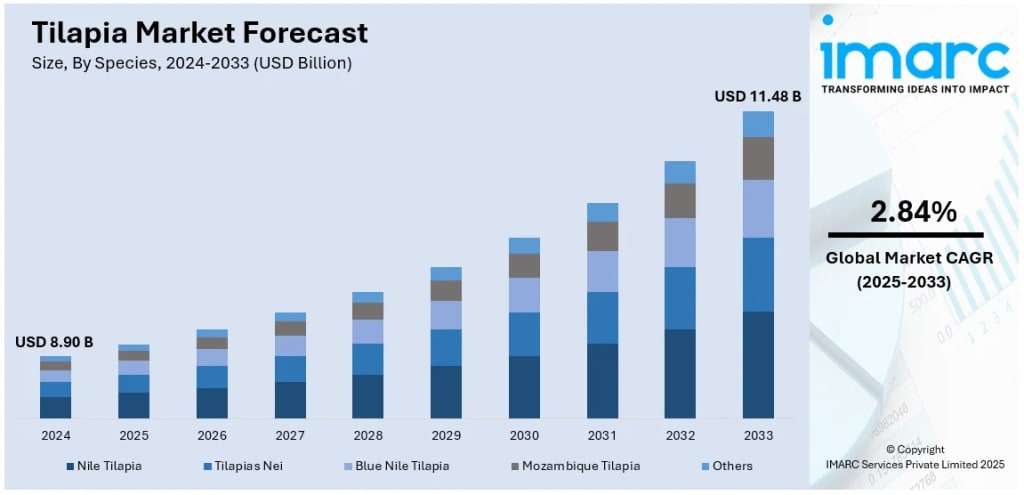
Rising global demand for affordable, high-protein food, growing aquaculture innovation, and supportive government policies are driving steady expansion in the tilapia industry. As one of the world's most farmed fish species — now cultivated in over 140 countries according to the FAO — tilapia has moved well beyond its regional roots to become a genuinely global commodity. According to IMARC Group's latest data, the global tilapia market size was valued at USD 8.90 Billion in 2024. Looking forward, IMARC Group estimates the market to reach USD 11.48 Billion by 2033, exhibiting a CAGR of 2.84% during 2025-2033. China currently dominates the market, holding a significant market share of over 29.8% in 2024.
Tilapia's appeal is straightforward: it's lean, mild-flavored, adapts well to different cuisines, and — critically — it is significantly cheaper to produce than most other protein sources. Farmed tilapia accounts for roughly 90% of all supply, with Nile Tilapia dominating commercial aquaculture due to its fast growth rate and disease resistance. Key markets span China, Indonesia, Egypt, Bangladesh, the Philippines, Brazil, and Thailand, each supported by a mix of small-scale rural farms and large commercial operations. Frozen fillets lead product demand, driven by convenience-focused consumers and cold chain improvements that now enable global distribution at competitive price points.
Get a Sample Report for Actionable Market Insights
Tilapia Market Growth Drivers:
• Rising Demand for Affordable, Protein-Rich Food
As global populations grow and middle-class households expand across developing economies, the need for cost-effective protein is intensifying. Tilapia fits the brief perfectly — it delivers high protein and low fat at a price point that makes it accessible to a wide range of consumers. India's middle class is projected to nearly double, reaching 61% of the population by 2046-47, signaling a massive wave of new protein demand in Asia alone. In Bangladesh, per capita fish consumption already stands at 26.6 kg annually — well above the minimum nutritional requirement of 18 kg — demonstrating how deeply fish-based protein is embedded in everyday diets.
• Technological Advances in Aquaculture Driving Production Efficiency
Modern tilapia farming looks very different from what it did a decade ago. Improvements in selective breeding, feed conversion ratios, and disease management have significantly boosted yields while reducing costs per kilogram. The global aquaculture sector reached 82.8 Million Tons in production volume, and tilapia is one of its fastest-scaling species. Genetically improved strains now grow faster and resist common pathogens more effectively, making farms more financially predictable. Innovations like recirculating aquaculture systems (RAS) are also allowing production to move inland and into urban-adjacent facilities, reducing dependence on coastal or tropical geographies and opening new supply corridors.
• Government Support and Export-Oriented Policy Frameworks
Governments in major producing countries have recognized tilapia as a food security asset and economic driver. China's aquaculture sector directly employs approximately 4.3 million rural workers according to the FAO, making it a critical livelihood program — not just a commercial industry. In Egypt, which produces 80% of Africa's farmed tilapia output at around 940,000 metric tons, public investment in fish farming infrastructure and farmer training has been central to maintaining that dominance. Export incentive programs in countries like Indonesia — where aquaculture contributes 69.5% of total fish production — are helping producers access premium international markets and compete on price with other seafood categories.
Tilapia Market Trends:
• Sustainability and Welfare Standards Reshaping Production Norms
Consumer expectations around responsibly sourced seafood are increasingly influencing tilapia supply chains. In September 2024, FAI, Egypt's Central Lab for Aquaculture Research, and Ethical Seafood Research formalized a partnership specifically focused on improving tilapia welfare standards in Egyptian farms — a notable signal that welfare certification is moving from premium niche to mainstream requirement. Retailers and food service buyers in Europe and North America are raising the bar on traceability and environmental impact documentation. Farms that can demonstrate sustainable practices and third-party certifications are gaining access to higher-margin markets, creating a competitive incentive for the broader industry to upgrade its standards.
• Value-Added and By-Product Innovation Expanding Revenue Streams
The tilapia industry is getting smarter about what it does with its entire catch. Regal Springs' launch of its "Natural Additions" business unit in 2024 — targeting 100% utilization of tilapia production by 2030 — is a clear indicator of where the market is heading. By-products including skin, scales, and trimmings are being converted into collagen, leather goods, and fishmeal, creating revenue streams that simply didn't exist before. This shift toward zero-waste production improves overall farm economics and appeals to sustainability-minded buyers. Branded, value-added retail formats like seasoned fillets and ready-to-cook pouches are also commanding higher margins than commodity frozen fish, attracting investment from processors looking to move up the value chain.
• Genetics and Breeding Programs Unlocking New Market Frontiers
Investment in tilapia genetics is accelerating, and the commercial impact is tangible. In February 2024, GenoMar Genetics Group — the global leader in tilapia genetics with over 30 years of selective breeding expertise — entered Brazil with a dedicated biosecure breeding center in Tocantins, bringing its advanced genetic lines to Latin America for the first time. Brazil is already one of the world's largest tilapia producers, and this expansion is expected to significantly improve the productivity of commercial farms in the region. Simultaneously, Kenya is seeing early-stage farm development programs like the Aller Aqua and IDH initiative in Homabay and Migori counties, which are training smallholders and providing quality inputs to build commercially viable operations from the ground up.
Recent News and Developments in the Tilapia Market
• October 2024: A state agency in Chennai launched culling operations in Adyar Creek to remove invasive tilapia populations threatening native species. The Chennai River Restoration Trust (CRRT) is leading the initiative, targeting adult tilapia whose rapid reproduction — including Genetically Improved Farmed Tilapia (GIFT) strains — has disrupted local aquatic biodiversity.
• July 2024: Aller Aqua and IDH launched a partnership to support out-grower tilapia farming across Kenya's Homabay and Migori counties. The program kicked off with over 250 farmers and aims to deliver quality inputs, hands-on training, and guaranteed market access, with farmers offered two full production cycles annually.
• May 2024: Regal Springs introduced "Natural Additions," a new business unit dedicated to maximizing the use of tilapia by-products, announced at Seafood Expo Global in Barcelona. The initiative is part of the company's commitment to achieving 100% utilization of its entire tilapia production by 2030.
• May 2024: Amyco Foods, a Hainan-based tilapia exporter, announced plans to expand its European market presence, positioning high-quality and competitively priced Chinese tilapia as a viable alternative to locally sourced freshwater fish in key European retail and food service channels.
• February 2024: GenoMar Genetics Group launched its advanced tilapia genetic line in Brazil, establishing a biosecure breeding center in Tocantins. The move brings genetics refined over three decades — previously exclusive to Asian markets — to Latin America, enabling local farms to benefit from faster-growing, more disease-resistant stock.
Note: If you require specific details, data, or insights that are not currently included in the scope of this report, we are happy to accommodate your request. As part of our customization service, we will gather and provide the additional information you need, tailored to your specific requirements. Please let us know your exact needs, and we will ensure the report is updated accordingly to meet your expectations.
About the Creator
Rahul Pal
Market research professional with expertise in analyzing trends, consumer behavior, and market dynamics. Skilled in delivering actionable insights to support strategic decision-making and drive business growth across diverse industries.



Comments
There are no comments for this story
Be the first to respond and start the conversation.