Historical
The Midnight Alley: The Boy Who Called His Killer “Dad”
Lightning cracked overhead as Detective Lena Carter’s boots splashed through the rain-slicked alley. The call had come just moments ago—a child was hurt, and the storm didn’t care. Narrow walls of brick reflected the flickering light from a struggling streetlamp, puddles trembling under each flash. On the wet ground lay a boy, twelve years old, eyes wide in final surprise, blood glimmering in crimson streams across the cracks beneath him. Clutched in his small, trembling fingers was a soaked scrap of paper. Carter leaned close, throat tight: the letters D_A_ smeared by rain.
By imtiazalamabout 10 hours ago in Fiction
Thread Count
Everyone remembers the thread. They remember how the princess pressed it into Theseus’s hand, how the hero unwound it behind him like a promise while he walked into the dark. They remember the monster waiting somewhere in the center, hooves echoing in the corridors, breath thick with heat.
By Alain SUPPINI2 days ago in Fiction
The Man Who Survived 76 Days Lost at Sea: A True Story of Survival. AI-Generated.
The Man Who Survived 76 Days Lost at Sea: A True Story of Survival The ocean can be beautiful, peaceful, and endless. But when you are lost in it—completely alone—it becomes something else entirely.
By Baseer Shaheen 3 days ago in Fiction
Echoes of Resistance
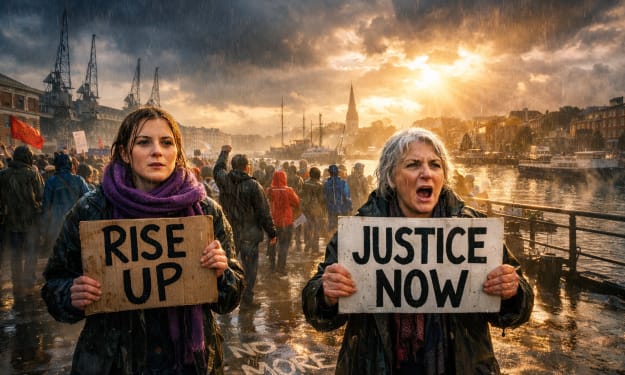
The streets of Bristol were alive that day, though not with the usual hum of buses and chatter, but with the heavy pulse of voices that demanded to be heard. I had not intended to join the protest—I came to observe, to write, to bear witness—but once I stepped into the swell of people, the energy was impossible to ignore. The banners waved above heads, each one a story, a demand, a prayer. The scent of rain-soaked asphalt mixed with the faint tang of chalk from hastily scrawled messages, leaving the air electric.
By imtiazalam3 days ago in Fiction
Eurydice's Truth
The poets say he turned back. They forgot that both gods and men had already silenced me. Even now I linger in the world of the dead, millennia after my husband showed how little faith he had in me. The stories say that after his awful death he found peace, that he could walk beside me with no need to look back. But in truth, he remains lost in his songs, and I am still an afterthought, or perhaps merely an ideal for his imagination.
By J.B. Miller4 days ago in Fiction
Al Martino and the First UK Number One
Al Martino and the First UK Number One In the autumn of 1952, the streets of London were alive with the gentle hum of post-war optimism. Radios perched on shelves in cozy living rooms played the latest hits, and families gathered around the small screens of television sets, hungry for music that felt both new and comforting. Among the influx of tunes that had begun to dominate the airwaves, one song quietly prepared to make history. It was “Here in My Heart” by Al Martino, a ballad that would not only capture the hearts of the British public but also secure its place as the very first number one on the newly compiled UK Singles Chart.
By George’s Girl 2026 4 days ago in Fiction
Divided By Our Skin
We climbed as far as we could go; it was impossible to reach the top. Obstacles stood out in every way; we never stood a chance together.alone, it all felt so right. Our families said it was wrong, as two people from different countries could never get along. But every step we took, side by side, made the struggle worth it. We laughed when we stumbled, sharing simple smiles that warmed my heart. Each moment together felt like a secret world, just ours, away from what others thought.
By George’s Girl 2026 4 days ago in Fiction
A Mother’s Fight: The Night Her Children Vanished. AI-Generated.
It was a quiet Thursday night when Maya Fernandez first noticed something was wrong. Her apartment, usually alive with the soft breathing of her children, Lucas (7) and Ana (5), was silent. The faint ticking of the wall clock sounded unnervingly loud. Maya’s heart thudded in her chest as she called out their names, her voice trembling: “Lucas? Ana?” No answer. A cold dread filled her chest. She rushed to their rooms—empty beds. Toys scattered, blankets tossed aside—but the children were gone. Panic surged, her hands shaking as she dialed her husband’s number. No answer. Her mind raced. Where could they be? Was this a random act of violence? Or something far more calculated? She knew instinctively: time was critical. Maya ran to the window, scanning the quiet streets below. Nothing. The city seemed asleep, indifferent to her terror. Every passing second stretched like an eternity. She grabbed a flashlight and retraced her children’s steps from earlier in the evening. Every corridor, every alley, every familiar corner became a potential clue. And then—a faint sound. A tiny giggle, almost swallowed by the night air. Maya’s pulse jumped. Could it really be them? She followed the sound cautiously, heart racing. The trail led to a small playground behind her apartment complex. The swings moved gently in the wind, casting long shadows under the dim streetlights. There they were: Lucas and Ana, huddled together, eyes wide with fear. The relief was instant, but fleeting. A shadow moved just beyond the glow of the lamppost. Someone had been watching, someone who knew her family’s routines intimately. Maya scooped them into her arms, tears streaming down her face. She whispered promises she had been clinging to all night: “You are safe now. I will never let anything happen to you.” The next morning, Maya began piecing together what had happened. She realized that the person who had taken her children was someone close, someone who knew their lives well. The betrayal cut deeper than the fear itself. Maya refused to be paralyzed by dread. She contacted the authorities, installed cameras, and enlisted the help of neighbors. Her relentless vigilance gradually unveiled small but crucial clues: strange phone calls, unrecognized visitors, and inconsistencies in stories she had once trusted. Every discovery brought renewed hope—and renewed fear. She knew the perpetrator was still out there, watching, waiting. Weeks passed. Maya’s efforts never wavered. She traveled to nearby towns, speaking to anyone who might have seen her children. She studied patterns, questioned strangers, and followed leads that seemed trivial but often proved essential. One late evening, she received a tip from a local shopkeeper—a child matching Lucas’s description had been seen near an abandoned warehouse. Maya’s heart raced. She didn’t hesitate. Alone, she drove there, her children’s voices echoing in her mind. The warehouse was empty, but in a hidden corner, she found a small blanket and a toy that belonged to Ana. Her hope surged. She was close. She could feel it. Finally, after months of searching, Maya located the children in a distant neighborhood, living under the watch of someone who had planned to keep them hidden. The reunion was overwhelming. Tears, laughter, disbelief, and sheer relief collided as Maya embraced her children, refusing to let go. Though safe, the ordeal left lasting scars. Maya became hyper-aware, cautious, and protective—but also stronger, braver, and more determined than ever. The experience taught her a profound lesson: love can push you beyond fear, doubt, and exhaustion. Her story spread through her community, inspiring other parents to trust their instincts and fight tirelessly for their children. For Maya, the memory of that night remains vivid—the fear, the despair, but ultimately, the triumph of unbreakable maternal love. Even years later, she reflects on that terrifying night, reminding herself and others: hope can endure even in the darkest hours, and sometimes a mother’s courage is the most powerful force in the world. Disclaimer: This story is inspired by documented real-life parental struggles and emotional suspense cases, but all names, locations, and personal identifiers have been fictionalized for privacy and storytelling purposes. Certain events and dialogue have been adapted for narrative engagement, while maintaining the essence of a mother’s determination and emotional journey. This article is intended for entertainment, inspiration, and human-interest reading, not as a legal or investigative report.
By Baseer Shaheen 5 days ago in Fiction
The Frozen Pass Mystery: The Night Nine Hikers Ran Into the Darkness. AI-Generated.
In the winter of 1959, a group of nine university students decided to attempt a difficult expedition through a remote mountain range deep in northern Russia. The leader of the group was Arman Karev, a calm and experienced hiker known among his friends for planning tough but exciting adventures. Joining him were his close friends: Leonid Petrov, Sasha Morov, Nikolai Varenko, Yuri Sokol, Viktor Belin, Irina Volkova, Tania Orlov, and Mira Petrenko. All of them were skilled hikers. Some had already completed several winter expeditions before. None of them were beginners, and they knew exactly how dangerous the mountains could be in February. Still, adventure called them. They began their journey at the end of January, carrying heavy backpacks, cameras, journals, and enough supplies to survive the brutal cold. Their goal was to cross the frozen mountain pass and return home with stories of challenge and victory. During the first days of the expedition, everything seemed normal. Photos later recovered from their cameras showed the group laughing, walking through deep snow, and setting up camp under the pale winter sky. They looked happy, confident, and completely unaware of the mystery their journey would become. But after they failed to return on the scheduled date, worry began to spread. Days turned into weeks. Finally, search teams were organized to look for the missing hikers. When rescuers reached the area where the group was believed to have camped, they quickly found something strange. The tent was still there. But something about it felt wrong. The fabric of the tent had been cut open from the inside. Experienced hikers would never destroy their own shelter in the middle of a snowstorm unless something forced them to escape immediately. Outside the tent, the snow told a silent story. Footprints led away from the campsite. But the rescuers noticed something terrifying. Some footprints appeared to belong to people who were barefoot or wearing only socks. In temperatures far below freezing, leaving shelter without boots or coats would be almost certain death. The tracks continued down the slope toward a dark forest about a kilometer away. When searchers followed the trail, they discovered the first two bodies beneath a tall cedar tree. It was Yuri Sokol and Leonid Petrov. Near them were the remains of a small fire, as if they had desperately tried to warm themselves before the cold became too much. Between the tree and the abandoned campsite, three more bodies were found: Arman Karev, Sasha Morov, and Nikolai Varenko. Their positions suggested something heartbreaking. It looked as if they had been trying to crawl back to the tent before collapsing in the snow. Weeks later, after heavy snow began to melt, the remaining four hikers were discovered inside a nearby ravine. What investigators saw next made the mystery even darker. Irina Volkova had a fractured skull. Viktor Belin had several broken ribs. Mira Petrenko was missing her tongue. And Tania Orlov had severe internal injuries that looked similar to those caused by a powerful collision. Yet strangely, there were almost no external wounds. Even more confusing, there were no signs that anyone else had been present. No other footprints. No evidence of an attack. Some of the hikers’ clothing was later reported to have unusual radiation traces, adding another layer of mystery to the case. Over time, theories began to appear everywhere. Some believed a sudden avalanche might have terrified the group. Others suggested secret military tests happening in the mountains that night. A few locals even claimed they had seen strange glowing lights in the sky during the same period. But none of the explanations fully answered the biggest question. Why would nine trained hikers suddenly panic so badly that they cut open their tent and run into the freezing darkness? Years later, the case file was quietly closed with a strange explanation. Officials simply stated that the hikers died due to “an unknown and overwhelming force.” The mountain pass where the tragedy happened was later renamed Frozen Pass in memory of the lost hikers. Even today, hikers who visit the area say the place feels unusually quiet. The wind moves slowly through the snow-covered slopes, and the forest stands dark and still beneath the mountains. Some visitors say that standing there at night feels unsettling—almost as if the mountain is hiding something. Something that happened long ago. Something no one has ever fully understood. And perhaps never will.
By Baseer Shaheen 5 days ago in Fiction