
Adhesion Promoter Market Trends: Sustainable Coatings, High-Performance Materials & Industry Forecast to 2034
How rapid growth in industrial coatings, protective paints, and composite materials is increasing the need for reliable adhesion promoters that enhance durability and surface bonding performance.

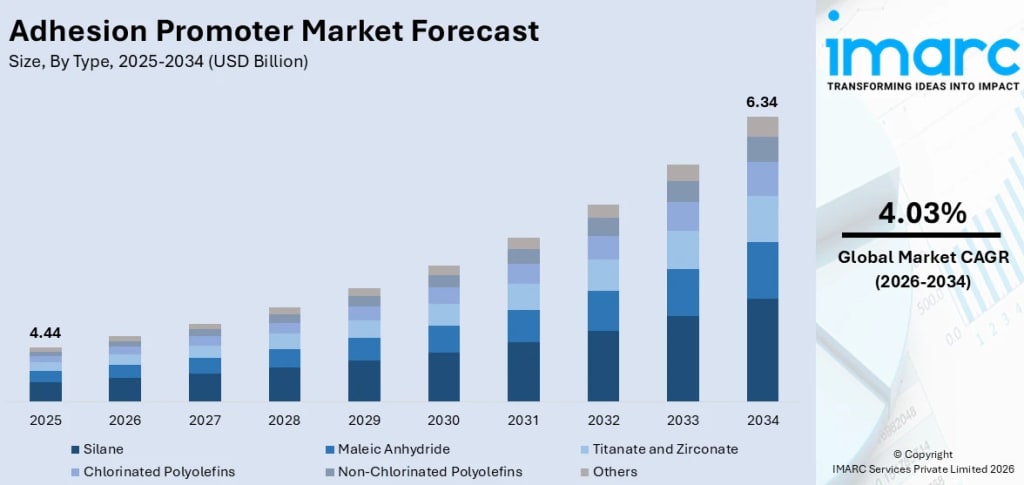
Optimizing bond strength and surface durability is becoming a central focus for industrial manufacturers as they transition toward advanced composites and high-performance coatings. According to IMARC Group’s latest data, the global adhesion promoter market size was valued at USD 4.44 Billion in 2025. Looking forward, IMARC Group estimates the market to reach USD 6.34 Billion by 2034, exhibiting a CAGR of 4.03% from 2026-2034. Asia Pacific currently dominates the market, holding a significant market share of over 45.3% in 2025.
The adhesion promoter sector has evolved into a vital multi-billion-dollar global industry, essential for ensuring structural integrity across the automotive, construction, and electronics sectors. Demand is largely driven by the shift toward lightweight materials in vehicle manufacturing and the increasing complexity of multi-layer flexible packaging. Innovation is currently centered on silane coupling agents, non-chromated surface pretreatments, and low-VOC formulations that meet strict environmental standards. Major segments include silanes, maleic anhydride, and chlorinated polyolefins, with applications spanning plastics, composites, and high-durability paints and coatings where interfacial bonding is critical.
Adhesion Promoter Market Growth Drivers:
- Rising Demand for Lightweight Materials in Automotive Manufacturing
The automotive industry is a primary engine for growth as manufacturers replace heavy steel components with lightweight plastics, carbon fiber composites, and aluminum to improve fuel efficiency and electric vehicle range. These materials often possess low surface energy, making them difficult to bond. Adhesion promoters bridge this gap by creating chemical links between the substrate and the coating or adhesive. With global passenger vehicle production reaching over 2.3 million units in single months like April 2024, the need for reliable bonding agents in next-generation vehicle platforms remains a critical priority for OEMs.
- Expansion of the Infrastructure and Construction Sector
Modern construction relies heavily on high-performance sealants, protective coatings, and decorative paints that must withstand extreme weather and moisture. Adhesion promoters are essential in these applications to prevent delamination and ensure long-term durability on diverse surfaces like glass, metal, and concrete. As urbanization accelerates across Asia and North America, the demand for "direct-to-metal" coatings which eliminate the need for separate primers—is rising. These innovations can reduce labor and material costs by nearly 20-25% for large-scale projects, making them highly attractive for industrial and architectural contractors.
Get Instant Access to the "Adhesion Promoter Market" Sample Report
- Technological Advancements in Electronics and Semiconductor Packaging
The electronics industry is increasingly utilizing adhesion promoters to enhance the reliability of printed circuit boards, displays, and semiconductor packaging. As devices become smaller and more powerful, the internal components require precise bonding that can survive thermal cycling and mechanical stress. Silane-based promoters are particularly valued here for their ability to modify surface chemistry at a molecular level. With the rapid expansion of 5G infrastructure and the surge in consumer demand for smart gadgets, the electronics sector has become a high-growth niche for specialized, high-purity adhesion solutions.
Adhesion Promoter Market Trends:
- Shift Toward Sustainable and Bio-Based Formulations
Environmental regulations and consumer pressure are driving a transition away from traditional adhesion systems that contain heavy metals or high levels of Volatile Organic Compounds (VOCs). Brands are now prioritizing non-chromated pretreatments and water-based variants that minimize environmental impact without sacrificing performance. A notable example is the introduction of renewable-resource-derived promoters for asphalt and industrial rubber, which help companies meet sustainability goals while maintaining product durability. This trend is particularly strong in Europe, where stringent chemical safety standards influence over 20% of the global market's innovation trajectory.
- Evolution of Green Tire Technology
The tire industry is undergoing a significant transformation with the adoption of silane coupling agents to create "green tires." These agents improve the affinity between silica and rubber, which can lower rolling resistance by up to 12% and significantly enhance wet grip performance. This technology is becoming a global standard as tire labeling mandates expand in regions like South Korea and Brazil. Major chemical suppliers are scaling up production capacity for low-fume silane grades to support this shift, reflecting a broader industry trend toward integrating safety and sustainability into high-volume manufacturing.
- Rise of High-Performance Flexible Packaging
Flexible packaging is gaining massive traction due to its lightweight nature and reduced shipping costs, but it requires sophisticated adhesion to bond multiple layers of films, foils, and resins. Adhesion promoters are crucial for preventing delamination in food and medical packaging, where barrier integrity is non-negotiable. The growth of e-commerce and the demand for longer shelf-life products have pushed manufacturers to develop promoters that work seamlessly with recycled plastics and biodegradable films. This application ensures that even as packaging materials become more eco-friendly, they do not lose the structural strength required for global distribution.
Recent News and Developments in Adhesion Promoter Market
- January 2025: Evonik announced the consolidation of its silica and silane operations to streamline the production of customer-specific coupling agents, focusing on high-growth applications in the automotive and tire industries.
- August 2024: Allnex launched ALNOVOL® PN 870, a sustainable adhesion promoter for tires that replaces traditional cobalt-based systems, offering improved aging properties and scorch resistance for technical rubber.
- April 2024: Vantage showcased its new iSAP 311 Inhibited Surface Adhesion Promoter at MRO Americas, highlighting a non-chromated surface pretreatment designed for the aerospace and general aviation sectors.
- February 2024: Boston Industrial Solutions introduced the Natron® G2 Glass Primer, a UV-based adhesion promoter specifically engineered to enhance the durability of digital printing on glass, tiles, and ceramics.
Note: If you require specific details, data, or insights that are not currently included in the scope of this report, we are happy to accommodate your request. As part of our customization service, we will gather and provide the additional information you need, tailored to your specific requirements. Please let us know your exact needs, and we will ensure the report is updated accordingly to meet your expectations.
About the Creator
Andrew Sullivan
Hello, I’m Andrew Sullivan. I have over 9+ years of experience as a market research specialist.
Keep reading
More stories from Andrew Sullivan and writers in Futurism and other communities.
RegTech Market Insights: AI Compliance Solutions, Risk Analytics & Forecast Outlook 2034
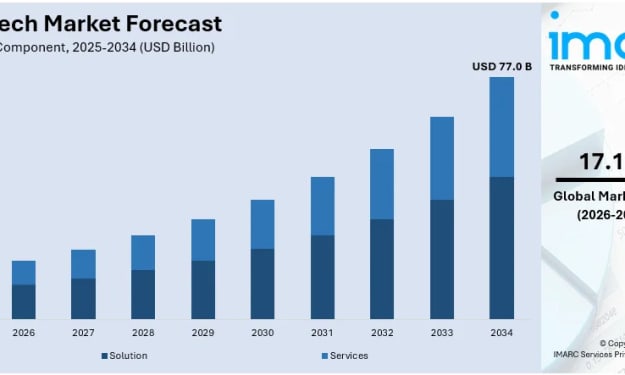
Rising regulatory complexities, the surge in digital transactions, and the need for cost-efficient compliance solutions are driving the RegTech demand, supported by advancements in AI, machine learning, and cloud computing. According to IMARC Group’s latest data, the global RegTech market size was valued at USD 18.6 Billion in 2025. Looking forward, IMARC Group estimates the market to reach USD 77.0 Billion by 2034, exhibiting a CAGR of 17.10% from 2026-2034.
By Andrew Sullivan3 days ago in Futurism
North America Creator Economy Market to hit USD 331.4 Billion By 2034
North America Creator Economy Market Overview The North America Creator Economy Market is projected to reach approximately USD 331.4 Billion by 2034, increasing from USD 55.8 Billion in 2024, reflecting a strong CAGR of 19.5% during the forecast period from 2025 to 2034.
By Roberto Crum2 days ago in Futurism
Hummus Market Trends: Vegan Diet Growth, Healthy Snacking & Forecast to 2034
Growing consumer interest in plant-based eating, a sharper focus on clean-label nutrition, and the global spread of Mediterranean food culture are all converging to make hummus one of the most talked-about products in the packaged food space right now. According to IMARC Group’s latest research, the global hummus market size reached USD 4.7 Billion in 2025. Looking forward, IMARC Group estimates the market to reach USD 9.1 Billion by 2034, exhibiting a CAGR of 7.50% during 2026–2034. North America currently dominates the global market, driven by strong consumer demand for healthy, plant-based snacks and widespread adoption of Mediterranean-style diets across the region.
By Suhaira Yusufa day ago in Futurism


Comments
There are no comments for this story
Be the first to respond and start the conversation.