
Honey Market Worth USD 15.4 Billion by 2033 at 5.2% CAGR
Global Honey Market: Growth, Trends, and Forecast (2023-2033)

Overview
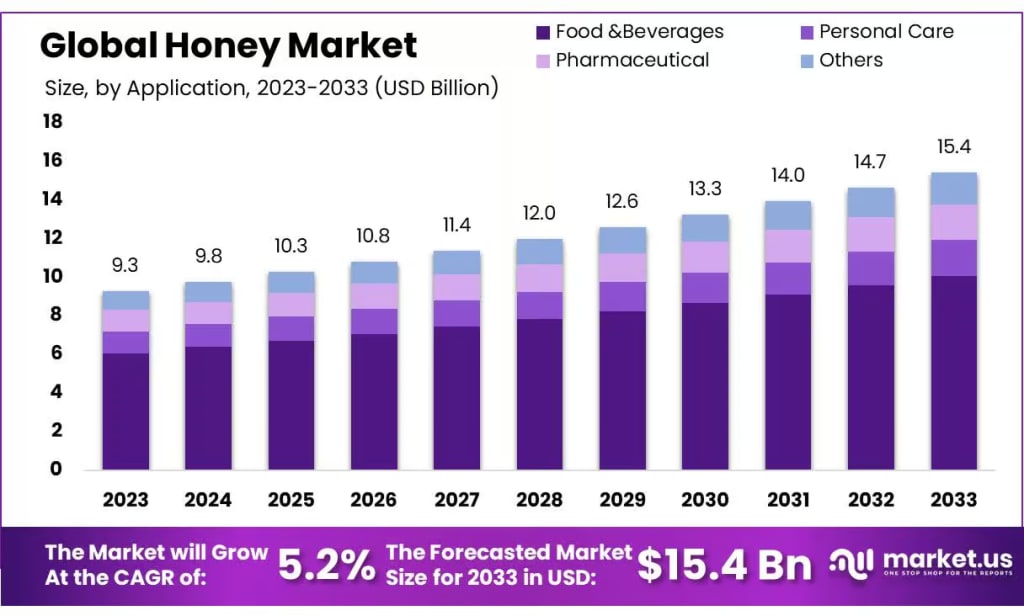
The Global Honey Market is on a robust growth path, projected to expand from USD 9.3 billion in 2023 to approximately USD 15.4 billion by 2033. This represents a steady compound annual growth rate (CAGR) of 5.2% over the forecast period.
This growth is primarily fueled by a global consumer shift toward natural and healthy lifestyles. Honey, prized for its rich vitamin, mineral, and antioxidant content, is increasingly replacing refined sugar as a preferred natural sweetener. The post-pandemic focus on immunity-boosting foods has further amplified this trend. With rising concerns over lifestyle diseases like diabetes and obesity, consumers are actively seeking natural alternatives to artificial sweeteners, solidifying honey's position as a nutritious and functional food.
Key Takeaways
- The Global Honey Market is projected to grow from USD 9.3 billion in 2023 to USD 15.4 billion by 2033, with a CAGR of 5.2%.
- Conventional honey held a 78.6% market share in 2023 due to lower cost and wider availability.
- Food and Beverage applications accounted for 65.3% of the honey market share in 2023.
- Hypermarkets and supermarkets held a 38.6% market share in distribution channels in 2023.
- Europe led the market with a 36.7% revenue share in 2023.
Key Market Segments
Processing Segment
In 2023, conventional honey dominated with a 78.6% market share, a lead it is expected to maintain. Its affordability and accessibility make it the default choice for the mass market. While organic honey is gaining traction among niche consumers, the conventional segment continues to evolve with new flavors and blends. A significant challenge for the industry, however, is the prevalence of adulterated honey, which threatens the profitability of producers committed to purity and quality.
By Product Type
Gained traction for its light color and mild, delicate flavor, appealing to consumers seeking a subtle honey taste. Led the market in 2023 with a 32.4% share, favored for its dark color and robust, molasses-like flavor, catering to those preferring intense honey profiles. It rose in popularity due to its gentle, floral flavor, making it a preferred choice for consumers seeking fragrant options. Attracted consumers with its complex, robust flavor derived from diverse nectar sources, offering a rich honey experience. Remained a staple for its classic, mild, and sweet flavor, appealing to those who favor traditional honey tastes. Encompasses niche honey types with unique flavors, catering to specialized consumer preferences.
By Application
Food & Beverages dominated with a 65.3% market share in 2023, driven by honey’s widespread use as a natural sweetener and flavor enhancer in various products. Gained prominence due to honey’s moisturizing and nourishing properties, making it a popular ingredient in skincare and haircare products. Leveraged honey’s antimicrobial and soothing qualities for use in medicinal products like cough syrups and wound dressings.
Distribution Channels
Hypermarkets and supermarkets captured the largest revenue share in 2023 at 38.6%, bolstered by increased product visibility through major retailers like Costco and Walmart. Consumers’ preference for inspecting products before purchase has driven sales through these channels. Fueled by shifting consumer preferences toward convenience, better product visibility, and home delivery. Online platforms offer enhanced customer service, easy navigation, and flexible return/exchange options, further boosting their growth.
Regional Analysis
Europe – The Established Leader (36.7% share): Europe's leading position is underpinned by high disposable incomes, urbanization, and a deeply integrated food and beverage industry that values honey as a natural ingredient. The region's food sector alone was valued at USD 3.4 billion in 2023.
Asia Pacific – The High-Growth Powerhouse (Highest CAGR): The Asia Pacific region is poised for explosive growth. Key drivers include a massive and growing millennial population with a preference for healthy and flavorful foods, alongside established market players and rising domestic honey production and consumption.
Top Use Cases
- Food and Beverage Sweetener: Honey is a natural sweetener used in drinks like tea and smoothies, and in foods like baked goods and sauces. Its unique flavors, like clover or buckwheat, enhance taste while offering health benefits, driving its popularity as a healthier alternative to sugar in recipes.
- Skincare and Cosmetics: Honey’s antimicrobial and moisturizing properties make it a key ingredient in skincare products like face masks, creams, and lotions. It helps soothe skin, reduce inflammation, and promote healing, appealing to consumers seeking natural, organic beauty solutions.
- Pharmaceutical Applications: Honey is used in cough syrups and wound dressings due to its antibacterial and healing properties. Its natural preservatives help treat sore throats and minor burns, making it a valuable ingredient in health products for natural remedy seekers.
- Nutritional Supplements: Honey is added to energy bars, health drinks, and supplements for its antioxidants and nutrients. Its natural energy boost and immune-supporting qualities attract health-conscious consumers, especially in organic and functional food markets.
- Beverage Innovation: Honey is used in craft beers, meads, and flavored cocktails, appealing to younger audiences. Its versatility in adding unique sweetness and depth to beverages drives innovation in the alcohol and non-alcoholic drink sectors.
Recent Developments
1. Beyond the Hive
- Beyond the Hive has focused on combating adulteration through advanced testing and consumer education. They emphasize traceability, promoting their single-origin and raw honey products as superior, pure alternatives to mass-market blends. Their development lies in leveraging technology for transparency, directly connecting conscious consumers with trusted beekeepers and high-integrity honey.
2. Barkman Honey LLC
- Barkman Honey is expanding its production capabilities with a new, state-of-the-art facility in Hesston, Kansas. This strategic investment significantly increases their capacity for processing, packaging, and warehousing. The development aims to enhance efficiency, meet growing demand, and strengthen its position as a leading supplier of bulk and private-label honey products in North America.
3. Dabur India Ltd.
- Dabur has heavily invested in combating honey adulteration. They implemented the Nuclear Magnetic Resonance (NMR) testing technology for all their honey, a first in India. This move, coupled with marketing campaigns like RealVsFake, aims to build consumer trust and differentiate their branded products in a market plagued with sugar syrup adulteration, reinforcing their commitment to purity.
4. Capilano Honey Ltd.
- Following a brand refresh to Hive & Wellness Australia, the company's key development is the launch of Hive+, a new range of functional honey products. These include infused varieties like Manuka Honey with Turmeric and Propolis, targeting the health and wellness sector and moving beyond traditional honey to offer added benefits to consumers.
5. New Zealand Honey Co.
- The New Zealand Honey Co. is expanding its presence in key international markets, particularly North America and Asia. Their recent development focuses on launching new, premium Manuka honey products with higher Unique Manuka Factor (UMF) ratings. This strategy targets the luxury wellness segment, emphasizing their authentic New Zealand origin and the potent health attributes associated with high-grade Manuka honey.
Conclusion
The honey market is poised for sustained growth, driven by the global convergence of health consciousness, demand for natural ingredients, and culinary exploration. Its unparalleled versatility allows it to thrive across the food, cosmetic, and pharmaceutical industries. As consumers continue to prioritize wellness, authenticity, and sustainable sourcing, the market offers significant opportunities for innovation, premiumization, and building trusted brands that champion purity and transparency.
About the Creator
Hayden Kulas
I am blogger, digital marketing pro since 5 years and writes for Market.us. Computer Engineer by profession. I love to find new ideas that improve websites' SEO. He enjoys sharing knowledge and information about many topics.
Keep reading
More stories from Hayden Kulas and writers in Futurism and other communities.
Battery Felts Market Report: USD 1889.4 Million by 2034 at 8.3% CAGR
Overview The Global Battery Felts Market is expected to be worth around USD 1,889.4 million by 2034, up from USD 851.2 million in 2024, and is projected to grow at a CAGR of 8.3% from 2025 to 2034. Battery felt is a specialized porous material, commonly made from carbon or graphite fibers, used in various battery technologies particularly redox flow batteries—to enhance electrical conductivity, electrolyte distribution, and overall battery efficiency.
By Hayden Kulasa day ago in Futurism
Construction Robots Market Outlook: Automation in Building Processes and Infrastructure Development Opportunities
According to IMARC Group's latest research publication, The global construction robots market size reached USD 171.4 Billion in 2024. Looking forward, IMARC Group expects the market to reach USD 556.1 Billion by 2033, exhibiting a growth rate (CAGR) of 13.27% during 2025-2033.
By James Whitmana day ago in Futurism
Quantum Networking Market to Reach US$ 19.406 Million By 2033
Quantum Networking Market Overview The Global Quantum Networking Market is projected to reach approximately USD 19,406 Million by 2033, increasing from USD 647.4 Million in 2023, reflecting a strong CAGR of 40.50% during the forecast period from 2024 to 2033.
By Roberto Crum2 days ago in Futurism


Comments
There are no comments for this story
Be the first to respond and start the conversation.