
Microcontroller Market Trends: IoT Expansion, Smart Devices Growth & Forecast to 2034
How expanding IoT ecosystems, rising adoption of smart consumer devices, and advancements in embedded semiconductor technologies are accelerating growth in the global microcontroller market.

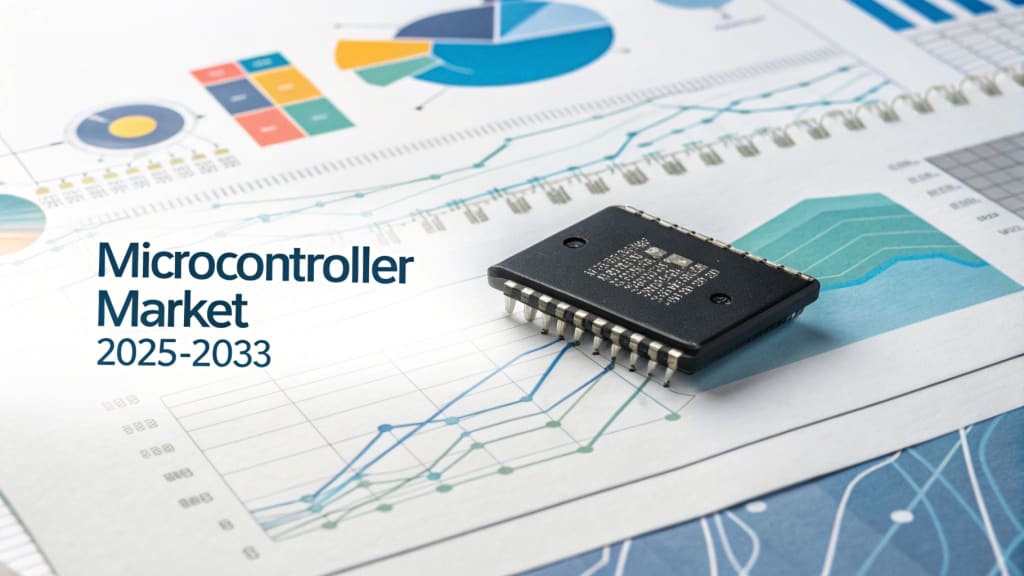
Rising integration of microcontrollers across smart devices, connected vehicles, and industrial automation is reshaping the global electronics landscape. Backed by explosive IoT growth, accelerating electric vehicle production, and the rapid shift toward edge intelligence, the microcontroller market is entering a new and sustained growth phase. According to IMARC Group's latest data, the global microcontroller market size reached USD 28.7 Billion in 2024. Looking forward, IMARC Group expects the market to reach USD 58.3 Billion by 2033, exhibiting a growth rate (CAGR) of 7.55% during 2025-2033. Asia Pacific currently dominates the market, holding the largest market share.
Microcontrollers are now embedded in virtually every connected system — from the antilock braking system in your car to the glucose monitor on your wrist. As compact, single-chip computers, they manage everything from basic sensor readings to real-time AI inference. Today's market goes far beyond legacy 8-bit chips; 32-bit microcontrollers now command over 42% of the market, driven by demand from complex IoT deployments, automotive subsystems, and industrial automation platforms. Key segments include automotive applications (the largest revenue generator), consumer electronics, industrial control, and healthcare devices. With over 40 billion IoT devices expected to be online globally by the end of the decade, and China already surpassing 2.57 billion active IoT terminals as of mid-2024, the appetite for microcontrollers shows no signs of slowing.
Microcontroller Market Growth Drivers:
Explosive Growth of IoT Devices and Smart Connected Systems
Microcontrollers are the nerve center of the IoT ecosystem, and the numbers make the opportunity clear. With over 40 billion IoT-connected devices forecast globally by 2030, demand for affordable, low-power embedded controllers is scaling fast. In consumer applications alone — smart home thermostats, wearable health trackers, industrial sensors — microcontrollers are responsible for local data processing, device-to-device communication, and real-time control. Companies like NXP Semiconductors and STMicroelectronics have responded with multi-protocol chips supporting Wi-Fi 6, Bluetooth LE 5.4, and Thread simultaneously. In China, rapid build-out of energy infrastructure projects is adding millions of IoT endpoints annually, turning Asia Pacific into the world's fastest-growing MCU region.
Automotive Electrification and Advanced Driver-Assistance Systems
Modern vehicles are essentially computers on wheels — and microcontrollers are everywhere inside them. The automotive segment is the single largest revenue generator for MCUs, with applications spanning powertrain management, airbag deployment, ADAS, infotainment, and battery management in EVs. In 2024, China produced 12.4 million electric vehicles, accounting for over 70% of global EV output, according to the International Energy Agency. Each new EV platform requires dozens of microcontrollers to manage battery cells, thermal systems, and onboard charging. Regulatory mandates like UNECE R155 are also pushing hardware-level cybersecurity requirements into automotive MCUs, increasing average semiconductor content per vehicle and lifting the market's average selling prices.
Industry 4.0 and the Automation of Manufacturing Processes
Factories around the world are rapidly deploying smart sensors, robotic arms, and programmable logic systems — all of which run on microcontrollers. The industrial automation segment alone is projected to capture over 52% of the IoT microcontroller market in 2025, according to multiple industry sources. In practice, MCUs power predictive maintenance systems that can cut unplanned manufacturing downtime by up to 50%, a compelling ROI for plant operators. The U.S. Semiconductor Industry Association reported a 4.3% year-on-year increase in semiconductor employment in 2024, reflecting the growing infrastructure investment behind this trend. Government-backed programs, from China's "Made in China 2025" to U.S. CHIPS Act provisions, are further accelerating domestic production and spurring demand for industrial-grade embedded controllers.
Microcontroller Market Trends:
Edge AI Integration — Intelligence Moving Directly onto the Chip
Perhaps the most transformative shift in the MCU space right now is the move to embed AI inference directly into the controller — no cloud required. This matters enormously in applications where milliseconds count: autonomous vehicles detecting hazards, industrial robots identifying defects, or medical monitors flagging anomalies in real time. STMicroelectronics' STM32N6 series, launched in early 2025, integrates machine learning directly into the microcontroller. Infineon's PSOC Edge MCU now supports NVIDIA Tao AI models, enabling high-accuracy vision applications on constrained hardware. The global edge AI market reached USD 20.78 billion in 2024, and growing microcontroller integration into this space means MCU vendors are no longer just selling chips — they are competing on AI developer toolchains and software ecosystems.
Migration from 8-Bit to 32-Bit Architectures Gaining Serious Momentum
The industry is in the midst of a decisive architectural shift. Legacy 8-bit and 16-bit microcontrollers are losing design-in battles to 32-bit platforms capable of handling multi-sensor fusion, machine learning workloads, and high-speed connectivity protocols. STMicroelectronics reported a 46% year-over-year drop in legacy MCU line revenues by Q2 2024 as design teams migrated to higher-value 32-bit options. Microchip Technology now derives over 53% of its FY2025 revenue from IoT verticals built on 32-bit cores, confirming this is mainstream acceptance rather than a niche trend. The 32-bit segment is projected to hold approximately 42.8% of the overall microcontroller market in 2025 — and its share is growing, particularly in automotive, industrial, and healthcare applications where computational demands are rising rapidly.
Energy Efficiency Becoming a Non-Negotiable Design Requirement
With billions of battery-powered and energy-harvesting devices coming online, ultra-low power consumption has become one of the top MCU purchase criteria — not a nice-to-have. NXP's MCX L series, introduced in January 2025, uses a 40 nm ultra-low-power process with Adaptive Dynamic Voltage Control, cutting energy use by up to 50% versus previous generations. STMicroelectronics' STM32U3 series, launched in March 2025, achieves dynamic consumption down to 10 µA/MHz. These advances are critical for applications like remote agricultural sensors, implantable medical devices, and smart city infrastructure, where replacing a battery can cost more than the device itself. Energy efficiency is now a key competitive differentiator among the top five MCU vendors — NXP, Renesas, STMicroelectronics, Microchip, and Infineon — who together hold over 55% of the global market.
Recent News and Developments in the Microcontroller Market:
• March 2025: Microchip Technology launched the PIC32A family of 32-bit microcontrollers, operating at 200 MHz with integrated high-speed analog peripherals including 40 Msps 12-bit ADCs. Designed for automotive, industrial, AI/ML, and medical markets, the new lineup reduces the need for external components, cutting system costs and bill-of-materials complexity.
• February 2025: Renesas Electronics introduced the RA4L1 microcontroller group — 14 new devices targeting ultra-low-power applications with advanced security features and segment LCD support. The launch underscores Renesas's continued push into healthcare, smart metering, and remote IoT, where battery longevity is critical.
• January 2025: NXP Semiconductors unveiled its MCX L series microcontrollers built on a 40 nm ultra-low-power process with Adaptive Dynamic Voltage Control technology. The new devices deliver up to 50% power reduction and are aimed squarely at IoT and industrial applications requiring extended battery life and field-deployed reliability.
• October 2024: Qualcomm Technologies and STMicroelectronics announced a strategic collaboration to integrate Qualcomm's AI-powered wireless connectivity — including Wi-Fi, Bluetooth, and Thread combo SoC — with ST's STM32 microcontroller ecosystem. The partnership is designed to simplify and accelerate development of next-generation industrial and consumer IoT applications enhanced by edge AI capabilities.
Note: If you require specific details, data, or insights that are not currently included in the scope of this report, we are happy to accommodate your request. As part of our customization service, we will gather and provide the additional information you need, tailored to your specific requirements. Please let us know your exact needs, and we will ensure the report is updated accordingly to meet your expectations.
About the Creator
Suhaira Yusuf
I specialize in Consumer Insights, focusing on transforming detailed market data into strategic business solutions that accelerate growth and improve customer engagement.
Keep reading
More stories from Suhaira Yusuf and writers in Futurism and other communities.
Hummus Market Trends: Vegan Diet Growth, Healthy Snacking & Forecast to 2034
Growing consumer interest in plant-based eating, a sharper focus on clean-label nutrition, and the global spread of Mediterranean food culture are all converging to make hummus one of the most talked-about products in the packaged food space right now. According to IMARC Group’s latest research, the global hummus market size reached USD 4.7 Billion in 2025. Looking forward, IMARC Group estimates the market to reach USD 9.1 Billion by 2034, exhibiting a CAGR of 7.50% during 2026–2034. North America currently dominates the global market, driven by strong consumer demand for healthy, plant-based snacks and widespread adoption of Mediterranean-style diets across the region.
By Suhaira Yusuf2 days ago in Futurism
Apple’s 2026 Reshuffle: 4 Surprising Shifts Redefining the Post-Ive Era
1. The "New" Apple Takes Shape The ghost of Jony Ive has finally left the building. Apple just concluded a "Big Week" that saw the release of seven distinct products—ranging from the breakthrough MacBook Neo to the M4 iPad Air and AirTag 2—but the real story isn't the hardware. It is the names on the leadership page.
By Tech Horizons5 days ago in Futurism
AI in Visual Effects Market Demand to Hit USD 9.6 Billion By 2033
The Global AI in Visual Effects Market is projected to reach approximately USD 9.6 Billion by 2033, rising from USD 1.6 Billion in 2023, reflecting a CAGR of 19.6% during the forecast period from 2024 to 2033. The market expansion is supported by the increasing use of artificial intelligence technologies in film production, gaming, advertising, and digital media.
By Roberto Crum4 days ago in Futurism
Lycan Lore
As the students of my 10am mythology class take their seats, I decide to steer the day's curriculum away from Greek and dive into a Western European discourse on the misaligned beliefs of the Werewolf. A tale of truth or fiction. No one really knows.
By Lamar Wigginsabout 13 hours ago in Fiction



Comments
There are no comments for this story
Be the first to respond and start the conversation.