
The “Silent Collapse” of a Star: A New Type of Stellar Death Discovered in Andromeda
Space

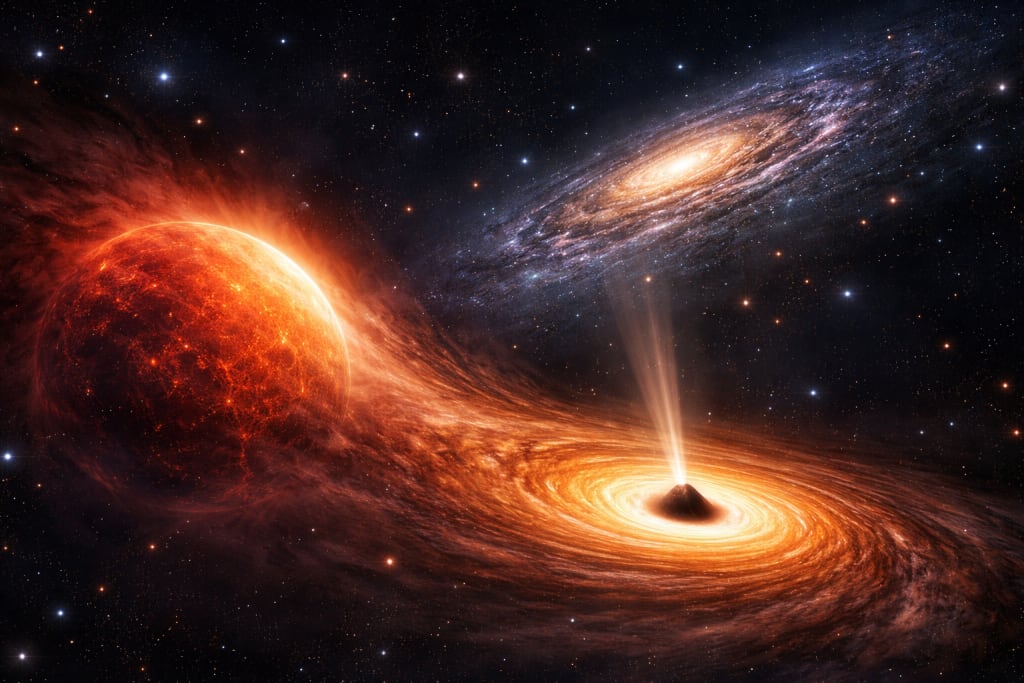
For more than a century, astronomers believed that the death of a massive star was always one of the most dramatic events in the universe. When a giant star exhausts its nuclear fuel, its core collapses under gravity and the outer layers explode outward in a spectacular supernova. These explosions are so powerful that, for a brief time, a single star can shine brighter than an entire galaxy.
However, recent observations suggest that not all stars die in such a dramatic way. Some may end their lives almost quietly—without the brilliant flash of a supernova. Instead, they simply fade away and vanish from the sky. This mysterious phenomenon has become known as a “silent collapse.”
Astronomers have recently found evidence of such an event in our neighboring galaxy, the Andromeda Galaxy. The discovery challenges long-standing ideas about how massive stars end their lives and how black holes form.
When a Star Disappears
Massive stars, those at least eight times heavier than our Sun, live relatively short but extremely intense lives. They burn through nuclear fuel rapidly, fusing heavier and heavier elements in their cores. Eventually, the core becomes dominated by iron, an element that cannot produce energy through fusion.
At that point, the star loses the ability to support itself against gravity.
In the traditional scenario, the core collapses in a fraction of a second. The collapse generates a powerful shock wave that blasts through the star’s outer layers. This produces a core-collapse supernova, a luminous explosion that spreads heavy elements across space.
But in some stars, the process appears to take a different path.
Instead of exploding, the collapsing core forms a black hole so quickly and with such strong gravity that the shock wave fails to push the outer layers away. Rather than being blown outward, the star’s material begins falling inward.
The result is dramatic in a different way: the star effectively collapses into itself.
Astronomers sometimes call this a failed supernova, but the term “silent collapse” better describes what observers see. Instead of an explosion, the star simply fades from view.
Evidence from the Andromeda Galaxy
The Andromeda Galaxy, located about 2.5 million light-years from Earth, is the nearest large galaxy to our own. Because it contains hundreds of billions of stars and is relatively close by cosmic standards, it provides astronomers with an excellent laboratory for studying stellar evolution.
During long-term surveys of Andromeda, astronomers tracked the brightness of thousands of massive stars. One particular red supergiant attracted attention because it behaved in an unusual way.
For many years, the star shone steadily and displayed characteristics typical of a late-stage massive star. Then its brightness began to slowly decline. At first, researchers suspected ordinary variability, which is common in giant stars. Some stars naturally pulsate or dim due to dust clouds forming around them.
However, this time the fading did not stop.
Over the course of several years, the star grew dimmer and dimmer until it vanished completely from optical observations. Importantly, no supernova explosion was recorded at its location. There was no sudden flash, no burst of radiation, and no expanding cloud of debris.
It simply disappeared.
Such behavior strongly suggests that the star underwent a direct gravitational collapse into a black hole.
How Astronomers Test the Idea
Confirming a silent stellar collapse is not straightforward. Stars can appear to disappear for several reasons, including thick dust clouds that block visible light. Because of this, astronomers rely on multiple observational techniques.
Infrared observations
Dust absorbs visible light but allows infrared radiation to pass through. If a star is merely hidden behind dust, infrared telescopes should still detect its glow. When astronomers search in infrared wavelengths and find nothing, it strengthens the case that the star truly vanished.
X-ray monitoring
If material continues falling into a newly formed black hole, it can heat up and emit X-rays. Sensitive space telescopes look for faint X-ray signals that might mark the location of the collapsed star.
Archival images
Astronomers also analyze decades of archived telescope images to confirm that the star previously existed and that its disappearance was genuine rather than a measurement error.
This combination of methods helps researchers determine whether they are witnessing one of the rare cases where a massive star dies without a supernova.
Why Silent Collapses Matter
The idea that stars can collapse quietly has major implications for astrophysics.
Black hole formation
A direct collapse means that most of the star’s mass ends up inside the black hole. This could explain why astronomers observe black holes with masses tens of times larger than the Sun.
Chemical evolution of galaxies
Supernova explosions distribute heavy elements such as iron, nickel, and oxygen into interstellar space. These elements eventually become part of new stars, planets, and even living organisms.
If a star collapses silently, those elements may remain locked inside the black hole instead of enriching the surrounding galaxy. This changes our understanding of how galaxies evolve chemically over time.
Counting stellar deaths
Astronomers estimate how often massive stars die by counting supernova explosions. But if some stars vanish without producing visible explosions, the true number of stellar deaths could be significantly higher than previously believed.
Could It Happen in Our Galaxy?
Astronomers are now monitoring many red supergiant stars within the Milky Way Galaxy and nearby galaxies to catch similar events.
One well-known star that briefly sparked speculation was Betelgeuse. In 2019 and 2020, this bright star dimmed dramatically, causing some scientists to wonder whether it might be approaching the end of its life.
The dimming ultimately turned out to be caused by a large cloud of dust ejected from the star’s surface rather than an imminent collapse. Still, the event demonstrated how carefully astronomers monitor massive stars that could potentially undergo a silent collapse.
A Quiet but Powerful Ending
The concept of a star dying without a supernova was once largely theoretical. Today, growing observational evidence suggests that silent collapses may indeed occur in the universe.
By watching galaxies such as the Andromeda Galaxy, astronomers can track millions of stars and detect subtle changes in their brightness over time. Each disappearing star may represent the birth of a new black hole—formed not through a brilliant cosmic explosion, but through a quiet and nearly invisible gravitational collapse.
If future observations confirm that silent stellar deaths are common, our understanding of how stars evolve, how black holes form, and how galaxies enrich themselves with heavy elements may need to be revised.
Sometimes, even in a universe filled with spectacular explosions, the most important events happen almost silently.
About the Creator
Keep reading
More stories from Holianyk Ihor and writers in Futurism and other communities.
The Vanishing Star in Andromeda: The Birth of a Black Hole Without a Supernova
For decades, astronomers believed that the death of a massive star was always accompanied by one of the most spectacular events in the universe: a supernova explosion. These cosmic blasts can briefly outshine entire galaxies and scatter heavy elements across interstellar space. However, recent observations suggest that not all massive stars end their lives in such dramatic fashion. Some may simply disappear.
By Holianyk Ihor4 days ago in Futurism
Bubble Tea Market: Exploring the Global Rise of the Boba Beverage Trend
Bubble Tea Market Overview The bubble tea market has become one of the fastest-growing segments in the global beverage industry. Bubble tea, often referred to as boba tea, was first introduced in Taiwan during the 1980s and quickly gained popularity across Asian countries. Over time, the beverage expanded into international markets, becoming a popular choice among consumers who enjoy creative and customizable drinks.
By James Smithabout 22 hours ago in Futurism
Air France Evacuation Flight Turns Back Because of Missile Fire
A planned evacuation flight operated by Air France was forced to abruptly turn back mid-route after missile activity was detected near its intended flight corridor, highlighting the growing dangers civilian aircraft face in conflict zones. The incident occurred late Tuesday evening as the aircraft, carrying evacuees and humanitarian personnel, attempted to depart a volatile region amid escalating military exchanges. According to aviation officials familiar with the situation, the aircraft had been chartered to transport civilians and diplomatic staff seeking to leave an area experiencing intensified hostilities. The flight had taken off successfully and climbed to cruising altitude when air traffic control and security monitoring systems detected missile launches within range of the aircraft’s projected flight path. Within minutes, pilots received instructions to alter course and return to the departure airport. Air France confirmed the diversion in a brief statement, emphasizing that the decision was made purely as a precaution to ensure passenger safety. “Our crew followed established international safety procedures after receiving security alerts regarding missile activity in the vicinity,” the airline said. “The aircraft returned safely without incident.” While the airline did not publicly identify the exact location of the event, aviation monitoring groups said the flight was operating in an area where military forces have recently exchanged long-range strikes. Civil aviation authorities frequently issue warnings when missile launches or air defense systems pose potential risks to passenger aircraft. Passengers aboard the flight described a tense but orderly situation. Shortly after the aircraft turned around, the captain reportedly addressed passengers over the intercom, explaining that security conditions along the route had deteriorated. Some travelers initially feared a technical issue but were reassured when the aircraft began descending back toward the airport. “We didn’t know exactly what was happening at first,” said one passenger who asked not to be identified. “The crew stayed calm and professional. Later they explained that missile launches had been detected and that it was safer to return.” Aviation safety experts say such diversions, while rare, have become more common as geopolitical conflicts increasingly intersect with international flight routes. Modern commercial aircraft rely on multiple sources of threat intelligence, including military radar feeds, satellite monitoring, and alerts from international aviation organizations. After the catastrophic downing of Malaysia Airlines Flight 17 in 2014, global aviation regulators strengthened procedures for monitoring conflict zones. Airlines now routinely adjust routes to avoid regions where missile systems could threaten high-altitude aircraft. “Airlines are extremely cautious today,” said a European aviation security analyst. “If there is even a small possibility that missile systems are active near a flight path, the safest option is to divert or cancel the flight.” The aborted evacuation mission underscores the growing challenges faced by governments trying to move civilians out of unstable regions. Evacuation flights often operate under tight time windows, relying on coordination between airlines, diplomatic services, and military authorities. Officials said discussions were underway to determine whether another evacuation attempt could be organized once conditions stabilize. In many such operations, governments work with commercial carriers like Air France because they have the logistical capacity and experienced crews needed to conduct large-scale passenger transport under difficult circumstances. Air France crews are trained for crisis operations, including sudden rerouting and emergency returns. In this case, airline officials praised the cockpit team for reacting quickly to the threat warning and maintaining clear communication with both passengers and air traffic control. Despite the tension surrounding the incident, all passengers and crew landed safely, and no injuries were reported. The aircraft returned to the airport approximately two hours after departure, where passengers were taken to a secure terminal area while authorities assessed the situation. Security analysts warn that the incident illustrates a broader trend: civilian aviation is increasingly affected by geopolitical conflict. As missile technology spreads and military confrontations become more unpredictable, airlines must constantly reassess flight paths and safety procedures. For now, the aborted evacuation flight stands as another reminder that even high-altitude commercial aircraft are not immune to the dangers created by modern warfare. Aviation officials say vigilance, intelligence sharing, and rapid decision-making remain the most effective tools to keep passengers safe when global tensions intrude into the skies.
By Fiaz Ahmed 7 days ago in Futurism


Comments
There are no comments for this story
Be the first to respond and start the conversation.