
Voice AI in Smart Homes Market to hit USD 514.62 Billion By 2034
Rising adoption of AI-powered voice assistants, smart speakers, and connected home devices is driving significant market expansion worldwide.

Voice AI in Smart Homes Market Overview
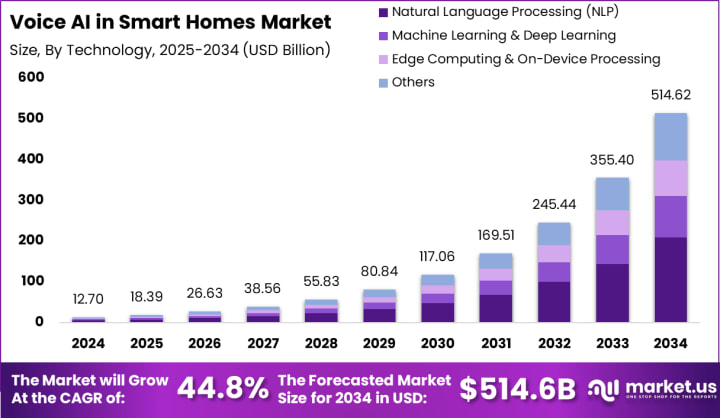
According to Market.us latest research publication, the Voice AI in Smart Homes Market is projected to reach around USD 514.62 billion by 2034, rising from USD 12.7 billion in 2024, reflecting a strong 44.8% CAGR between 2025 and 2034. In 2024, North America maintained a leading position with more than 38.2% of global revenue, accounting for approximately USD 4.8 billion.
The strong presence of connected home devices, high consumer technology adoption, and advanced digital infrastructure contributed to regional leadership. Increasing integration of artificial intelligence into voice assistants, smart speakers, and home automation systems continues to accelerate market expansion across residential environments.
Explore Detailed 2025-2035 Market Report Forecasts Today
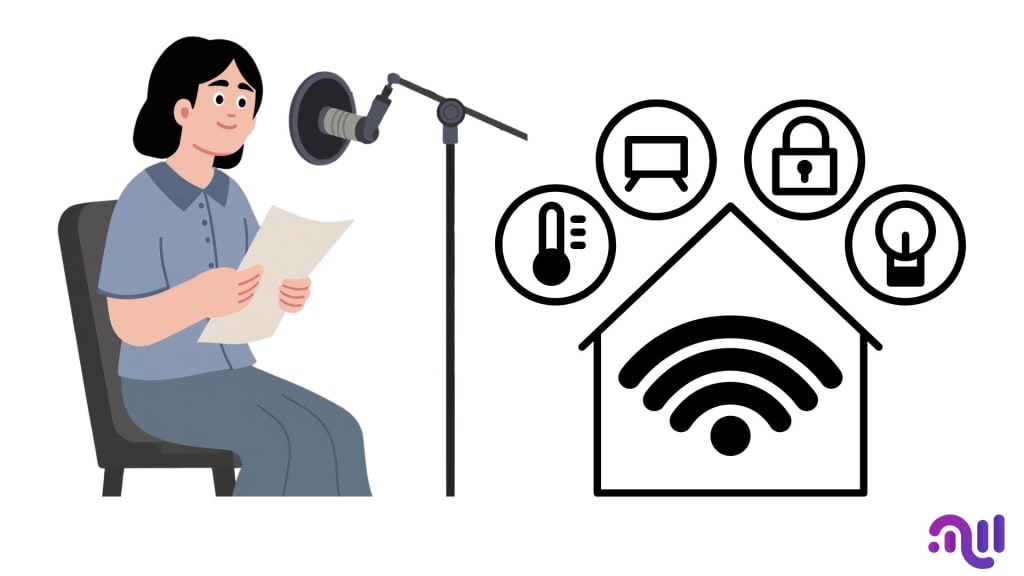
Voice AI in smart homes refers to artificial intelligence systems that allow users to control household devices using voice commands. These systems enable communication with smart lighting, security cameras, thermostats, entertainment systems, and appliances through natural language interaction. Growing consumer interest in hands free technology and convenience has strengthened demand for voice enabled ecosystems. As internet connected devices increase in households, voice AI is becoming a central interface for managing home environments efficiently.
How AI is Reshaping the Future of the Market?
Artificial intelligence is transforming the way smart homes operate by enabling more natural communication between humans and devices. Voice recognition models have improved significantly, with speech accuracy exceeding 95% in many modern systems. Machine learning algorithms allow devices to understand user preferences, schedules, and behavior patterns, enabling personalized automation. This shift has changed voice assistants from simple command tools into intelligent home management systems.
AI driven voice platforms also improve interoperability between different smart devices within a home network. Natural language processing enables systems to interpret context, meaning that a single voice request can trigger multiple automated actions. For example, a command such as “good night” can simultaneously adjust lighting, lock doors, and set security systems. As AI models continue to evolve, voice interfaces are expected to become the primary control layer for connected home ecosystems.
Scope and Research Methodology
The market evaluation of Voice AI in Smart Homes focuses on the adoption of voice enabled technologies within residential automation systems. Analysis typically considers factors such as device penetration, consumer adoption patterns, connectivity infrastructure, and integration with Internet of Things platforms. Data used in industry assessments is commonly derived from technology adoption surveys, smart device shipment statistics, and consumer behavior studies. These insights help identify patterns that influence future demand.
Research approaches also include examination of technological advancements in speech recognition, natural language processing, and AI enabled automation platforms. Secondary sources such as government digital adoption reports, technology usage studies, and smart home adoption statistics contribute to the analysis. Market trends are evaluated through comparisons of regional smart home penetration rates and connected device adoption. Such methods allow a structured understanding of how voice AI is evolving across global residential environments.
Key Forces Driving Market Expansion
Growing penetration of smart home devices is a primary factor supporting the expansion of voice AI technologies. Industry estimates indicate that more than 400 million smart home devices are currently installed globally, including smart speakers, thermostats, and connected appliances. Voice control simplifies interaction with these devices, making home automation more accessible to a broader consumer base. As the number of connected devices increases, voice AI platforms become essential for managing complex digital home environments.
Another major force is the rapid adoption of smart speakers and voice assistants. Surveys indicate that nearly 35% to 40% of households in developed economies use at least one voice enabled device. The convenience of controlling multiple home systems through simple commands has increased consumer reliance on voice interfaces. As smart home ecosystems expand, voice AI is expected to play a critical role in creating seamless digital living experiences.
Market Dynamics
Emerging Trends Analysis
One important emerging trend is the integration of voice AI with predictive automation. Modern smart home platforms analyze behavioral data to anticipate user needs, such as adjusting temperature before occupants arrive home. This shift moves voice assistants from reactive tools toward proactive home management systems. Predictive automation increases efficiency and enhances user comfort within residential environments.
Another trend involves multi device voice synchronization across the home. Voice assistants are increasingly designed to function across several devices simultaneously, enabling consistent responses regardless of location within a home. This technology allows seamless interaction across smart speakers, televisions, and mobile devices. The development of unified voice ecosystems is expected to strengthen the role of AI powered assistants in household automation.
Driver Analysis
A key driver of the market is the rapid growth of connected home infrastructure. Global internet penetration has surpassed 66%, and broadband connectivity has expanded significantly in urban and suburban areas. Reliable internet connectivity enables cloud based voice processing and device synchronization. As connectivity improves, the adoption of voice controlled systems continues to increase.
Consumer demand for convenience and automation also drives market growth. Voice interaction reduces the need for manual device control or smartphone applications. Tasks such as adjusting lighting, managing entertainment systems, or controlling home appliances can be completed instantly through spoken commands. This convenience factor has encouraged widespread adoption of voice AI technology in modern households.
Restraint Analysis
Privacy concerns remain one of the most significant restraints affecting voice AI adoption. Voice enabled devices often rely on continuous listening capabilities to detect activation commands. Some consumers remain cautious about potential misuse of personal voice data or unauthorized recordings. These concerns have influenced purchasing decisions in certain regions.
Data security risks also create barriers to adoption. Smart home ecosystems involve multiple connected devices sharing sensitive information across networks. If security standards are weak, these systems may become vulnerable to cyber threats. Addressing data protection concerns through stronger encryption and transparent privacy policies is essential for maintaining consumer trust.
Opportunity Analysis
Significant opportunities exist in the integration of voice AI with home health monitoring technologies. Voice enabled systems can assist elderly individuals by providing reminders for medication, emergency alerts, and daily health tracking. As aging populations increase globally, demand for accessible home assistance technologies is expected to rise. Voice AI offers an intuitive interface for individuals who may not be comfortable with complex digital devices.
Another opportunity is the expansion of voice AI into energy management systems. Smart homes increasingly use voice assistants to monitor electricity consumption and control energy intensive devices. By integrating with smart meters and energy management platforms, voice AI can help households reduce power usage and optimize efficiency. Growing interest in sustainable living is expected to strengthen demand for such solutions.
Challenge Analysis
One major challenge is the complexity of integrating voice AI across multiple device manufacturers and platforms. Smart home ecosystems often consist of products from different vendors, which may use incompatible communication protocols. This fragmentation can reduce system reliability and create difficulties for users attempting to manage devices through a single voice interface.
Another challenge involves maintaining high speech recognition accuracy across different languages, accents, and environmental conditions. Background noise, dialect variations, and speech patterns can affect the performance of voice recognition systems. Continuous improvements in AI language models are required to ensure reliable communication between users and devices. Addressing these limitations will be essential for broader global adoption.
Top Use Cases
Voice AI in smart homes is widely used for home automation and device control. Users commonly rely on voice assistants to manage lighting, heating systems, and security devices through simple spoken commands. These functions improve convenience while also supporting energy efficiency. Automated voice commands enable residents to control multiple devices simultaneously without manual interaction.
Another important use case is smart entertainment management. Voice assistants allow users to search for movies, control television settings, adjust audio systems, and access streaming services. This feature has become particularly popular as connected televisions and smart speakers become more common in households. Voice control simplifies content discovery and enhances the overall entertainment experience within connected homes.
Conclusion
Voice AI technology is rapidly transforming the structure of smart home ecosystems by introducing natural language interfaces for device interaction. Improvements in artificial intelligence, speech recognition, and connected device infrastructure have strengthened the role of voice assistants in modern households. As the number of connected devices continues to grow, voice AI is becoming an essential layer for managing digital home environments efficiently.
Future growth is expected to be influenced by advances in predictive automation, improved privacy protections, and stronger device interoperability. Expanding applications in energy management, home healthcare, and integrated entertainment systems will further increase adoption. With continued technological development and growing consumer demand for automation, voice AI is positioned to remain a key component of the evolving smart home landscape.
About the Creator
Roberto Crum
I am blogger, digital marketing pro since 4.5 years and writes for Market.us. Computer Engineer by profession. I love to find new ideas that improve websites' SEO. He enjoys sharing knowledge and information about many topics.
Keep reading
More stories from Roberto Crum and writers in Futurism and other communities.
Digital Out-Of-Home Advertising Market to hit USD 60 Billion By 2033
The Global Digital Out-Of-Home (DOOH) Advertising Market is projected to reach approximately USD 60 Billion by 2033, increasing from USD 19 Billion in 2023, growing at a CAGR of 11.8% during the forecast period from 2024 to 2033. This significant growth is fueled by the rising demand for dynamic, interactive, and data-driven advertising solutions that engage consumers in high-traffic outdoor environments. As digital screens, interactive kiosks, and other forms of digital signage continue to replace traditional static billboards, DOOH advertising is becoming a dominant force in the advertising landscape.
By Roberto Crum3 days ago in Futurism
Smart Home Technology: What Life Looks Like When Your Home Can Actually Think
It is seven in the morning and the kitchen already knows. The blinds have lifted just enough to let in soft light without waking anyone who is still sleeping. The kettle began heating two minutes ago.
By CurlsAndCommas5 days ago in Futurism
The Ink Isn’t Dry on the iPhone 17e, and the 18e is Already “Finalized”
The Exhausting Speed of "New" It’s early March 2026, and if you’re reading this on a brand-new iPhone 17e, I have some unsettling news: your tech is already haunted by the ghost of its successor. We’ve reached a point where the "new" doesn't even have time to gather dust before the "next" starts taking up rent in our collective consciousness. It’s an exhausting, hyper-accelerated loop that keeps us perpetually looking past the glass in our hands toward a horizon that never actually arrives.
By Tech Horizonsa day ago in Futurism



Comments
There are no comments for this story
Be the first to respond and start the conversation.