
Ancient Mummy from Luxor Tomb Put on Public Display in Egypt
A remarkably preserved mummified body discovered in a tomb near Luxor is now being exhibited, offering new insights into ancient Egyptian burial traditions and history.

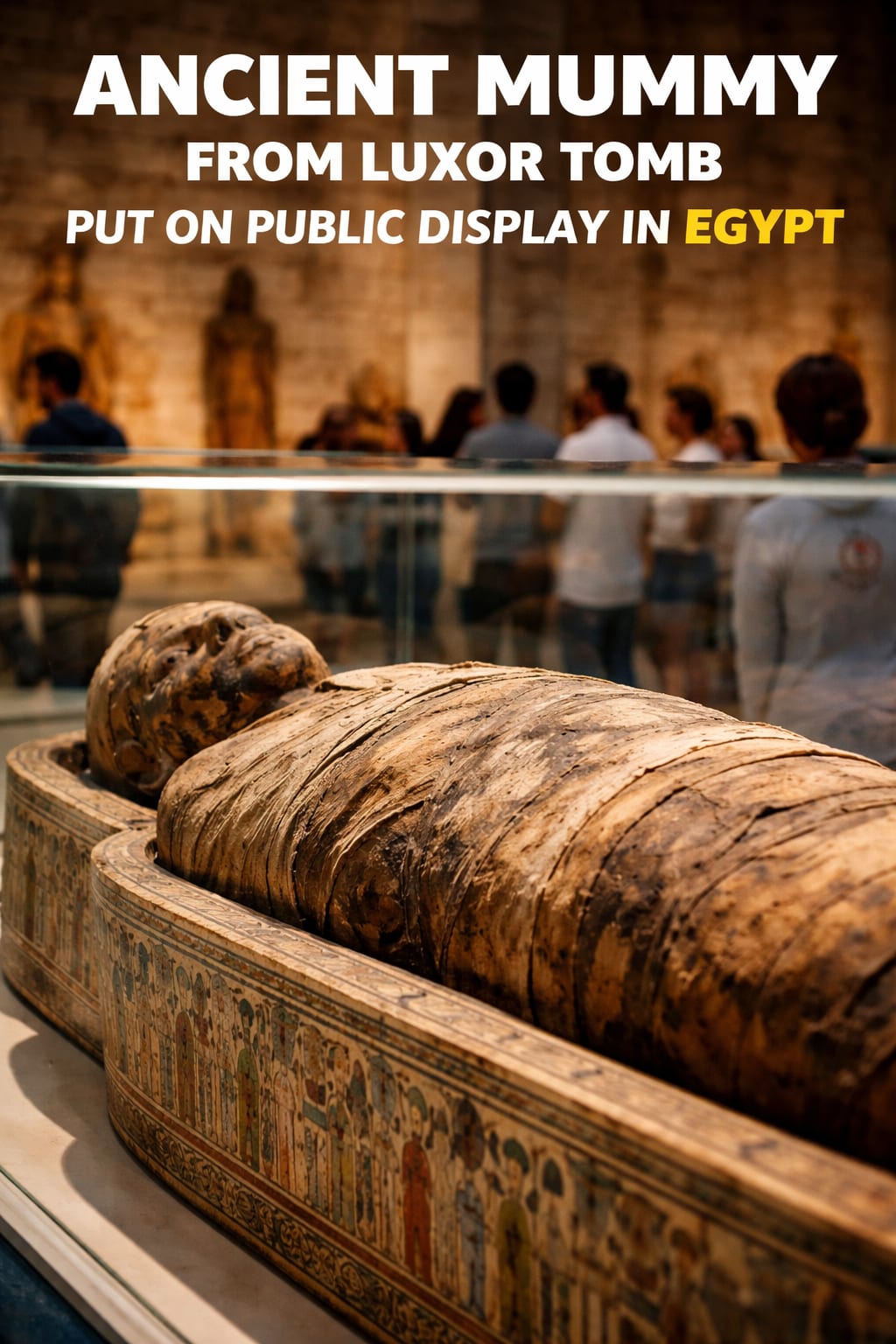
Archaeologists in Egypt have unveiled a remarkable discovery from the historic region of Luxor—a well-preserved mummified body found inside an ancient tomb. The mummy, believed to be thousands of years old, has now been placed on public display, giving historians, scientists, and visitors a rare opportunity to observe an authentic relic of ancient Egyptian civilization.
The discovery was made during an excavation near the famous burial grounds close to the Valley of the Kings, one of the most significant archaeological sites in the world. The region has long been known as the final resting place of powerful rulers, nobles, and important figures of ancient Egypt. Experts believe the newly displayed mummy likely belonged to a high-ranking official or member of the elite class who lived during one of Egypt’s powerful dynasties.
Archaeologists say the mummy was found inside a carefully constructed tomb that had remained largely undisturbed for centuries. Inside the burial chamber, researchers discovered several artifacts including fragments of decorated wooden coffins, pottery vessels, and small religious items that were traditionally buried with the dead. These objects were believed to help guide the deceased safely into the afterlife.
The body itself is remarkably well preserved, with visible wrappings and traces of the intricate embalming techniques used by ancient Egyptians. According to experts, the process of mummification was a sacred ritual that reflected the Egyptian belief in life after death. By preserving the body, ancient Egyptians believed the soul could recognize and return to it in the afterlife.
Researchers have already begun detailed examinations of the mummy using modern technology such as CT scans and digital imaging. These non-invasive methods allow scientists to study the body without damaging the fragile remains. Early findings suggest the individual may have lived more than 2,500 years ago, possibly during the later dynastic periods of ancient Egypt.
The mummy has now been placed on display at a museum exhibition organized by the Egyptian Ministry of Tourism and Antiquities. Officials say the exhibition is part of a broader effort to showcase Egypt’s rich archaeological heritage while also encouraging tourism.
Visitors to the exhibition can see the mummy inside a specially designed protective glass case that controls temperature, humidity, and light exposure. These measures are necessary to ensure the ancient remains remain preserved for future generations.
Experts from the Supreme Council of Antiquities have emphasized that discoveries like this provide valuable information about daily life, health, and social structure in ancient Egypt. By analyzing bones, teeth, and burial objects, scientists can learn about diet, diseases, and the cultural practices of people who lived thousands of years ago.
Luxor itself has often been described as the world’s greatest open-air museum. The city sits on the banks of the Nile River and is surrounded by temples, tombs, and monuments built during the height of ancient Egyptian civilization. Every year, new discoveries continue to emerge from its sands, reminding researchers that much of Egypt’s past is still waiting to be uncovered.
In recent years, Egypt has intensified archaeological exploration across many historical regions, leading to numerous exciting discoveries including tombs, statues, and ancient burial chambers. These finds have helped deepen global understanding of ancient Egyptian culture and its sophisticated religious traditions.
The public display of the newly discovered mummy has already attracted widespread attention from historians and tourists alike. For many visitors, seeing such a well-preserved ancient body offers a powerful connection to the past and a deeper appreciation of the remarkable achievements of ancient Egyptian civilization.
Officials hope the exhibition will inspire greater interest in archaeology and cultural heritage, while also highlighting the importance of protecting historical sites. As research continues, experts believe the mummy and its surrounding artifacts may reveal even more secrets about the life of the individual who once lived in one of history’s most fascinating civilizations.
For now, the ancient figure rests quietly in its display case—an enduring reminder of Egypt’s extraordinary past and the mysteries that still lie hidden beneath the desert sands of Luxor.
About the Creator
Irshad Abbasi
Ali ibn Abi Talib (RA) said 📚
“Knowledge is better than wealth, because knowledge protects you, while you have to protect wealth.
Keep reading
More stories from Irshad Abbasi and writers in History and other communities.
Ancient Egyptian Tomb Yields Newly Discovered Mummified Remains of Royal Goldsmiths
In a remarkable archaeological discovery in Egypt, a team of researchers has uncovered a series of mummified remains belonging to royal goldsmiths within a previously unexplored tomb. The find, located near Luxor in the Valley of the Kings, offers an extraordinary glimpse into the lives of highly skilled artisans who served the pharaohs of ancient Egypt.
By Irshad Abbasi 2 days ago in History
The Year 1986 in Review: Fun Facts, Trivia, and Historic Highlights
This quick read is a collection of fun facts, trivia, and historical events from the year 1986. Discover the year’s top news stories, most influential people, sports trivia, grocery prices, and much more.
By Gregory DeVictor2 days ago in History



Comments
There are no comments for this story
Be the first to respond and start the conversation.