
Hasan-i Sabbah’s Garden of Paradise: Legend or Historical Reality?
Exploring the mysterious story of the secret “heaven” linked to the leader of the medieval Nizari Ismailis.

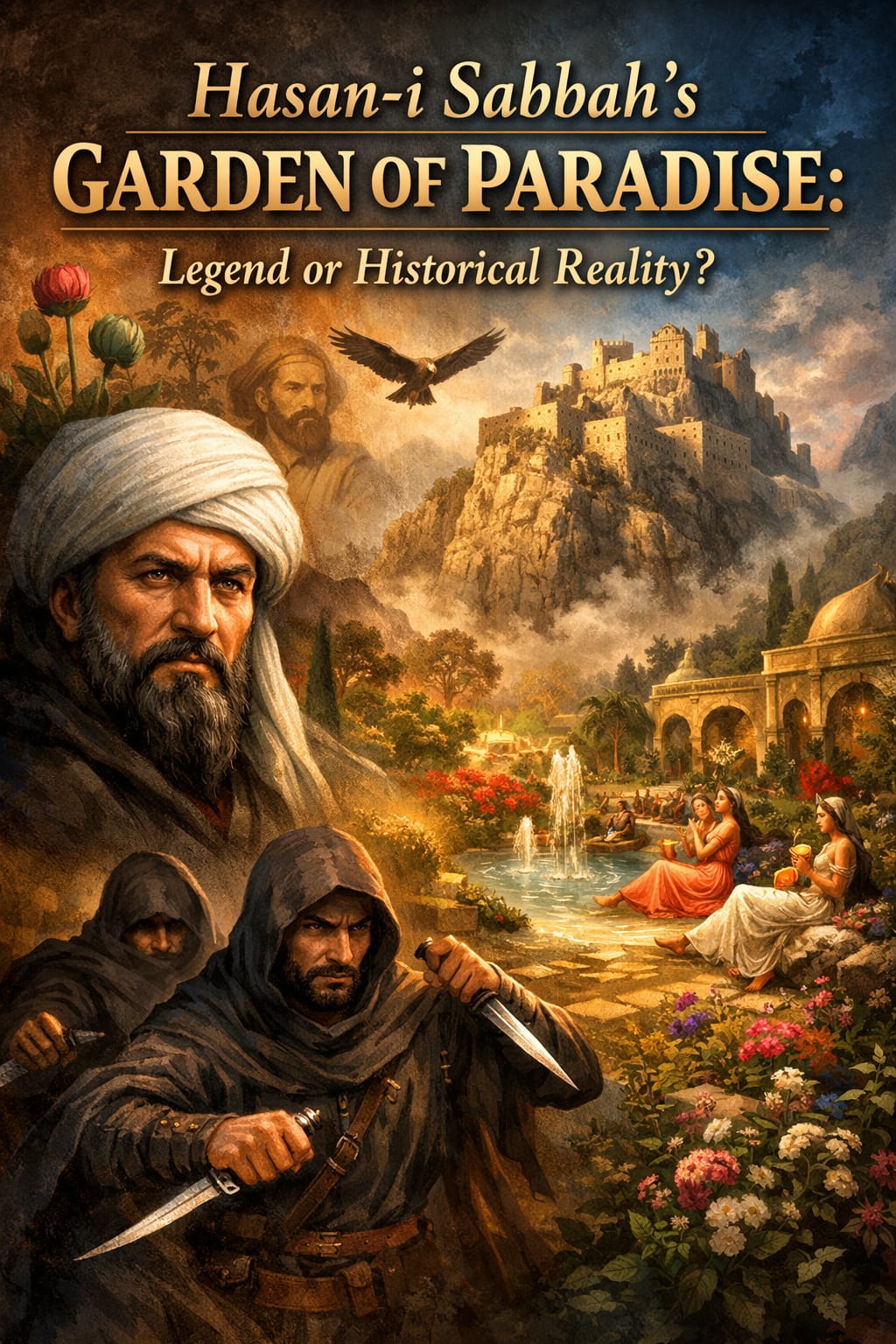
Among the many legends of medieval history, few stories are as fascinating and controversial as the tale of the “Garden of Paradise” associated with Hasan-i Sabbah. He was the founder and spiritual leader of the Nizari Ismaili movement in Persia during the 11th and early 12th centuries. From his mountain stronghold at Alamut Castle, Hasan-i Sabbah built a powerful and mysterious network of followers who became known in Western literature as the “Assassins.” One of the most enduring legends about him is the claim that he created a secret garden designed to resemble paradise, where young recruits were tricked into believing they had experienced heaven.
The story became widely known in Europe through the writings of the Venetian traveler Marco Polo. In his famous book The Travels of Marco Polo, he described a magnificent hidden garden filled with beautiful palaces, flowing streams, wine, exotic fruits, and attractive maidens. According to Polo’s account, Hasan-i Sabbah allegedly used this garden to control his followers.
The legend claims that young recruits were secretly drugged with hashish and carried into the garden while they were unconscious. When they woke up surrounded by luxury and beauty, they believed they had entered paradise. After some time, they were drugged again and taken back outside the garden. Hasan-i Sabbah would then tell them that they had experienced heaven and could return permanently if they obeyed his orders and proved their loyalty.
This story supposedly explains why Hasan-i Sabbah’s followers were so fearless and willing to sacrifice their lives in dangerous missions. Many European writers believed that the word “assassin” came from the Arabic word “Hashshashin,” meaning “hashish users.” Over time, the tale became one of the most famous legends about secret societies in medieval history.
However, modern historians strongly question the accuracy of this story. Many scholars argue that the tale was exaggerated or even invented by outsiders who misunderstood or deliberately misrepresented the Nizari Ismaili community. In fact, there is little reliable historical evidence from contemporary sources that confirms the existence of such a paradise garden.
Hasan-i Sabbah himself was known as a highly disciplined and intellectual leader. After capturing Alamut Castle in 1090, he transformed it into the center of the Nizari Ismaili State. From this fortress and several other mountain strongholds, his followers resisted the powerful Seljuk Empire, which ruled much of the region at the time.
Instead of fighting large conventional battles, the Nizari Ismailis adopted a strategy of targeted political assassinations against powerful enemies such as military commanders and political leaders. Their agents, known as “fida’is,” were famous for their dedication and willingness to risk their lives for their cause. These dramatic operations created fear among their enemies and helped the small Ismaili state survive for many years despite being surrounded by powerful rivals.
Historians today believe that the loyalty of these followers was not the result of drugs or deception but rather strong ideological commitment, religious belief, and strict training. The community was highly organized and intellectually active, with libraries and scholars working inside Alamut Castle.
Archaeological studies of the ruins of Alamut have also failed to find evidence of a luxurious garden matching the descriptions found in Marco Polo’s writings. While the castle complex likely had gardens and cultivated land for survival, nothing suggests the existence of a paradise-like setting designed to deceive followers.
Furthermore, Marco Polo himself traveled through the region many decades after Hasan-i Sabbah’s death in 1124. This raises serious questions about the reliability of his account. Many historians believe that Polo may have repeated stories he heard from others rather than describing something he personally witnessed.
Over time, the legend of Hasan-i Sabbah’s garden spread widely in Europe and became part of popular imagination. Writers and storytellers turned the tale into a symbol of mystery, intrigue, and secret power in the medieval East.
Today, most scholars view the story of the “Garden of Paradise” as more myth than reality. It reflects the fears, misunderstandings, and fascination that surrounded the Nizari Ismailis in medieval times. While Hasan-i Sabbah was indeed a powerful and strategic leader, the dramatic story of a drug-induced paradise is likely a mixture of exaggeration and legend.
Yet the story continues to capture people’s imagination even today. Whether fact or fiction, the legend of Hasan-i Sabbah’s paradise remains one of the most intriguing tales from the history of the medieval Islamic world, reminding us how myths and history can sometimes blend together.
About the Creator
Irshad Abbasi
Ali ibn Abi Talib (RA) said 📚
“Knowledge is better than wealth, because knowledge protects you, while you have to protect wealth.
Keep reading
More stories from Irshad Abbasi and writers in History and other communities.
Father of Millions, Yet Not Always a Father to His Own Sons
Few figures in world history have left as profound a mark as Genghis Khan. Known for his extraordinary military genius and ruthless campaigns, he forged the largest contiguous empire the world had ever seen—the Mongol Empire. Yet beyond the battlefield and the politics of conquest lies a fascinating paradox: while Genghis Khan is believed to be the ancestor of millions of people today, his relationship with his own sons was complicated, strained, and sometimes filled with uncertainty.
By Irshad Abbasi about 11 hours ago in History
The London Smog of 1952: The "Great Smog" that killed 12,000 people in four days of absolute, yellow darkness.
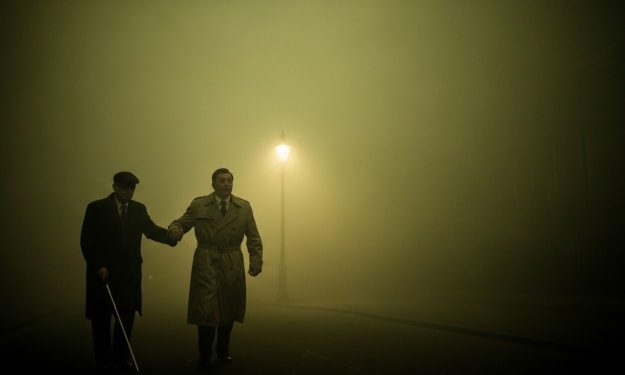
The taste of a copper penny coated in rotten egg yolk. That was the first warning. It was Friday, December 5, 1952. A blind man led a sighted businessman across Euston Road, tapping his white cane against the invisible curb. The businessman couldn't see his own shoes. The air had turned into a thick, yellowish-green soup that smelled of burning hair and raw sulfur. It was not a fog. It was an executioner. Over the next four days, twelve thousand Londoners would choke to death in their own beds, murdered by the very fireplaces they lit to keep warm.
By The Chaos Cabinet2 days ago in History



Comments
There are no comments for this story
Be the first to respond and start the conversation.