
Mughal History Removed from Indian School Curriculum
A controversial educational reform sparks debate over history, identity, and politics in modern India.

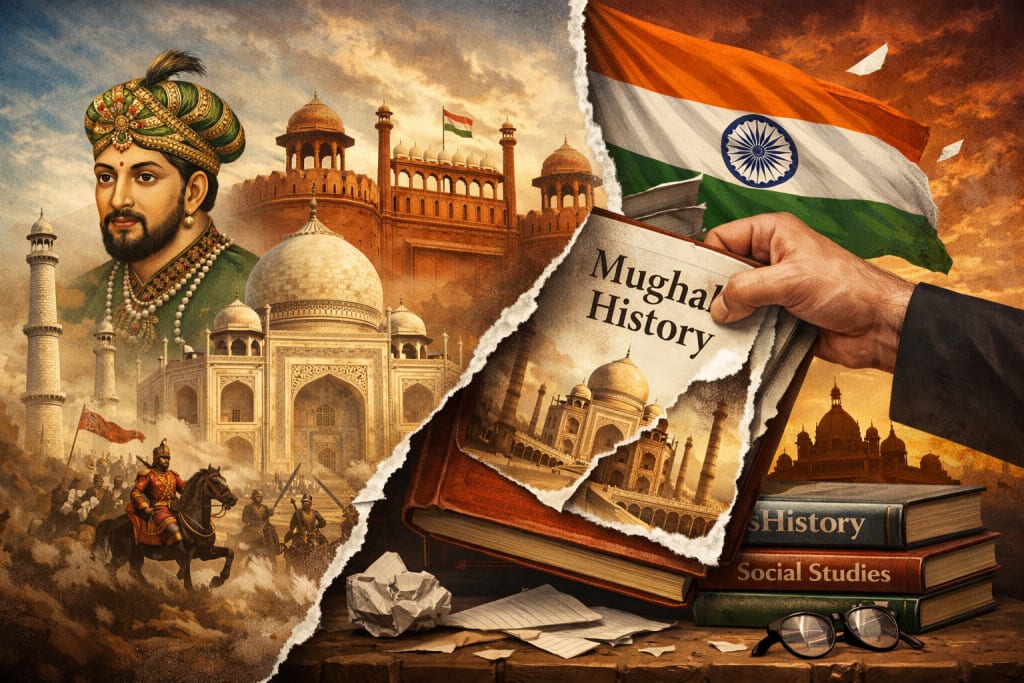
In recent years, the decision to remove significant portions of Mughal history from school textbooks in India has sparked a heated debate among historians, educators, politicians, and the general public. The move, introduced as part of broader curriculum revisions, has raised questions about how history should be taught and whether political ideologies are influencing the way the past is presented to future generations.
The Mughal Empire was one of the most powerful and influential dynasties in the history of the Indian subcontinent. Founded in 1526 by Emperor Babur after the First Battle of Panipat, the empire ruled large parts of South Asia for more than three centuries. Mughal rulers such as Akbar, Jahangir, Shah Jahan, and Aurangzeb played major roles in shaping the region’s culture, politics, architecture, and economy. Monuments like the Taj Mahal, Red Fort, and many gardens, mosques, and cities across India stand as reminders of the Mughal era.
However, recent curriculum changes introduced by India’s National Council of Educational Research and Training (NCERT) have reduced or removed several chapters related to the Mughal period from school textbooks, particularly in middle and secondary education. Officials behind the decision have argued that the revisions were part of an effort to streamline the syllabus and reduce the academic burden on students after the disruptions caused by the COVID-19 pandemic.
Despite this explanation, critics believe the move reflects deeper political motivations. Some historians argue that removing Mughal history risks distorting the historical narrative of the subcontinent. They say the Mughal Empire played a crucial role in shaping the political and cultural landscape of South Asia, and eliminating its study from textbooks could leave students with an incomplete understanding of their country’s past.
Many scholars also emphasize that history is complex and should include multiple perspectives rather than excluding entire eras or dynasties. According to them, the Mughal period contributed not only to architecture and art but also to administrative systems, literature, and economic networks that influenced the region for centuries.
Supporters of the curriculum changes, however, argue that Indian history has long been overly focused on the Mughal period, while the achievements of earlier Hindu kingdoms and regional powers have received less attention. They believe that revising textbooks provides an opportunity to highlight other dynasties and civilizations that flourished in the subcontinent before and during the Mughal era.
This debate reflects a broader discussion taking place in India about national identity and the interpretation of history. For some groups, revisiting historical narratives is part of reclaiming indigenous heritage and correcting what they perceive as colonial or biased perspectives. For others, the removal of certain historical periods raises concerns about historical revisionism and the politicization of education.
International observers and academic communities have also been following the developments closely. Many historians stress that history education should remain balanced and evidence-based. They argue that understanding past empires, including both their achievements and controversies, is essential for developing critical thinking and historical awareness among students.
Students themselves are often caught in the middle of this debate. While some may welcome a lighter academic workload, others worry that gaps in historical education could limit their understanding of the diverse cultural influences that shaped modern India. Teachers, too, face challenges in explaining complex historical developments when key chapters or references are removed from official textbooks.
Beyond the classroom, the discussion has spread across media platforms, universities, and political circles. Public debates about the Mughal legacy continue to reflect broader questions about how societies remember their past and how historical narratives influence present-day politics and cultural identity.
Ultimately, the controversy surrounding the removal of Mughal history from Indian textbooks highlights a universal challenge: deciding what parts of history should be taught and how they should be presented. History is not merely a record of past events; it is also a tool through which societies interpret their identity and values.
As India continues to grow as a diverse and complex nation, the conversation about history education will likely remain ongoing. Whether the curriculum will be revised again in the future remains uncertain, but the debate itself demonstrates the powerful role that history plays in shaping public discourse and national consciousness.
About the Creator
Irshad Abbasi
Ali ibn Abi Talib (RA) said 📚
“Knowledge is better than wealth, because knowledge protects you, while you have to protect wealth.
Keep reading
More stories from Irshad Abbasi and writers in History and other communities.
Muhammad Shah “Rangila”: The Colorful Emperor of a Fading Empire
Among the later rulers of the Mughal Empire, Muhammad Shah Rangila stands out as one of the most colorful and controversial figures in South Asian history. Known for his love of music, dance, art, and luxury, he earned the nickname “Rangila,” meaning “the colorful” or “the pleasure-loving.” While his reign brought a cultural revival in some ways, it also coincided with a period of serious political decline in the Mughal Empire.
By Irshad Abbasi about 12 hours ago in History
India’s Biggest Bank Fraud: Vijay Mallya
An Indian man who was once called the “King of Good Times” in his era lived a life like a king. He would throw parties worth millions of rupees in a single night. While billionaires around the world owned private jets, he even had his own Boeing 727.
By Imran Ali Shah5 days ago in History
Becca
"Everything is so... flat." Denille said stupidly as she looked around her new neighborhood. She looked around at the muted desert where even the smallest sign of life seemed to have given up. The plant life was shrubs that were half cooked by the heat and where there should have been a lawn, a mess of white rocks laid glistening in the sun. Even the sky looked stretched thin, like the sun had ironed it smooth. She’d moved from Riverside, where at least there were hills, but here in Barstow, everything felt baked and brittle.
By Sara Wilson7 days ago in Fiction


Comments
There are no comments for this story
Be the first to respond and start the conversation.