
The “Bhagat Singh of Sindh” Remembered in India but Forgotten in His Own Homeland
A young freedom fighter who sacrificed his life against British rule, yet his story remains largely overlooked where he was born.

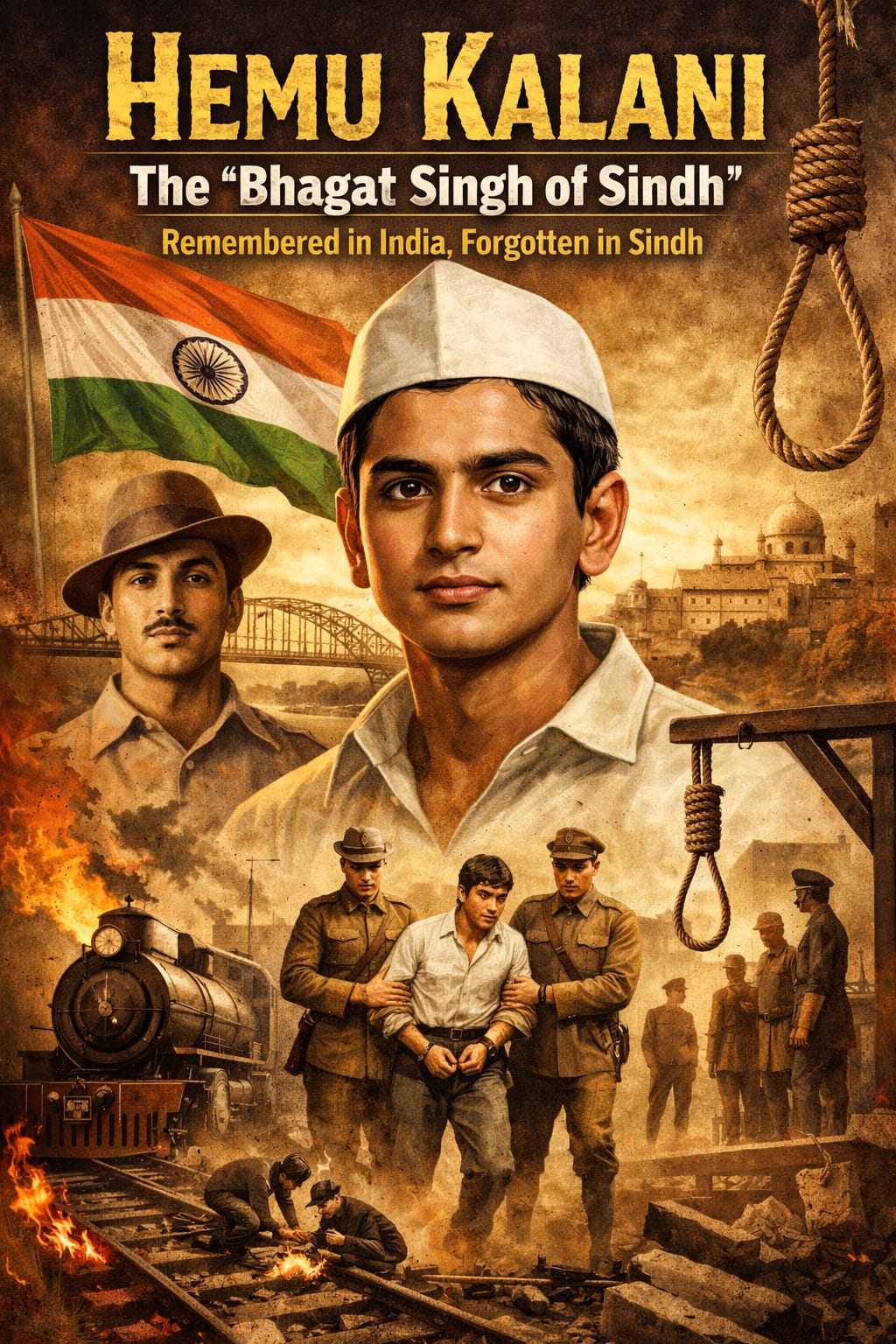
History is filled with stories of brave individuals who sacrificed everything for the freedom of their people. Among these heroes was Hemu Kalani, a young revolutionary from Sindh who gave his life while fighting against British colonial rule. Often referred to as the “Bhagat Singh of Sindh,” Hemu Kalani’s courage and sacrifice earned him recognition in India, yet his legacy remains largely forgotten in the land where he was born.
Hemu Kalani was born on March 23, 1923, in Sukkur, a historic city in the Sindh region. At that time, the Indian subcontinent was under British rule, and the struggle for independence was gaining strength across the region. Like many young people of his generation, Hemu was inspired by revolutionary leaders who challenged colonial authority and demanded freedom.
From an early age, Hemu Kalani became involved in political activism. He joined a youth organization known as the Swaraj Sena, which aimed to mobilize young people against British rule. The group encouraged acts of resistance and worked to spread the message of independence among the public.
Hemu was deeply influenced by the revolutionary spirit of figures such as Bhagat Singh, who had become a symbol of resistance against colonial oppression. Inspired by such heroes, Hemu believed that freedom required courage, sacrifice, and action.
In 1942, the independence movement reached a new level with the launch of the Quit India Movement, a mass protest demanding that the British leave the country immediately. Demonstrations and acts of resistance erupted across the subcontinent. Young activists like Hemu Kalani were determined to play their part in the struggle.
During this time, Hemu received information that a train carrying British troops and military supplies was scheduled to pass near Sukkur. These troops were reportedly being sent to suppress the growing independence movement. Determined to stop them, Hemu and his companions devised a plan to sabotage the railway track.
The plan was simple but dangerous: remove the fishplates from the railway track so that the train would derail and the troops would not reach their destination. Late at night, Hemu and his friends went to the railway line to carry out the operation.
However, before they could complete their task, British soldiers spotted them. Hemu’s companions managed to escape, but Hemu himself was captured by the authorities. Despite being arrested, he refused to reveal the names of his fellow activists.
The British authorities subjected him to harsh interrogation and torture in an attempt to extract information. Yet Hemu remained firm and loyal to his cause. His silence protected his companions but sealed his own fate.
Eventually, he was tried by a British military court. The court sentenced him to death for attempting to sabotage the railway line. Despite appeals for mercy and requests to reduce the sentence, the British administration refused to change the verdict.
On January 21, 1943, Hemu Kalani was executed by hanging. He was only 19 years old.
His death turned him into a symbol of youthful courage and resistance. For many people, he represented the fearless spirit of young revolutionaries who were willing to sacrifice their lives for freedom.
After the partition of the subcontinent in 1947, Sindh became part of Pakistan. Over time, the memory of Hemu Kalani faded from public attention in his birthplace. In contrast, in India he continued to be honored by the Sindhi community and others who remembered his contribution to the independence struggle.
Several schools, roads, and public places in India have been named after him. Statues and memorials also commemorate his sacrifice, keeping his story alive for future generations.
Historians often describe him as a hero who transcended borders. His struggle was not limited to any single country but was part of a broader fight against colonial rule. His story also reflects the complex history of the subcontinent, where political changes sometimes reshape how historical figures are remembered.
Today, many believe that Hemu Kalani deserves wider recognition in South Asia. His courage, loyalty, and willingness to sacrifice his life at such a young age remain an inspiring example.
Remembering figures like Hemu Kalani is not only about honoring the past. It is also about understanding the power of courage, conviction, and the desire for freedom.
Though decades have passed since his execution, the story of the “Bhagat Singh of Sindh” still carries an important message: even the actions of a single determined young person can leave a lasting mark on history.
About the Creator
Irshad Abbasi
Ali ibn Abi Talib (RA) said 📚
“Knowledge is better than wealth, because knowledge protects you, while you have to protect wealth.
Keep reading
More stories from Irshad Abbasi and writers in History and other communities.
The Hidden City Beneath the Desert: A Discovery That Shocked the World
For centuries, vast deserts around the world have been seen as empty and lifeless landscapes. Endless waves of sand stretch for miles, hiding whatever once existed beneath them. But sometimes, the desert keeps secrets—secrets so extraordinary that when they are finally discovered, they can change history itself.
By Irshad Abbasi about 10 hours ago in History
The Year 1978 in Review: Fun Facts, Trivia, and Historic Highlights
This quick read is a collection of fun facts, trivia, and historic events from the year 1978. Discover the year’s top news stories, most influential people, sports facts, historic firsts, entertainment trivia, and much more.
By Gregory DeVictor3 days ago in History


Comments
There are no comments for this story
Be the first to respond and start the conversation.