
The Unearthed Legacy of Pharaoh Ramesses II
Archaeologists in Egypt discover the long-buried torso of a monumental statue of Ramesses II, shedding new light on the grandeur of one of ancient Egypt’s greatest rulers.

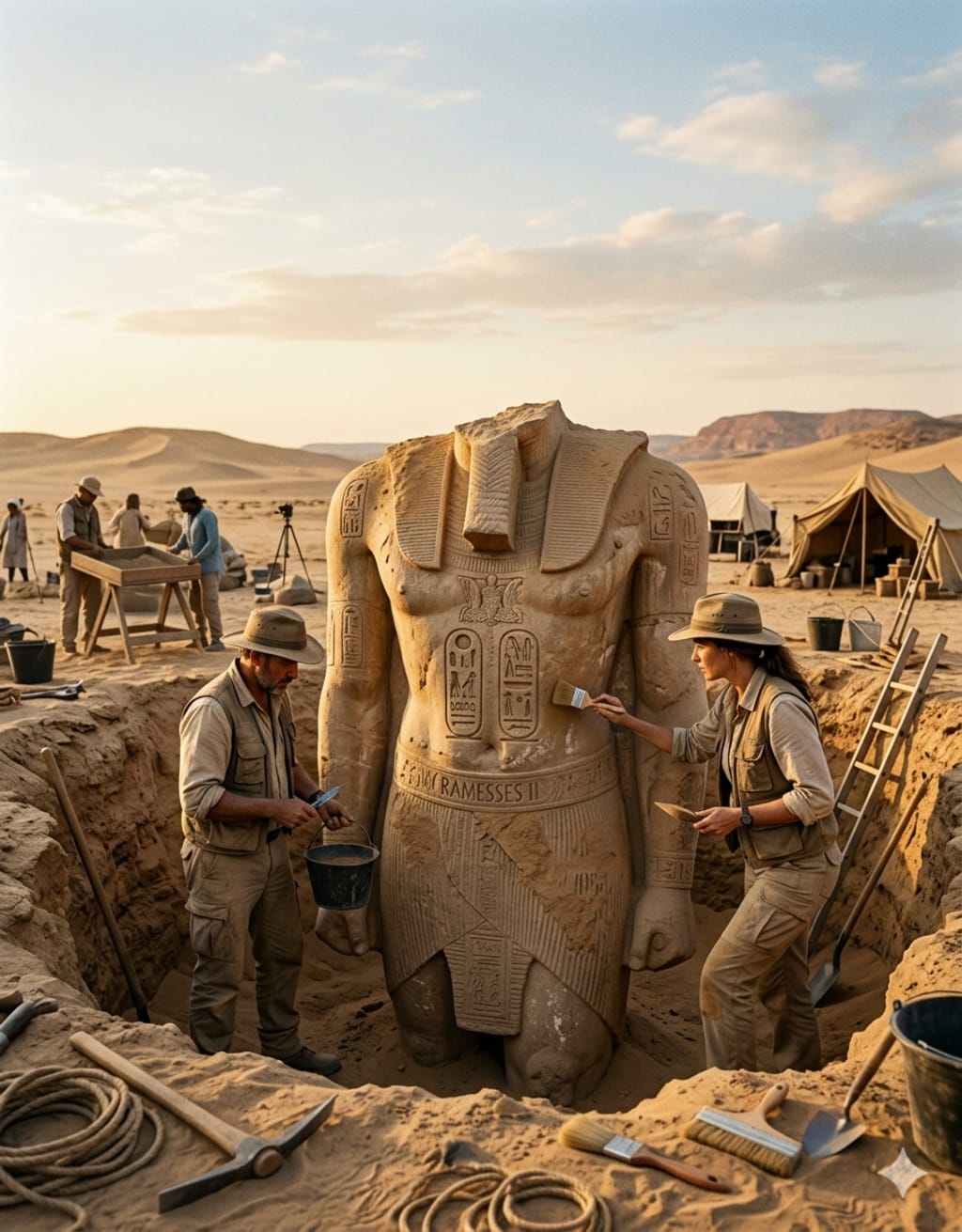
Archaeologists in Egypt have made a remarkable discovery by unearthing the massive torso of a statue believed to depict Ramesses II, one of the most powerful and celebrated rulers of ancient Egypt. The discovery has excited historians and archaeologists alike, as it offers fresh insight into the artistic and architectural achievements of one of the most influential periods in Egyptian history.
The statue’s torso was discovered during ongoing excavation work near the ancient city of Minya, a region rich in archaeological remains. The statue fragment, carved from limestone, is believed to have once been part of a colossal monument dedicated to the pharaoh, who ruled Egypt for nearly seven decades during the 13th century BCE. Although only the torso portion has been recovered so far, experts say the size and craftsmanship indicate that the statue once stood several meters tall.
Ramesses II, often referred to as Ramesses the Great, ruled ancient Egypt from 1279 to 1213 BCE during the 19th Dynasty of the New Kingdom. His reign is widely regarded as one of the most prosperous and powerful in Egyptian history. Known for his ambitious building projects, military campaigns, and grand monuments, Ramesses II left behind an extraordinary legacy that continues to fascinate scholars today.
According to Egypt’s Ministry of Tourism and Antiquities, the statue fragment measures several feet in height and shows intricate details typical of royal Egyptian sculpture. Carvings on the piece reveal parts of traditional royal clothing and decorative patterns associated with pharaonic imagery. Despite the damage caused by centuries of burial and natural erosion, the statue still preserves important artistic elements that help researchers identify the ruler it represents.
Archaeologists believe the statue may have originally been part of a temple complex dedicated to the pharaoh. During Ramesses II’s reign, Egypt witnessed an unprecedented boom in monument construction. Temples, statues, and colossal sculptures were erected across the kingdom to celebrate the power of the pharaoh and honor the gods.
Among the most famous monuments associated with Ramesses II are the massive temples of Abu Simbel Temples, where enormous seated statues of the ruler guard the temple entrance. These monumental works were designed not only as religious structures but also as powerful symbols of Egypt’s strength and the divine authority of its king.
The newly discovered statue fragment may help historians better understand how royal statues were distributed throughout Egypt’s cities and temples. Many such statues were placed in strategic locations to reinforce the pharaoh’s presence and authority across the vast kingdom.
Experts also note that large statues of rulers served a political and religious purpose. In ancient Egyptian belief, statues were more than decorative objects; they were considered spiritual vessels that could house the essence or presence of the ruler. By erecting colossal statues across the land, pharaohs ensured that their legacy and influence endured long after their reign ended.
Ramesses II is also remembered for his military leadership. One of his most famous campaigns was the Battle of Kadesh, fought against the Hittite Empire around 1274 BCE. Although the outcome of the battle remains debated by historians, it eventually led to one of the earliest known peace treaties in recorded history.
The discovery of the statue torso demonstrates how much of Egypt’s ancient past still lies hidden beneath the desert sands. Archaeological missions across the country continue to reveal temples, tombs, statues, and artifacts that provide valuable clues about the civilization that flourished along the Nile River thousands of years ago.
Researchers will now conduct detailed studies of the statue fragment, including analysis of the carving style, stone composition, and remaining inscriptions. These investigations may help determine the statue’s original location, its full size, and the specific monument it once belonged to.
Officials hope that further excavations in the area may reveal additional fragments of the statue, including the head or lower body. If more pieces are found, archaeologists may eventually be able to reconstruct the monument and display it in a museum, allowing visitors to witness another impressive example of ancient Egyptian craftsmanship.
For now, the discovery of Ramesses II’s statue torso stands as a powerful reminder of Egypt’s rich archaeological heritage. Each new find adds another piece to the vast puzzle of ancient history, bringing modern scholars closer to understanding the lives, beliefs, and achievements of one of the world’s most remarkable civilizations.
About the Creator
Irshad Abbasi
Ali ibn Abi Talib (RA) said 📚
“Knowledge is better than wealth, because knowledge protects you, while you have to protect wealth.
Keep reading
More stories from Irshad Abbasi and writers in History and other communities.
Mystery of the Egyptian Pyramids: Has the Most Complex Puzzle Finally Been Solved?
For centuries, the construction of the great pyramids of Egypt has been one of the world’s most fascinating historical mysteries. Towering above the desert sands near the ancient city of Giza, these monumental structures have puzzled historians, engineers, and archaeologists alike. How could a civilization that existed more than 4,500 years ago build such massive and precisely aligned structures without modern machinery?
By Irshad Abbasi 2 days ago in History
What St. Patrick’s Day Really Means: A Story Woven in Green and Shadow
What St. Patrick’s Day Really Means: A Story Woven in Green and Shadow St. Patrick’s Day comes each year like a familiar tune drifting down a long corridor of memory. The world dresses itself in green, the fiddles come out, and laughter rises from places that have forgotten why the day mattered in the first place. For many, it has become a carnival of noise, a blur of beer and novelty hats, a holiday flattened into something loud and careless. But beneath that surface lies a story older than the parades, older than the pubs, older even than the feast day itself. It is the story of a people who carried poetry in their bones and sorrow in their pockets, who crossed oceans with nothing but hope, and who built new lives in places that did not always welcome them. To understand St. Patrick’s Day, one must listen for the heartbeat beneath the noise, the quiet rhythm of endurance that has always defined the Irish spirit.
By Julie O'Hara - Author, Poet and Spiritual Warrior2 days ago in History


Comments
There are no comments for this story
Be the first to respond and start the conversation.