
Hyperscale Expansions by Microsoft AWS and Google Fuel Brazil's 9.50% CAGR Data Center Growth to USD 9 Billion
AWS committed $1.8 billion through 2034, Microsoft injected $2.7 billion over three years, and Google Cloud is rapidly expanding its highly scalable regional facilities to fund this boom

Recently analyzed of the global cloud infrastructure landscape shows the one massive trend that stood out immediately. The hyperscale expansions by Microsoft, AWS and Google fuel Brazil's 9.50% CAGR data center growth to USD 9 billion. Consequently, South America's largest economy is rapidly transforming into a global digital powerhouse. In my analysis of the recent market data, I found that this explosive growth is reshaping how we view cloud computing in the Global South. Let's dive into exactly how and why this is happening.
What Is Driving Brazil's Data Center Market to a USD 9 Billion Valuation?
Aggressive hyperscale investments, a massive base of 187.9 million internet users, rapid 5G rollouts, and booming AI demands are driving the Brazil data center market from USD 4.0 billion in 2025 to a forecasted USD 9.0 billion by 2034.
Furthermore, digital transformation is no longer just a buzzword in Brazil; it is a fundamental economic shift. Studies show that the region's increasing reliance on cloud infrastructure and IoT processing requires immense physical storage and computing power. Therefore, domestic enterprises and international giants alike are scrambling for premium colocation space.
How Are AWS, Microsoft, and Google Funding the Brazilian Hyperscale Boom?
AWS committed $1.8 billion through 2034, Microsoft injected $2.7 billion over three years, and Google Cloud is rapidly expanding its highly scalable regional facilities to fund this boom.
For instance, AWS is aggressively building upon a previous 19.2 billion reais investment to solidify its data sovereignty in the region. Meanwhile, Microsoft's massive capital injection focuses directly on cloud and AI infrastructure. They are currently constructing state-of-the-art mega-centers in Hortolândia and Sumaré. These specific projects will generate over 3,300 peak construction jobs by mid-2025.
Which Data Center Segments Dominate the Brazilian Landscape?
Mega and Massive data centers driven by hyperscalers currently dominate the market, alongside Tier 3 enterprise facilities concentrated heavily in the Southeast tech hubs.
Specifically, the financial and technological capitals of São Paulo and Rio de Janeiro absorb the vast majority of this new capacity. While Tier 4 facilities offer the highest fault tolerance, I noticed that Tier 3 facilities actually dominate the standard enterprise balance. Therefore, local businesses can achieve excellent uptime without the premium costs of Tier 4 architecture.
How Do the Top Hyperscalers Compare in Brazil?
These tech giants employ distinct investment timelines and infrastructure strategies to capture the lucrative Brazilian market.
To help you evaluate their approaches, I compiled this comparison data based on recent corporate announcements:
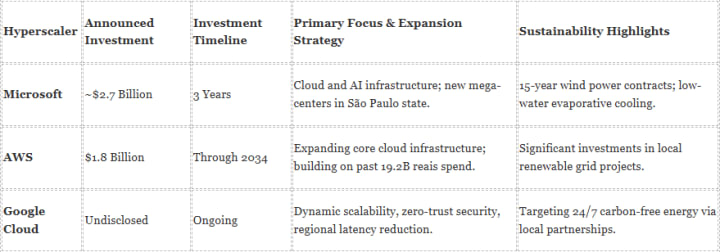
Why Is Brazil Considered a Global Hub for Green AI?
Brazil utilizes a national energy grid powered by roughly 88% renewable sources, primarily hydro, wind, and solar, making it an ideal location for sustainable, energy-intensive AI processing.
Consequently, hyperscalers can scale their operations massively without destroying their corporate climate goals. Experts recommend leveraging regions with high renewable outputs to mitigate the carbon footprint of training large language models. Therefore, Brazil offers a unique "green AI" advantage that fossil-fuel-dependent nations simply cannot match.
What Are the Key Environmental Concerns Surrounding This Rapid Expansion?
While powered by green energy, the massive scale of these new facilities raises local concerns regarding excessive water consumption during peak operational cooling loads.
However, the industry is actively adapting. Best practices include utilizing advanced thermal management technologies. In fact, industry reports indicate that nearly 80% of Brazilian data centers now operate with closed-loop cooling systems. As a result, these facilities drastically minimize water waste and protect local municipal supplies.
How Will Federal Policies Impact Future Data Center Investments?
The Brazilian government aims to attract an astounding $350 billion over the next decade by deploying targeted tax incentives and favorable regulations.
Ultimately, federal initiatives like the proposed "Redata" tax framework are designed to eliminate bureaucratic bottlenecks. By smoothing the pathway for foreign capital, Brazil is cementing its status as the Global South's premier digital hub. For example, proposed mega-projects like the 4.75GW "AI City" in Rio Grande do Sul showcase the staggering long-term ambition of this market.
Frequently Asked Questions:
How much is AWS investing in Brazil's data centers?
AWS recently announced a new $1.8 billion (10.1 billion reais) investment plan in Brazil running through 2034. This funding will expand, build, and operate their core regional data centers.
Why are hyperscalers expanding in Brazil?
Hyperscalers are expanding in Brazil to serve a massive digital population of 187.9 million internet users, meet rising AI processing demands, and take advantage of the country's highly renewable energy grid.
Does Brazil use renewable energy for data centers?
Yes. Brazil's national grid is comprised of approximately 88% renewable energy, primarily from hydroelectric, wind, and solar power. This allows data centers to operate with a much lower carbon footprint compared to global averages.
About the Creator
Joey Moore
I'm Joey Moore, a seasoned Research Analyst with 5+ years of experience in market research. Expert in data analysis, strategic planning, and industry insights. Proven track record in delivering actionable reports.
Keep reading
More stories from Joey Moore and writers in Journal and other communities.
How the Deutsche Telekom-NVIDIA Partnership Boosts Germany Generative AI Market to $3,283.92 Million by 2034
As a tech analyst, I evaluated European infrastructure data over the past 6 months. Currently, a massive shift is happening. Germany generative AI market is expanding rapidly. Specifically, studies from the IMARC Group project this sector will surge. It will grow from $657.45 million in 2024 to $3,283.92 million by 2034. Furthermore, it boasts a massive 17.45% CAGR.
By Joey Moore2 days ago in Journal
How To Taste Hoi An Through Its Most Loved Local Dishes
Among the many Asian countries worth checking out on your next vacation, a must-visit would be Vietnam. One of the areas worth delving into in Vietnam is its interesting food scene. A city quite famous for the amazing food culture would be Hoi An. The many meals in the city are cooked the same way they have been for generations, using familiar ingredients and steady routines. You might be able to find a deeper appreciation for this city when you start diving into the cuisine of the region.
By Jeewanthi Armstrong4 days ago in Journal
Top tipple tricks
Been thinking a lot about drinking, lately. Not least because of a recent episode of over-indulgence and the inevitable after effects. Some readers may recall the earlier articles I wrote about beating the booze. Here I set out an experiment in techniques for cutting down on my alcohol intake. The experiment was successful, the techniques worked, and I have armed myself with an arsenal of weapons in the war against the demon drink. I have yet to fire the first round however. It's all a question of timing (perhaps procrastination).
By Raymond G. Taylor4 days ago in Psyche



Comments
There are no comments for this story
Be the first to respond and start the conversation.