
Reflecting on the Last Ten Nights of Ramadan: Are We Truly Changing
A personal reflection on the spiritual depth and purpose of Ramadan's final nights
Ramadan arrives each year like a gentle reminder from Allah Mighty. How about said a pause, a reset, a chance to return to ourselves. Yet as the last ten nights approach, I find myself wondering: Are we truly absorbing the blessings of this holy month, or we simply moving through familiar routines?. This question has bee sitting with me, especially when the life's unexpected challenges made me reflect more deeply on what real spiritual change looks like.
I had planned to write earlier,but an emergency at home made it difficult to focus. And I didn't want to simply copy and references or hadiths. My intention was to write something more personal something that speaks to the heart rather than repeating what we can easily search online. Anyone can type "What to do in the last ten nights of Ramadan" and find long lists of recommended actions. But the question that keeps returing to my mind is deeper:What benefits are we truly gaining from these nights? Are we changing from within or do we return to our old habits as soon as Ramadan ends?
Ramadan is a month that strengthens us in every way. It softens our heart, disciplines our routines, and reminds us of our purpose. It teaches us patience, gratitude and self control. It gives us a chance to reset our spiritual compass. Now that the last ten nights have arrived, many of us naturally shifts our focus to worship. We pray more, we make heartfelt duas, we read Quran and we ask Allah for forgiveness. We do extra nawafals, we increase our charity and we try to be more mindful of our actions.
But every year, as the blessed nights approach, I find myself asking the same question: Are we truly transforming, or are we simply performing? Are we worshipping with intention, or are we following a routine because it is expected during Ramadan?.
The Cycle We Repeat Every Year
If you scroll thorugh social media, you will find endless reminders about the last ten nights. Motivational posts, hadiths, checklists and schedules flood our screens. These reminders are beneficial, but reminders alone do not change us. Worship without reflection becomes habit. Habit without intention becomes empty.
We often focus heavily on the odd nights, hoping to catch Laylat -ul- Qadar. But the truth is that no one knows which night it is. It could be any night in the last ten . Limiting ourselves only to the odd nights may cause us to miss blessings that Allah Mighty has hidden in the even ones. The mercy of Allah Mighty is not restricted to a number. His forgiveness in not limited to a date.
A More Meaningful Approach
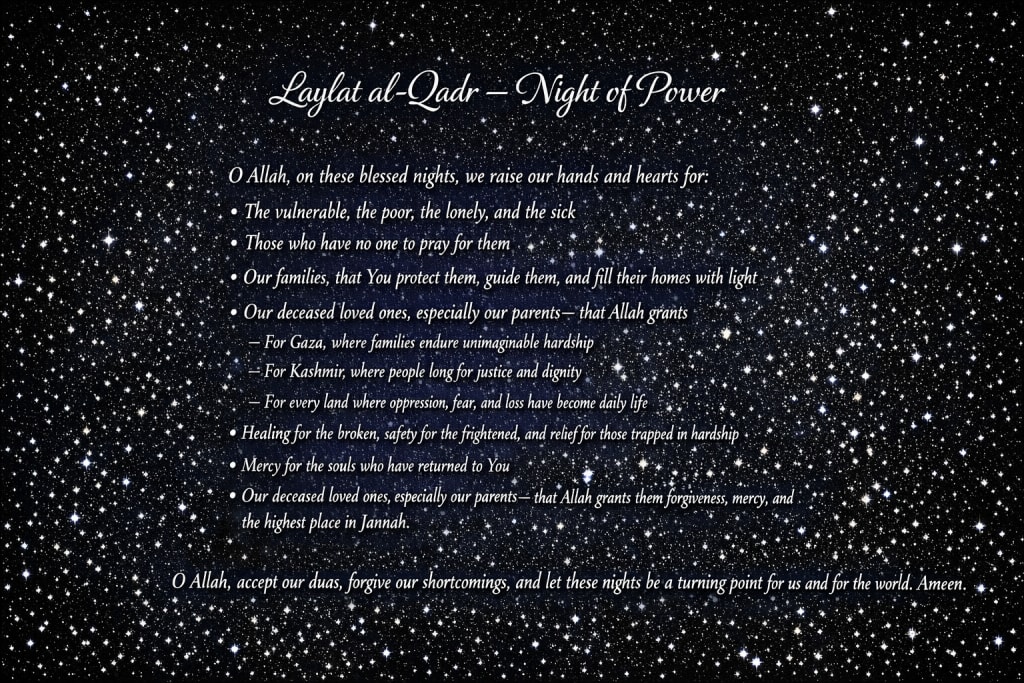
Each night in the last ten nights of Ramadan, we pause to reflect and pray not only for ourselves, but for those struggles often go unseen. This approach invites us to expand our circle of comapssion and make our duas more inclusive and transformative.
What We Pray For
- Our families, that maybe protected, guided and healed.
- Our deceased loved ones, epsecially our parents that Allah Mighty them forgiveness, mercy and the highest place in the Jannah
- The vulnerable, the poor , the poor, the lonely, and the sick
- That mercy, justice and healing reach those who are forgotton
- That our hearts awaken to the needs of others
- That we become vessels of compassion not just in Ramadan, but beyond
- Peace in the world, especially where innocent lives are lost:
- In Gaza, where families endure unimaginale hardship.
- In Kashmir, where people long for justice and dignity.
- In every land where people suffer unseen and unheard.
- Mercy,justice, and healing for those who are forgotten. displaced, or grieving.
- Awakening our hearts that we may become more aware of others' pain and more willing to act.
- Compassion beyond Ramadan that we carry spirit into our daily lives, becoming vessels of kindness and change.
Why It Matters
This approach transform our worship into force of empathy. It remind us that Laylat-ul-Qadar is not only about personal forgiveness, but about collective healing. By praying for others, we become part of the mercy we seek.
Let this be in the Ramadan where our duas reach beyond our needs and touch the lives of those who need them most.
About the Creator
Uzma
Mum, homemaker, and gentle storyteller. I write about motherhood, reflection, and the quiet moments that shape everyday life. I also share some of my writing on Wattpad, exploring simple routines, faith, and personal growth.
Keep reading
More stories from Uzma and writers in Motivation and other communities.
Parents & Travel: How the Journey Changes With Time
We all love travelling. When holidays approach, excitement fills the house. We open our laptops and phones, searching for cheap tickets or the best travel benefits. Some prefer trains, some loves flying, others enjo long drive or even bus journey.
By Uzma26 days ago in Motivation




Comments
There are no comments for this story
Be the first to respond and start the conversation.