
India Fertilizer Market Size and Forecast 2026–2034
Rising Food Demand, Government Support, and Modern Farming Practices Fuel Market Expansion

India’s fertilizer industry is entering a period of steady growth as the country continues to strengthen its agricultural productivity to feed a rapidly growing population. Fertilizers play a vital role in ensuring higher crop yields, improving soil fertility, and supporting sustainable farming practices across the nation.
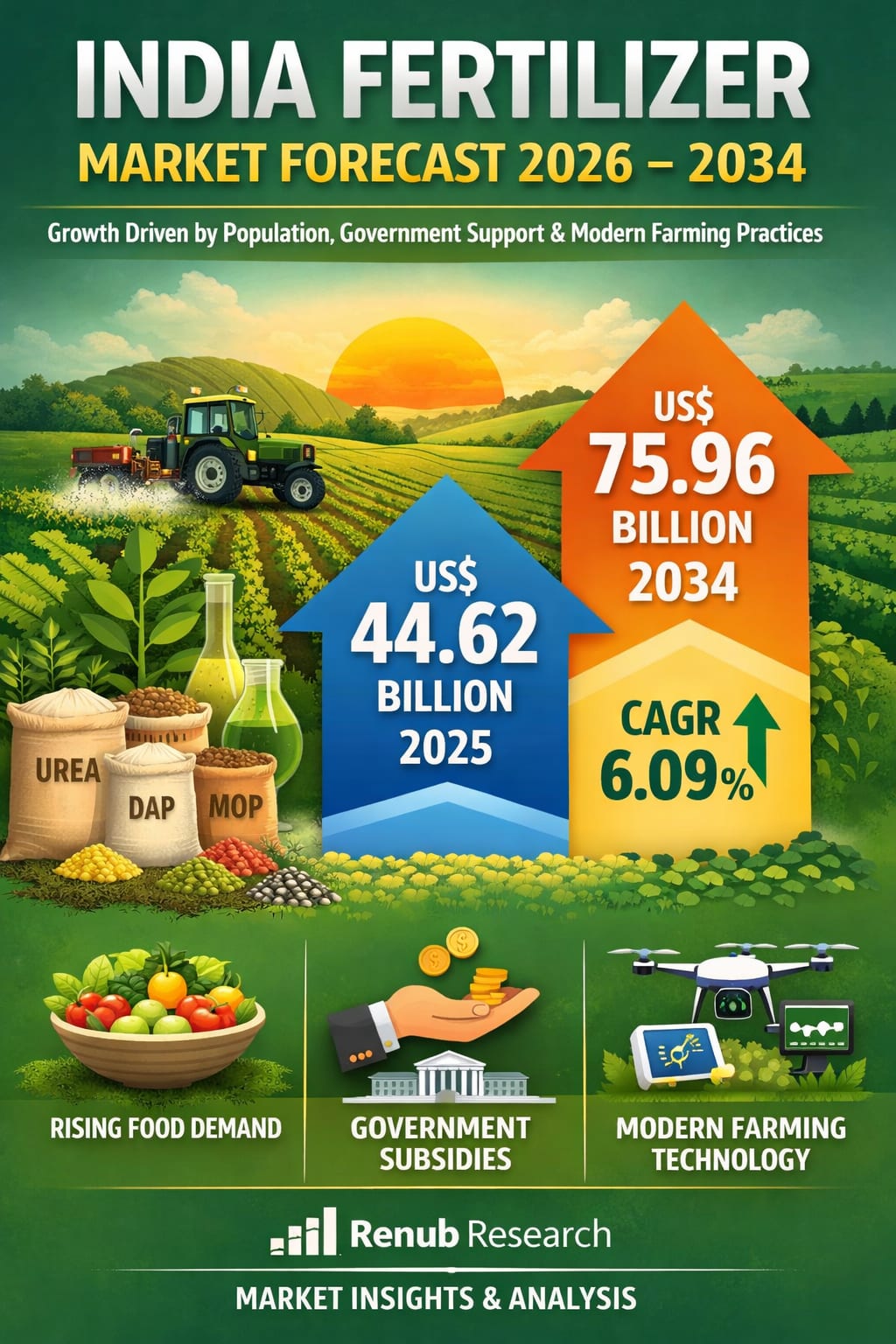
According to market insights from Renub Research, the India Fertilizer Market is expected to grow from US$ 44.62 Billion in 2025 to US$ 75.96 Billion by 2034, expanding at a compound annual growth rate (CAGR) of 6.09% during 2026–2034. The growth is largely driven by rising food demand, increasing population, strong government subsidies, and the adoption of advanced agricultural technologies.
India remains one of the world’s largest agricultural producers, and fertilizers remain a cornerstone of its agricultural strategy. As the country strives to maintain food security while facing limited arable land, fertilizer consumption is expected to remain essential for improving crop productivity.
India Fertilizer Market Outlook
Fertilizers are organic or inorganic substances applied to soil or plants to provide essential nutrients required for healthy crop growth and higher agricultural productivity. These nutrients include nitrogen, phosphorus, potassium, as well as secondary and micronutrients that help improve soil fertility and plant development.
In agriculture, fertilizers are used to boost crop yields, enhance quality, and maintain nutrient balance in the soil. Today, fertilizers are available in various forms, including chemical fertilizers, organic fertilizers, and biofertilizers, each serving specific agricultural requirements.
India’s dependence on agriculture plays a major role in driving fertilizer demand. With a population exceeding 1.4 billion people, the country must constantly increase food production to meet domestic consumption needs. However, limited cultivable land and declining soil fertility require farmers to rely heavily on fertilizers to maintain productivity.
Government initiatives and subsidy programs have further accelerated fertilizer use across India. Additionally, the adoption of modern irrigation systems and improved farming techniques has increased the demand for balanced nutrient application, strengthening the fertilizer market.
Growth Drivers of the Indian Fertilizers Market
Rising Food Demand and Population Growth
One of the strongest growth drivers of the fertilizer market in India is the country’s rapidly expanding population. India recently surpassed China as the world’s most populous nation, with a population exceeding 1.42 billion people.
As the population grows, the demand for staple foods such as cereals, pulses, fruits, and vegetables also increases. However, the availability of cultivable land remains limited. Farmers must therefore produce more food from the same land area, increasing reliance on fertilizers to enhance agricultural productivity.
Fertilizers help replenish soil nutrients lost during repeated cropping cycles. High-yield farming systems require consistent nutrient supply to maintain soil fertility and crop health. As food demand continues to grow, fertilizer consumption remains essential for maintaining stable agricultural output.
Projections suggest that India’s population could reach nearly 1.7 billion by the 2060s, making efficient agricultural production increasingly critical. This trend ensures sustained long-term demand for fertilizers in the country.
Strong Government Support and Subsidy Programs
Government policies and subsidy programs have played a critical role in shaping the fertilizer industry in India. Fertilizers such as urea, diammonium phosphate (DAP), and complex fertilizers are heavily subsidized by the government to make them affordable for farmers.
These subsidies ensure that even small and marginal farmers can access fertilizers at affordable prices, which supports agricultural productivity and food security.
Several government initiatives have strengthened the fertilizer ecosystem, including:
Direct Benefit Transfer (DBT) system for fertilizer subsidies
Soil Health Card Scheme to promote balanced nutrient use
Programs encouraging efficient fertilizer utilization
Policies supporting domestic fertilizer production
Additionally, India has been investing in nano-liquid fertilizers, which offer improved nutrient efficiency and reduced environmental impact. By 2025, the government aims to expand nano fertilizer production through multiple manufacturing plants capable of producing millions of bottles of nano urea and nano DAP annually.
Such initiatives are designed to enhance fertilizer efficiency while reducing excessive chemical usage.
Adoption of Modern Farming Practices and Technology
The growing adoption of modern agricultural practices is another important factor driving fertilizer demand in India. Advanced farming techniques such as precision agriculture, mechanized farming, and improved irrigation systems require balanced nutrient management for optimal crop growth.
Precision agriculture, for example, uses technology to analyze soil conditions and apply fertilizers in the correct quantities. This helps increase yield while minimizing nutrient wastage.
Technological innovation is also helping India develop indigenous fertilizer production capabilities. In August 2025, researchers successfully developed water-soluble fertilizer technology using domestic raw materials, which could significantly reduce dependence on imports.
Such innovations may allow India to move from being a major fertilizer importer to potentially becoming a key exporter of specialized fertilizers in the future.
Key Challenges in the India Fertilizers Market
Imbalanced Fertilizer Usage and Soil Health Degradation
Despite strong market growth, the Indian fertilizer sector faces challenges related to imbalanced fertilizer usage. Farmers often overuse nitrogen-based fertilizers such as urea because they are more heavily subsidized than phosphorus or potassium fertilizers.
This imbalance can negatively affect soil health over time. Excessive nitrogen application can reduce soil fertility, lower crop productivity, and cause environmental damage through nutrient runoff.
To address this issue, the government is promoting balanced nutrient use through soil testing programs and awareness campaigns. Encouraging farmers to adopt integrated nutrient management practices remains a key priority.
Dependence on Imports and Rising Production Costs
India’s fertilizer industry relies heavily on imported raw materials such as phosphates, potash, and natural gas. Fluctuations in global commodity prices and supply chain disruptions can significantly impact fertilizer availability and production costs.
Higher energy costs also increase manufacturing expenses for domestic producers. Although government subsidies help keep fertilizer prices affordable for farmers, they place a substantial burden on public finances.
Reducing import dependence by developing domestic production capacity and alternative technologies remains a critical challenge for the industry.
India Urea Fertilizer Market
The urea fertilizer segment dominates the Indian fertilizer market due to its importance as a primary nitrogen source for crops. Urea is widely used for cultivating cereals, pulses, oilseeds, and various cash crops.
The fertilizer supports strong plant growth and increases agricultural yield, making it an essential input for farmers across the country.
Government subsidies have kept urea prices affordable, encouraging widespread adoption. Additionally, the introduction of neem-coated urea has improved nutrient efficiency and reduced misuse.
Despite concerns about excessive nitrogen usage, urea continues to play a crucial role in India’s agricultural productivity.
India MOP Fertilizer Market
Muriate of Potash (MOP) fertilizers supply potassium, which is essential for plant health, disease resistance, and water regulation. Crops such as sugarcane, fruits, vegetables, and oilseeds rely heavily on potassium-based fertilizers.
However, India does not possess significant potash reserves, making the MOP fertilizer market highly dependent on imports. Government price controls and subsidies help maintain stable supply and affordability.
As farmers become more aware of the importance of potassium for crop quality and yield, MOP fertilizer consumption is expected to increase steadily.
India Cooperative Fertilizer Market
Cooperative institutions play an essential role in distributing fertilizers across India, especially in rural areas. These organizations maintain extensive distribution networks that deliver fertilizers directly to farmers.
Cooperatives prioritize affordability, timely availability, and farmer education. Their strong relationships with farming communities help build trust and ensure equitable access to agricultural inputs.
Government support and integration with agricultural extension programs further strengthen the role of cooperatives in India’s fertilizer ecosystem.
India Public Fertilizer Market
Public sector companies are an important component of the fertilizer industry in India. These government-backed enterprises ensure stable fertilizer production and supply across the country.
Public sector fertilizer manufacturers receive financial and policy support from the government, enabling them to maintain affordable pricing and consistent supply. Their role is especially critical for ensuring national food security.
India Private Fertilizer Market
Private sector companies contribute to the fertilizer industry through innovation, operational efficiency, and product diversification. Many private firms focus on producing specialty fertilizers, micronutrients, and advanced nutrient solutions.
These companies also invest in expanding distribution networks and introducing new agricultural technologies. As farmers increasingly seek balanced nutrient solutions, private sector participation is expected to grow.
Regional Insights: Fertilizer Demand Across Indian States
Punjab
Punjab is often referred to as the “breadbasket of India” due to its large-scale wheat and rice production. Intensive agriculture and extensive irrigation systems make fertilizers essential for maintaining high yields.
Urea and DAP remain the most commonly used fertilizers in the state, although concerns over soil degradation have led to increased soil testing initiatives.
Uttar Pradesh
Uttar Pradesh has one of the largest agricultural areas in India and produces crops such as wheat, rice, sugarcane, pulses, and oilseeds. High population density and strong food demand encourage intensive farming practices, increasing fertilizer consumption.
Government subsidy programs and widespread distribution networks ensure fertilizer availability across rural regions.
Madhya Pradesh
The fertilizer market in Madhya Pradesh is expanding due to crop diversification and improved farming techniques. The state is a major producer of soybeans, wheat, pulses, and oilseeds.
Expanding irrigation systems and government initiatives such as soil health cards are encouraging balanced fertilizer use.
Tamil Nadu
Tamil Nadu’s fertilizer demand is driven by intensive farming practices and the cultivation of crops such as rice, sugarcane, cotton, and fruits. Limited arable land has increased cropping intensity, which requires consistent nutrient supply.
Growing awareness about balanced fertilizer application is also boosting demand for specialty fertilizers.
Key Companies in the India Fertilizer Market
Several major companies operate within the Indian fertilizer industry, contributing to production, innovation, and distribution.
Key players include:
Nagarjuna Fertilizers and Chemicals Ltd.
Chambal Fertilisers & Chemicals Ltd.
Rashtriya Chemicals & Fertilizers Limited
National Fertilizers Ltd.
Coromandel International Ltd.
These companies compete through product innovation, expansion strategies, and improved supply chain capabilities to strengthen their market position.
Final Thoughts
India’s fertilizer market is poised for steady expansion as the country continues to prioritize food security and agricultural productivity. Rising population, strong government support, and increasing adoption of modern farming techniques are expected to drive long-term growth.
At the same time, addressing challenges such as soil health degradation and import dependence will be crucial for maintaining sustainable growth in the fertilizer industry.
With continued investment in advanced fertilizers, domestic manufacturing capabilities, and precision agriculture, India’s fertilizer market is set to play a critical role in shaping the future of the country’s agricultural economy.
About the Creator
Sakshi Sharma
Content Writer with 7+ years of experience crafting SEO-driven blogs, web copy & research reports. Skilled in creating engaging, audience-focused content across diverse industries.
Keep reading
More stories from Sakshi Sharma and writers in Trader and other communities.
Saudi Arabia In-Vitro Diagnostics Market Size and Forecast 2026–2034
Introduction Healthcare systems across the globe are evolving rapidly as countries prioritize early diagnosis, disease prevention, and improved treatment outcomes. In this transformation, in-vitro diagnostics (IVD) plays a critical role by enabling healthcare professionals to detect diseases quickly and accurately using laboratory tests performed on biological samples.
By Sakshi Sharma2 days ago in Trader




Comments
There are no comments for this story
Be the first to respond and start the conversation.