
India Spice Market Size & Forecast 2026–2034
Growing Domestic Consumption, Global Demand for Indian Cuisine, and Food Processing Expansion Fuel Market Growth

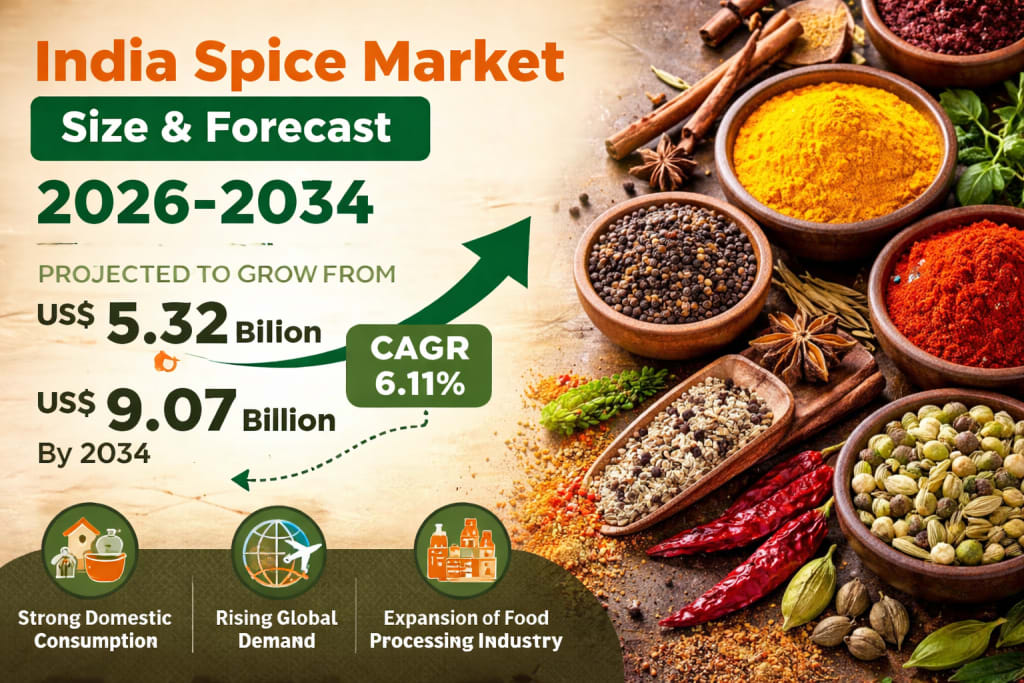
India’s long-standing reputation as the “Land of Spices” continues to strengthen as demand rises both domestically and internationally. According to Renub Research, the India Spice Market is projected to grow from US$ 5.32 billion in 2025 to US$ 9.07 billion by 2034, expanding at a compound annual growth rate (CAGR) of 6.11% between 2026 and 2034.
This steady growth reflects a combination of factors including the country’s strong culinary traditions, expanding food processing industry, rising urban consumption patterns, and increasing global popularity of Indian cuisine. As health-conscious consumers seek natural ingredients and authentic flavors, spices are gaining renewed importance not only as flavoring agents but also as functional food ingredients with medicinal benefits.
India is already recognized as the largest producer, consumer, and exporter of spices globally, and its influence in the global spice trade is expected to grow significantly over the coming decade.
India Spice Market Outlook
Spices are plant-based ingredients obtained from seeds, roots, bark, fruits, or flowers and are widely used to enhance the flavor, aroma, and color of food. Popular Indian spices include turmeric, cumin, coriander, cardamom, black pepper, and cloves, which are essential components of everyday cooking.
Beyond culinary use, spices are valued for their medicinal, preservative, and health-enhancing properties. Many spices possess antioxidant, antimicrobial, and anti-inflammatory characteristics, making them highly attractive in the modern wellness-driven food market.
Indian cuisine, known worldwide for its complex flavors and aromatic spice blends such as garam masala and curry powder, heavily relies on these ingredients. Each region of India has its own unique spice combinations, reflecting cultural diversity and culinary innovation.
India’s favorable climate and diverse agricultural zones allow the cultivation of numerous spice varieties, strengthening the country's dominance in global spice production. Combined with the rapid growth of packaged food products and international demand for Indian flavors, the spice industry is becoming an increasingly important contributor to the country’s food economy.
Growth Drivers of the India Spice Market
Strong Domestic Consumption and Cultural Importance
One of the most powerful growth drivers of the India spice market is the country’s deeply rooted culinary culture. Spices are essential ingredients in almost every Indian dish, providing distinctive flavor, aroma, and color.
Each Indian state has its own unique cooking style and spice combinations, which ensures consistent demand across the country. From North Indian garam masala blends to South Indian curry spices, regional diversity keeps the domestic spice market vibrant.
The rising population and growing middle class are further strengthening demand. Increasing disposable income allows consumers to purchase premium and branded spice products, including organic varieties and specialty blends.
Urbanization has also transformed food consumption patterns. Busy lifestyles have increased the demand for ready-to-cook spice mixes and packaged seasoning products, offering convenience without compromising taste.
Additionally, the surge in home cooking—particularly during and after the pandemic—encouraged households to experiment with different spice blends, boosting retail spice sales.
The expanding food processing industry is another contributor, as spices are essential ingredients in packaged snacks, sauces, ready meals, and processed foods.
Growing Export Demand and Global Popularity of Indian Spices
India’s spice industry is strongly export-oriented, supplying high-quality spices to markets worldwide. Products such as turmeric, cumin, black pepper, and cardamom are particularly popular in international markets due to their rich flavor and health benefits.
The increasing global demand for ethnic cuisines, particularly Indian and Asian food, has significantly expanded the export potential of Indian spices.
Health awareness has also played a key role in boosting global demand. Spices like turmeric and black pepper are widely recognized for their medicinal benefits, including anti-inflammatory and antioxidant properties.
Major importers of Indian spices include North America, Europe, the Middle East, and Asia. Government initiatives supporting agricultural exports and improved logistics infrastructure are further strengthening India’s position in the global spice trade.
As of FY25 (up to December 2024), India exported spices and spice products to around 200 countries worldwide. The top ten importing nations—including China, the United States, UAE, Bangladesh, Thailand, Malaysia, the UK, Saudi Arabia, Indonesia, and Germany—accounted for more than 60% of total export earnings.
The growing global food processing industry and rising demand for natural ingredients are expected to create further opportunities for Indian spice exporters.
Expansion of Food Processing Industry and Organized Retail
India’s rapidly expanding food processing industry and organized retail sector are playing a crucial role in boosting the spice market.
Demand for processed food products—including ready-to-eat meals, frozen foods, sauces, snacks, and instant mixes—has grown significantly in recent years. These products rely heavily on high-quality spices and seasoning blends.
Food manufacturers increasingly use processed and blended spices to maintain consistent taste and quality in packaged products.
At the same time, the expansion of supermarkets, hypermarkets, and e-commerce platforms has improved consumer access to branded spice products. Packaged spices are becoming more popular because they offer better hygiene, standardized quality, and longer shelf life compared to loose spices sold in traditional markets.
Many leading spice brands are introducing innovative products such as ready-to-cook spice mixes, organic spices, and specialty seasoning blends.
A major industry development occurred in June 2025, when ITC acquired Sresta Natural Bioproducts, the owner of 24 Mantra Organic, for ₹472.50 crore, strengthening its presence in the organic food segment.
These developments demonstrate how modernization of retail and food manufacturing is transforming India’s spice market.
Challenges in the India Spice Market
Price Volatility and Weather Dependence
Despite strong growth prospects, the spice industry faces several challenges. One of the most significant is price volatility caused by changing weather conditions.
Spice cultivation heavily depends on climate patterns, particularly the monsoon season. Extreme weather events such as droughts, floods, or unseasonal rainfall can significantly affect crop yields.
This imbalance between supply and demand often leads to fluctuations in spice prices, affecting farmers, manufacturers, and exporters.
Since a large portion of spice production is handled by small-scale farmers, they are particularly vulnerable to climate risks.
In addition, rising input costs—such as fertilizers, labor, and transportation—have increased overall production costs, placing further pressure on the industry.
Quality Issues and Lack of Standardization
Maintaining consistent quality standards remains another challenge in India’s spice industry.
Improper handling, storage, and processing can affect spice quality, especially when products are exported to international markets with strict safety regulations.
Small-scale producers often lack modern processing facilities and quality management systems, which can lead to inconsistencies in product standards.
Non-compliance with international food safety regulations may result in shipment rejections in export markets.
To address these challenges, the industry must invest in better processing infrastructure, quality control systems, and farmer education programs.
Key Product Segments Driving the Market
Chilies Spice Market
India is one of the world’s largest producers and exporters of chilies. Major chili-producing states include Andhra Pradesh, Telangana, Karnataka, and Maharashtra.
Chilies are widely used in Indian cuisine to add spice, color, and flavor to dishes. Indian chili varieties are highly valued globally due to their strong flavor and vibrant color.
Increasing exports to markets in Asia, Europe, and North America are driving growth in the chili spice segment.
Pepper Spice Market
Black pepper, often referred to as the “king of spices,” holds an important place in both domestic and international markets.
Major pepper-producing regions include Kerala, Karnataka, and Tamil Nadu. The spice is widely used in cooking, pharmaceuticals, and herbal remedies.
Growing health awareness and demand for natural ingredients are increasing global consumption of pepper.
Meat and Poultry Spice Products
Demand for meat and poultry spice blends is rising rapidly due to increasing meat consumption and the popularity of ready-to-cook products.
Popular spice blends include chicken masala, tandoori masala, and meat curry masala.
The expansion of quick-service restaurants, hotels, and packaged food companies is further boosting demand for these seasoning blends.
Frozen Food Spice Market
The frozen food segment is expanding quickly as urban consumers seek convenient meal solutions.
Spices play a critical role in maintaining the authentic taste and aroma of frozen meals such as curries, snacks, and ready-to-cook products.
Advancements in cold storage infrastructure and the rise of online grocery platforms are supporting this segment’s growth.
Spice Powder Market
The spice powder segment is experiencing strong growth due to its convenience and ease of use.
Popular products include turmeric powder, chili powder, cumin powder, and coriander powder.
Consumers prefer spice powders because they save preparation time while maintaining consistent flavor.
Improved packaging, longer shelf life, and quality assurance are encouraging consumers to choose branded spice powder products.
Regional Insights: Key Spice Markets in India
Maharashtra
Maharashtra is a major spice-producing state known for crops such as turmeric, chili, coriander, and cumin. Regions like Sangli and Kolhapur are famous for their high-quality spice production.
The presence of food processing industries and packaging companies also contributes to market growth in the state.
Uttar Pradesh
With its large population and growing retail infrastructure, Uttar Pradesh represents a major consumption hub for spices.
The state’s expanding supermarket network and improving transportation systems have strengthened its position as an important distribution center.
West Bengal
West Bengal’s spice market is driven by strong culinary traditions and growing demand for packaged spices.
Spices such as mustard, cumin, turmeric, and chilies are widely used in Bengali cuisine.
The state’s well-developed logistics infrastructure also makes it an important trading hub for eastern India.
Rajasthan
Rajasthan plays a key role in spice production and exports. The state produces cumin, coriander, fennel, fenugreek, and chili.
Cities like Jodhpur and Kota are major spice trading centers, contributing significantly to India’s domestic and export spice markets.
Competitive Landscape
Several well-known companies dominate India’s organized spice industry. These companies are expanding their product portfolios, improving packaging technology, and strengthening distribution networks.
Key companies operating in the India spice market include:
Aachi Spices & Foods Pvt Ltd
Badshah Masala
Eastern Condiments Private Limited
Mahashian Di Hatti Private Limited (MDH)
MTR Foods Pvt Ltd.
Patanjali Ayurved Limited
DS Group (Catch)
Ushodaya Enterprises Pvt. Ltd. (Priya)
These companies compete through product innovation, brand recognition, and expanding retail presence.
Final Thoughts
India’s spice industry stands at the intersection of tradition and modernization. While spices have been an integral part of Indian culture for centuries, the sector is now evolving rapidly due to technological advancements, organized retail expansion, and growing international demand.
With strong domestic consumption, increasing exports, and the rising popularity of packaged and organic spices, the India Spice Market is set for sustained growth through 2034.
If the industry continues to improve quality standards, invest in processing infrastructure, and support farmers with modern agricultural practices, India will likely maintain—and even strengthen—its position as the global leader in the spice trade.
About the Creator
Sakshi Sharma
Content Writer with 7+ years of experience crafting SEO-driven blogs, web copy & research reports. Skilled in creating engaging, audience-focused content across diverse industries.
Keep reading
More stories from Sakshi Sharma and writers in Trader and other communities.
Global Vacuum Truck Market Size & Forecast 2026–2034
Introduction The global vacuum truck market is witnessing steady growth as governments, municipalities, and industries place greater emphasis on sanitation, environmental safety, and efficient waste management. Vacuum trucks play a critical role in collecting, transporting, and disposing of liquid, sludge, slurry, and hazardous waste materials. These specialized vehicles are widely used in municipal sanitation systems, wastewater treatment plants, construction projects, and industrial operations.
By Sakshi Sharmaabout 6 hours ago in Trader
Australia Fertilizer Market Growth, Forecast, and Strategic Insights 2034
Fertilizers play a crucial role in modern agriculture by supplying essential nutrients that enhance crop productivity and soil health. In Australia, where agriculture remains a cornerstone of the national economy, fertilizers are widely used to maintain soil fertility and support the cultivation of grains, oilseeds, fruits, vegetables, and other crops.
By Rashi Sharmaa day ago in Trader



Comments
There are no comments for this story
Be the first to respond and start the conversation.