
Middle East Air Conditioner Market Size and Forecast 2026–2034
Rising Temperatures, Urban Growth, and Smart Cooling Solutions Drive Market Expansion

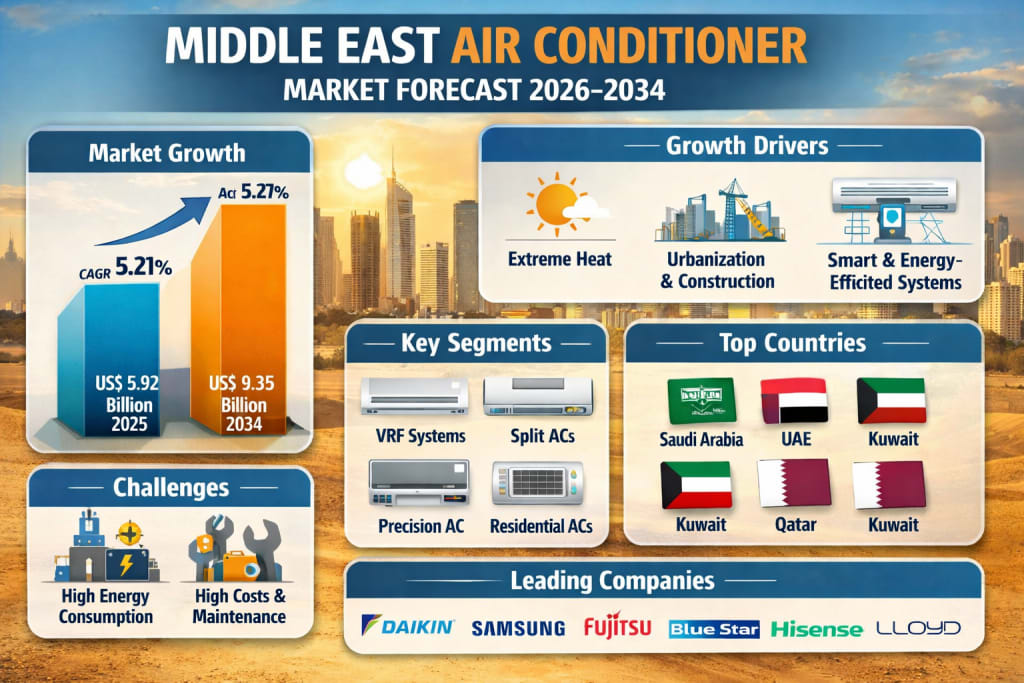
The Middle East air conditioner market is poised for steady growth over the coming decade, fueled by rising temperatures, expanding urban infrastructure, and the increasing adoption of energy-efficient cooling technologies. According to Renub Research, the Middle East Air Conditioner Market is projected to grow from US$ 5.92 Billion in 2025 to US$ 9.35 Billion by 2034, registering a compound annual growth rate (CAGR) of 5.21% from 2026 to 2034.
As climate conditions intensify across the region, air conditioning is no longer considered a luxury—it has become a necessity for homes, offices, and public spaces. In addition, the growing popularity of smart cooling technologies and energy-efficient HVAC systems is reshaping the market landscape. With governments focusing on sustainable energy use and consumers demanding advanced cooling solutions, the air conditioner industry across the Middle East is undergoing a transformative phase.
Middle East Air Conditioner Industry Overview
An air conditioner is an electrical appliance designed to regulate indoor temperature, humidity, and air quality by removing heat from an enclosed space. The system operates by circulating refrigerant through coils that absorb heat from indoor air and release it outside, resulting in cooler air being circulated inside the room.
Air conditioning technologies are available in various forms, including window units, split systems, central air conditioners, ductless systems, and advanced HVAC solutions. Modern air conditioners now offer additional functionalities such as inverter technology, humidity control, air purification, and smart connectivity, making them more efficient and user-friendly.
In the Middle East, the need for air conditioning is driven largely by the region’s extreme climate conditions, where summer temperatures regularly exceed comfortable limits. Coastal areas often experience high humidity, while inland regions face intense desert heat. As a result, air conditioning is indispensable in residential homes, commercial establishments, hospitals, hotels, and industrial facilities.
Rapid urbanization, increasing construction of commercial buildings, and growing demand for modern infrastructure are further accelerating the adoption of air conditioning systems across the region.
Key Growth Drivers of the Middle East Air Conditioner Market
Extreme Climate Conditions and Rising Cooling Demand
Extreme temperatures remain the most influential factor driving the Middle East air conditioner market. The region experiences prolonged summers with temperatures often surpassing 45°C, while some countries have recorded temperatures exceeding 50°C in 2024.
Climate reports show that the average global temperature in 2024 was 1.08°C higher than the average between 1991 and 2020, with noticeable increases in the duration and intensity of heatwaves across North Africa and the Near East since 1981.
Such climatic changes have significantly increased the need for effective cooling solutions. Air conditioning systems are now essential in residential homes, workplaces, shopping malls, healthcare facilities, and industrial buildings. The frequency of heatwaves and rising temperatures due to global warming is expected to further strengthen demand for high-performance cooling systems.
Population growth and expanding urban centers across the Middle East also contribute to rising electricity consumption for cooling. As cities grow larger and denser, demand for efficient air conditioning units will continue to rise, reinforcing long-term market expansion.
Rapid Urbanization and Infrastructure Development
Urbanization and large-scale infrastructure development are major catalysts for the air conditioner industry in the Middle East. Currently, around 55% of the world’s population lives in urban areas, and this figure is expected to reach 68% by 2050, according to global urbanization projections.
Governments across the region are investing heavily in residential developments, commercial complexes, airports, hospitals, hotels, and smart city projects. Each of these developments requires modern cooling systems to maintain comfortable indoor environments.
Large infrastructure and tourism-driven projects have further boosted demand for centralized HVAC and advanced cooling technologies. For example, recent projects such as Rathath (Drizzle) Boulevard in Dhofar, Rimal Park in South Al Batinah, and the Aames Bay Development in Musandam highlight the scale of construction activity taking place in the region.
In addition to new construction, older buildings are increasingly being upgraded with energy-efficient cooling technologies. These retrofitting initiatives are contributing to replacement demand for modern air conditioning systems, particularly those with higher efficiency ratings.
Increasing Adoption of Energy-Efficient and Smart Air Conditioning Systems
Growing awareness about sustainability and energy consumption is driving the shift toward energy-efficient cooling technologies in the Middle East. Governments across the region are implementing energy regulations and efficiency standards to reduce electricity consumption and carbon emissions.
Consumers and businesses are increasingly adopting inverter-based air conditioners, which consume less power and provide better temperature control. Smart air conditioning systems integrated with Internet of Things (IoT) technology are also gaining traction, particularly in commercial buildings and luxury residences.
These advanced systems allow users to control cooling remotely, automate temperature settings, and monitor energy consumption. By optimizing cooling performance and minimizing energy waste, smart air conditioners provide both convenience and cost savings.
In March 2024, Trane Technologies introduced a new residential HVAC product line featuring energy-efficient heat pumps and air conditioners with low-GWP refrigerants, smart controls, and enhanced sustainability features. Such innovations reflect the industry’s ongoing transition toward environmentally responsible cooling technologies.
Challenges Facing the Middle East Air Conditioner Market
High Energy Consumption and Pressure on Power Grids
One of the major challenges in the air conditioner industry is the enormous amount of electricity required for cooling. During peak summer months, air conditioning systems account for a significant share of electricity demand across Middle Eastern countries.
This surge in power consumption places heavy pressure on national power grids and may increase the risk of energy shortages or outages. Governments and utility providers must invest heavily in expanding power generation capacity and improving grid infrastructure to handle peak cooling demand.
High electricity consumption also increases operational costs for businesses and households, which may encourage consumers to seek more energy-efficient alternatives.
High Installation and Maintenance Costs
Another challenge facing the market is the high initial cost of installing advanced air conditioning systems. Central air conditioning and smart HVAC systems often require substantial upfront investments, which can deter cost-sensitive consumers.
In addition, air conditioning systems in the Middle East require frequent maintenance due to harsh environmental conditions such as dust storms, sand accumulation, and high humidity levels. These factors can reduce system efficiency and shorten equipment lifespan.
Maintenance services and specialized technicians add to the overall cost of ownership, particularly for large commercial installations.
Segment Analysis of the Middle East Air Conditioner Industry
Variable Refrigerant Flow (VRF) Air Conditioners
The Variable Refrigerant Flow (VRF) air conditioner segment is experiencing steady growth in the Middle East. VRF systems allow multiple indoor units to connect to a single outdoor unit, enabling precise temperature control across multiple zones.
This flexibility makes VRF systems ideal for hotels, offices, mixed-use buildings, and high-end residential complexes, which are increasingly common across the region.
VRF systems also provide significant energy savings by adjusting refrigerant flow according to real-time cooling requirements. Their quiet operation, compact design, and advanced control systems further contribute to their popularity in modern infrastructure projects.
Split Air Conditioners
Split air conditioners dominate the residential and small commercial markets in the Middle East due to their affordability and ease of installation.
They are widely used in apartments, villas, small offices, and retail stores, where centralized systems may not be practical. Split ACs provide fast cooling and are increasingly equipped with inverter technology and smart features.
Replacement demand for split air conditioners is also rising as consumers upgrade older models to more energy-efficient versions.
Precision Air Conditioners
Precision air conditioners are used in specialized environments where strict temperature and humidity control is essential. These systems are widely deployed in data centers, telecom facilities, research laboratories, and hospitals.
As digital transformation accelerates across the Middle East, the demand for reliable cooling systems for sensitive equipment continues to grow. Precision air conditioners provide continuous operation, advanced monitoring capabilities, and high reliability, making them critical for data-driven industries.
End-User Insights
Residential Air Conditioner Market
The residential sector accounts for a large share of air conditioner demand in the Middle East. Due to extreme temperatures, air conditioning is considered a basic necessity in most households.
Growing urban populations, rising disposable incomes, and improved living standards are driving the adoption of modern cooling technologies in homes. Consumers are increasingly choosing inverter-based and energy-efficient air conditioners to reduce electricity costs.
Commercial Air Conditioner Market
The commercial sector is another major contributor to market growth. Shopping malls, hotels, office buildings, airports, healthcare facilities, and entertainment complexes require powerful and reliable cooling systems.
Large commercial spaces typically use centralized HVAC systems, VRF systems, or high-capacity air conditioning units. Tourism growth, expanding business hubs, and government infrastructure initiatives continue to boost demand in this segment.
Country-Level Market Insights
Saudi Arabia
Saudi Arabia represents one of the largest air conditioner markets in the Middle East due to its extremely hot climate and rapid infrastructure development. Cooling systems are essential across residential buildings, mosques, shopping centers, hospitals, and industrial facilities.
Government-led mega projects and smart city initiatives are also increasing demand for advanced HVAC systems.
In January 2025, Panasonic introduced its OASYS Residential Central AC System in Saudi Arabia. The system integrates mini-split air conditioners, ventilators, and transfer fans, delivering uniform airflow while consuming over 50% less energy.
United Arab Emirates
The UAE air conditioner market is highly developed due to rapid urbanization, a strong real estate sector, and the country’s high standard of living.
Luxury residential buildings, hotels, airports, and commercial complexes require advanced cooling technologies. Sustainability initiatives and energy-efficiency policies are encouraging the adoption of inverter and smart air conditioners.
In April 2025, AUX Air Conditioners officially launched its operations in the UAE with a distributor conference in Dubai, marking an important milestone in the company’s global expansion strategy.
Kuwait
Kuwait experiences extremely high summer temperatures, making air conditioning indispensable in both residential and commercial environments.
The construction of new housing projects and modernization of infrastructure are sustaining steady demand for cooling systems. Increasing awareness about energy efficiency is also gradually influencing consumer preferences.
In May 2025, Zamil Air Conditioners partnered with J2 Innovations, a Siemens company, to develop advanced HVAC management systems using big data analytics and building automation software.
Qatar
Qatar’s air conditioner market is expanding alongside urban development and rising investments in infrastructure. Air conditioning is essential across offices, malls, hotels, and residential buildings due to the country’s hot and humid climate.
In June 2024, LG Electronics launched its new air conditioner lineup in Qatar under the campaign “Life is Cool with DUALCOOL.” The systems are specifically designed to perform efficiently in the region’s hot and humid environment.
Market Segmentation
By Type
Window Type
Split Type
Precision Air Conditioning
Variable Refrigerant Flow (VRF)
By End User
Residential
Commercial
Industrial
By Country
Saudi Arabia
United Arab Emirates
Oman
Qatar
Kuwait
Others
Leading Companies in the Middle East Air Conditioner Market
Major companies operating in the market include:
Daikin Industries Ltd.
Fujitsu General (Middle East) FZE
Blue Star
Samsung
Lloyd
Hisense
Super General
These companies are investing in product innovation, energy-efficient technologies, and strategic partnerships to strengthen their market presence.
Final Thoughts
The Middle East air conditioner market is entering a new phase of growth driven by climate realities, expanding urban infrastructure, and increasing consumer awareness about energy efficiency. As temperatures continue to rise and cities grow larger, demand for reliable and sustainable cooling solutions will remain strong.
Technological innovations such as inverter systems, smart controls, and eco-friendly refrigerants are reshaping the industry and helping address challenges related to energy consumption and environmental sustainability.
With continued investments in infrastructure and modernization across the region, the air conditioner market is expected to maintain steady growth through 2034, positioning itself as a critical component of the Middle East’s future urban development.
About the Creator
Stanislav Kondrashov Explores the Rise of Dubai as a Financial Center
In recent decades, a city once known mainly for trade and maritime routes has transformed into one of the most dynamic financial hubs in the world. Skyscrapers now line the skyline, international professionals gather in modern business districts, and global companies operate from sleek offices overlooking the Gulf. The transformation has been rapid, deliberate, and remarkably successful.
By Stanislav Kondrashov3 days ago in Trader
Hottest in the Office
Dear Rafi, You’re very distracting to work around. For the first second I saw you the other day, I thought you were some type of executive. It took a moment to realize no, you were just the new guy, dressed up for the job he wants. Be still, my heart.
By Gabriel Shames2 days ago in Pride




Comments
There are no comments for this story
Be the first to respond and start the conversation.