
I Chose Self-Publishing Because 70% Royalties Sounded Better. Then 70% Of Zero Changed My Mind.
Self-publishing vs traditional publishing: what I actually lost, what I actually gained, and how to make this decision instead of assuming one path is obviously right.

I have a self-published book, and it was a flop. Only sold 10 copies type of flop.
But I didn't choose self-publishing after careful consideration of both paths. I chose it because it seemed obviously better, and I didn't want to interrogate that assumption.
When I listed the pros and cons, self-publishing won every category. Full control. Higher royalties. Faster timeline. No gatekeepers. No querying. No waiting eighteen months for someone to decide my book deserved to exist.
And traditional publishing looked like a slow, gatekept, low-royalty relic that existed mainly to make agents feel important.
Then 1 Lovelock Drive sold ten copies, and I understood, with the clarity that only failure provides, that I hadn't been weighing pros and cons at all.
I'd been confirming a decision I'd already made.
The advantages of self-publishing are real. Every single one I listed was accurate. But I hadn't considered what I was giving up.
And the things I gave up turned out to matter more than I expected.
What I Lost
I lost professional infrastructure.
Traditional publishers provide authors with a team. They give you a developmental editor who's worked on hundreds of books, a cover designer who understands genre visual language, a copyeditor, a proofreader, a marketing department, and a distribution network.
I had to assemble all of this myself, with my own money, using my own judgment about quality.
My judgment was bad. I hired a copyeditor when I needed a developmental editor. I created the book cover myself, which turned out well, but didn't hold a candle to other professional covers. I had no marketing plan beyond a few Instagram posts and hope.
A traditional publisher wouldn't have let me make any of those mistakes, because making those decisions is their job, and they've done it thousands of times.
I spent over three thousand dollars on editing and cover design (a graphic designer to help me create the graphics). A traditional publisher would have provided better versions of both for free, because the cost is absorbed by the publisher as an investment in the book's commercial success.
I lost distribution.
1 Lovelock Drive exists on Amazon. That's it.
It's not in bookshops. It's not in libraries. It's not in airport terminals, supermarket book sections, or subscription boxes.
A traditionally published book has access to physical retail channels that self-published books functionally don't.
For some genres, this matters less. Romance readers buy primarily online. But even within online retail, traditional publishers have relationships with retailers, placement opportunities, and promotional infrastructure that individual authors can't access.
I lost credibility.
I don't agree with this bias, but it exists: "traditionally published" still carries weight that "self-published" doesn't.
For speaking opportunities, teaching positions, literary awards, media coverage, and professional recognition, the traditional publishing credential opens doors that self-publishing doesn't.
The bias is eroding, but it hasn't disappeared.
I lost advance money.
Traditional publishers pay an advance against future royalties. Even modest debut advances of five to ten thousand dollars are guaranteed money before the book earns a penny in sales.
I received nothing upfront. I spent thousands to publish. My financial position before any sales: negative.
I lost external validation.
When a traditional publisher accepts your book, they're investing real money because they believe it can succeed commercially.
That investment is a signal to the market: this book has been vetted by professionals who stake their reputation and finances on their judgment.
Self-published books carry no such signal. Readers have no external indicator of quality before they open the book.
My book had to earn trust from zero.
What I Gained With Self-Publishing
I gained complete creative control.
I chose the cover, title, price, description, categories, and publication date. Nobody told me to change the ending, soften a character, or retitle for market appeal.
For better or worse, the book is exactly what I wanted it to be.
For the worse, as it turned out. Because some of the decisions I'd have been told to change were decisions that needed changing.
Complete control is powerful when your judgment is good. It's dangerous when it isn't.
I gained speed.
Traditional publishing takes one to two years from acceptance to publication. I went from finished manuscript to published book in under five months.
I was impatient, and self-publishing accommodated my impatience. Whether that impatience served the book is another question.
I gained higher royalties per copy.
Amazon pays 70% royalty on ebooks priced between $2.99 and $9.99. Traditional publishers pay 10–15% of the cover price for print, 25% of the net for ebooks. The per-copy maths favours self-publishing dramatically.
But per-copy royalties are meaningless without copies sold.
70% of 10 copies is less than 15% of 1,000.
I'd focused on the percentage and ignored the volume. The royalty advantage is real. It only materialises if readers find the book.
I gained the ability to publish at all.
Traditional publishing requires writing a book that an agent believes they can sell, finding that agent through a process with a success rate in the single digits, and then the agent sells it to a publisher.
This process takes years and fails for most writers.
Self-publishing requires uploading a file. My book exists because I chose to publish it, not because someone gave me permission.
I gained an education.
I learned how publishing actually works. Categories, keywords, algorithms, pricing strategy, metadata, launch mechanics, ad platforms, review culture and discoverability.
If a traditional publisher had handled everything, I'd know none of this. Now I understand the business.
That understanding is shaping everything about how my second novel will launch.
The Question That Actually Matters
The question isn't which path is better. It's about which trade-offs you can live with.
Traditional publishing trades speed and control for infrastructure, distribution, credibility, and guaranteed income. You wait longer. You compromise more. But you get a team, a signal, and money upfront.
Self-publishing trades infrastructure and credibility for speed, control, and higher per-copy earnings. You move faster. You decide everything. But you fund everything, build everything, and carry the full risk yourself.
I chose self-publishing for the right reasons, but I executed it poorly. The path wasn't the problem; my execution was.
What I'm Doing Differently
My second novel will be self-published. It will be the same path but an entirely different execution.
I'm building an audience before the book exists. This article series, the email list, the platform - all of it is pre-launch infrastructure that 1 Lovelock Drive never had.
I'm hiring a developmental editor first, not a copyeditor.
I'm briefing a genre-specific cover designer with market references, not personal preferences.
I'm planning a three-month launch campaign with advance readers, strategic pricing, and sustained post-launch visibility.
I'm not changing the path. I'm becoming the professional infrastructure that traditional publishing would have provided.
The difference between self-publishing well and self-publishing badly is the difference between running a business and uploading a file. I uploaded a file last time. This time, I'm running a business.
Self-publishing isn't the easier path. It's the path where everything is your responsibility. If you're willing to take that responsibility seriously, it works. If you're not, it produces ten copies and silence.
I know which version I'm choosing this time.
---
I write about the emotional and practical reality of being a writer - drafting, doubt, discipline, and publishing while still figuring it out.
Mostly for people who write because they have to, need to, want to | linktr.ee/ellenfranceswrites
About the Creator
Ellen Frances
Daily five-minute reads about writing — discipline, doubt, and the reality of taking the work seriously without burning out. https://linktr.ee/ellenfranceswrites
Keep reading
More stories from Ellen Frances and writers in Writers and other communities.
Nobody In Any Classroom Ever Said, "What If No One Reads My Book?"
I studied English in school. Drama and Theatre at university, with English electives and a screenwriting module. After graduating, I took multiple skills-based writing courses - copywriting, content strategy, and freelance writing. I've been formally educated in words from every angle the system offers.
By Ellen FrancesExclusive • 8 days ago
Early March 2026: 4 Goals Accomplished
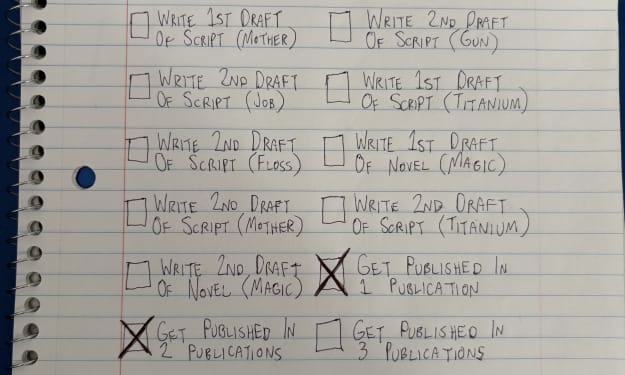
It's early March and I've now accomplished my 4th writing goal for the year of 2026. Before diving into the behind-the-scenes of it... why not tell you up front what that accomplishment was? I was published in a 2nd publication for this year. Published in Helix Literary Magazine out of Central Connecticut State University. You can read it for free right now!
By Stephen Kramer Avitabile7 days ago in Writers
The Future of Fixation: Exploring Advanced Maxillofacial Implants
Maxillofacial surgery has changed significantly over the last two decades. Earlier, fracture management and reconstructive procedures were more invasive, recovery was longer, and implant options were limited. Today, surgeons have access to advanced maxillofacial implants that are more precise, lighter, and biologically friendly. These developments are shaping the future of fixation in facial trauma and reconstructive surgery.
By Siora Surgicals 3 days ago in Writers


Comments
There are no comments for this story
Be the first to respond and start the conversation.