Iazaz hussain
Bio
Start writing...
Stories (88)
Filter by community
The City That Remembered Your Name
On a cold November evening, Elena boarded a train that did not appear on any timetable. She had spent the whole day wandering through the old central station of Valmere, a quiet European city tucked between mountains and sea. The station itself looked like a relic of another century—arched ceilings of stained glass, brass clocks ticking too loudly, and walls layered with the ghosts of old travel posters advertising destinations that no longer existed. Elena was not searching for adventure. She was running from it. Three weeks earlier, her brother Luca had vanished without explanation. No goodbye. No message. Just an abandoned apartment and a phone that rang into silence. The police had closed the case with careful words and tired eyes: People leave sometimes. But Elena knew Luca. He never left without telling her where he was going. That evening, while sitting on a wooden bench near Platform 9, she noticed a flicker of movement at the far end of the station. A train had arrived without sound. Its carriages were painted a deep, midnight blue, and its windows glowed faintly from within. Above it, a single sign blinked: Destination: NOMEVIA Elena had never heard of such a place. Neither had her phone. Before she could think, she stood up and walked toward the train. Something in her chest tightened, as if the air itself were calling her name. The doors slid open. Inside, the train was nearly empty. A single conductor stood near the entrance, dressed in an old-fashioned uniform with silver buttons and a hat tilted low over his eyes. “Ticket?” he asked. “I don’t have one,” Elena said. The conductor studied her face for a long moment, then reached into his pocket and handed her a thin paper slip. “You already paid,” he replied. “You just don’t remember when.” The doors closed. The train began to move. Subtitle 2: The City Without Maps Nomevia did not appear on any map. When the train stopped, Elena stepped into a city made of pale stone and soft light. Streets curved in impossible directions, and buildings seemed to lean inward, as if listening. The air smelled of rain and old books. People walked calmly through the streets, but something was strange about them. When Elena passed, they looked at her with recognition. “Welcome back,” a woman whispered. A child pointed at her. “That’s her.” Elena’s heart pounded. “Back from where?” She followed a narrow street into a wide square dominated by a clock tower. Its hands did not show time but names—thousands of names, engraved in gold, circling endlessly. At the base of the tower, someone stood waiting. “Luca,” Elena breathed. Her brother looked thinner, his hair longer, but his eyes were the same. Alive. Real. “You found it,” he said softly. “I hoped you would.” “Where are we?” she demanded. “Why did you disappear?” Luca glanced at the tower. “This is Nomevia. The city that remembers people the world forgets.” Elena stared at him. “That makes no sense.” “It does,” Luca said. “Think about it. Refugees with no papers. Artists whose work was burned. People erased by war, history, or fear. When no one speaks your name anymore, Nomevia does.” Elena felt cold. “And you?” “I wasn’t forgotten,” Luca said. “Not yet. But I was close.” Subtitle 3: The Price of Being Remembered They walked through streets lined with libraries instead of shops. Inside each building were shelves filled not with books, but with lives—photographs, letters, recordings of voices speaking in dozens of languages. “This is where names go when no one says them anymore,” Luca explained. Elena touched a dusty photograph of a young soldier. Beneath it was written: Marek Nowak, 1916–1939. Remembered by no one. Her chest tightened. “Why did you come here?” she asked. Luca hesitated. “I started hearing it in my dreams. The city. It called me. I thought… maybe I could help.” “Help how?” “By leaving the real world and staying here,” he said. “If I stay, someone else can return. Nomevia trades memory for presence.” Elena stopped walking. “You’re saying… you replace someone?” Luca nodded. “Someone who no longer has anyone left to remember them.” Elena’s voice trembled. “And if I take you back?” “Then someone else disappears into silence.” The tower chimed. A new name appeared on its face. ELENA MORO Her breath caught. “Why is my name there?” Luca’s face paled. “Because you found the city. It has noticed you.” Subtitle 4: The Choice The conductor appeared beside them, silent as a shadow. “Time is limited,” he said. “One of you must stay.” Elena felt her knees weaken. “That’s not a choice. That’s cruelty.” “Memory is never fair,” the conductor replied. “But it is necessary.” Elena looked at Luca. Her brother. The only family she had left. “You were going to give up your life for strangers,” she said. Luca smiled sadly. “Aren’t strangers just people waiting to be known?” Elena thought of the tower. The names. The forgotten faces. She made her decision. “I will stay,” she said. Luca grabbed her arm. “No.” “You brought me here,” she whispered. “So you could leave. I see it now. You wanted someone to remember you enough to replace you.” Luca’s eyes filled with tears. “I didn’t mean for it to be you.” “But it is,” Elena said. She turned to the conductor. “Take him home.” The conductor nodded. The city trembled. Light rose from the tower and wrapped around Luca. His voice echoed once: “I’ll remember you.” Then he was gone. Subtitle 5: The City That Knows Her Name Years passed in Nomevia. Elena became a keeper of names. She recorded stories, preserved memories, and whispered them into the tower at night so they would never vanish. Sometimes, trains arrived with new travelers. Some returned. Some stayed. And in the real world, Luca told people about a strange city that saved his life. He wrote about it. He spoke Elena’s name to anyone who would listen. Because of him, Elena’s name never disappeared from the tower. And because of her, thousands of forgotten lives were spoken again. In a city that remembered everyone, she learned the most powerful truth: As long as someone says your name, you are never truly lost.
By Iazaz hussainabout a month ago in Fiction
The Man Who Missed the Train
Subtitle 1: A Life That Looked Ordinary In a small town near Lyon, France, there lived a man named Julien Moreau. To most people, Julien was invisible. He worked as a cleaner at a railway station, starting his shift before sunrise and ending when most people were already having dinner. His uniform was always neat, but his eyes carried the quiet weight of disappointment.
By Iazaz hussainabout a month ago in Motivation
The Winter I Learned How to Begin Again
In a small coastal town in northern Spain, where the Atlantic winds never seemed to rest, lived a man named Mateo Alvarez. His town was known for fishing boats, quiet cafés, and generations of families who believed in steady work and predictable lives. Mateo believed in that too — until his didn’t work out. At thirty-two, Mateo thought he had finally made it. He had opened a tiny graphic design studio near the harbor, dreaming of working with companies across Europe. He imagined creating logos for French wine brands, websites for German startups, and posters for Italian festivals. He believed talent and effort would be enough. They weren’t. Subtitle: The First Fall The first year of Mateo’s business was hard but hopeful. He worked late nights, drank cheap coffee, and waited for emails that rarely came. A few local restaurants hired him to design menus. A surf shop asked for a logo. It wasn’t much, but it felt like movement. Then the contracts stopped. A large client from Barcelona never paid him. Two projects were canceled without explanation. Rent went up. Electricity bills stacked on his desk like silent threats. Mateo began borrowing money from friends, promising it was temporary. By winter, he had to close the studio. On the last day, he sat on the floor of the empty room and listened to the sound of the wind outside. It felt like the town itself was reminding him that dreams were fragile. Failure was not dramatic. It was quiet. It was slow. It felt like disappointment mixed with shame. Subtitle: Going Home Without Answers Mateo moved back into his childhood home with his mother. Every morning, he watched neighbors leave for work while he stayed behind. He avoided old friends. He told people he was “between projects,” though he knew he was unemployed. At night, he scrolled through social media, watching others announce promotions, travels, and successes. Each post felt like proof that he was falling behind. Europe liked stories of ambition — but it did not always talk about the cost of failure. Mateo began to believe his dream had been childish. That art was a luxury. That stability mattered more than vision. For months, he did nothing. Subtitle: The Job He Didn’t Want One morning, his mother placed a newspaper on the kitchen table and pointed at a small ad: “Printing factory needs night shift operator.” Mateo resisted. He didn’t want to work with machines. He wanted to create. But hunger changes pride. The factory smelled of ink and metal. The machines roared like animals that never slept. His job was simple: feed paper into the press and check for mistakes. The hours were long. The pay was low. But something unexpected happened. Mateo began noticing the labels, packaging designs, and fonts passing through his hands. Wine bottles, cereal boxes, shipping labels — all designed by someone, somewhere. And slowly, an idea returned. Subtitle: Learning in the Shadows During breaks, Mateo studied the designs he printed. At home, he opened his old laptop and redesigned them in his own style. He watched free online courses from Sweden, Poland, and the Netherlands. He learned about user experience, modern branding, and minimalist design. He didn’t call it a dream this time. He called it practice. Instead of chasing big clients, he focused on small improvements: A better portfolio. Cleaner layouts. Stronger concepts. He stopped telling people what he wanted to become. He worked quietly. Failure had taught him something success never did: patience. Subtitle: The Second Attempt One year later, Mateo posted his work on a European freelance platform. No dramatic announcement. No confident promises. Just samples of what he could do. The first message came from a bakery in Belgium. They needed a logo. The second from a small hotel in Croatia. They wanted a website banner. The third from a candle shop in Finland. They paid little — but they paid. Mateo worked after night shifts, eyes heavy but heart focused. Each project became better than the last. He asked for feedback. He accepted criticism. He improved. This time, he did not rush. He built slowly, client by client, country by country. Subtitle: Redefining Success Three years after closing his first studio, Mateo opened a new one — not near the harbor, but in his home. His clients came from across Europe: France, Germany, Denmark, and Ireland. He never became famous. His name never trended. But he paid his bills. He helped his mother. He slept without fear. More importantly, he trusted himself again. He understood something now that his younger self never had: Success is not the opposite of failure. It is often born from it. Subtitle: What Failure Really Gave Him Failure had taken Mateo’s pride. But it gave him discipline. Failure had taken his business. But it gave him knowledge. Failure had taken his confidence. But it gave him humility. In many European cultures, people admire quiet progress — the kind built on consistency rather than drama. Mateo’s journey fit that tradition better than his first dream ever did. Final Subtitle: The Winter Was Not the End When tourists walk past Mateo’s old studio near the harbor, they see an empty shop. They don’t know it once held a man who believed too fast and fell too hard. But somewhere in a small home office, surrounded by sketches and glowing screens, Mateo works on designs for places he has never visited — cities he might one day see. And every winter, when the wind grows loud again, he remembers the season that taught him how to begin. Not boldly. Not loudly. But wisely.
By Iazaz hussainabout a month ago in Motivation
The Last Light in Apartment 309
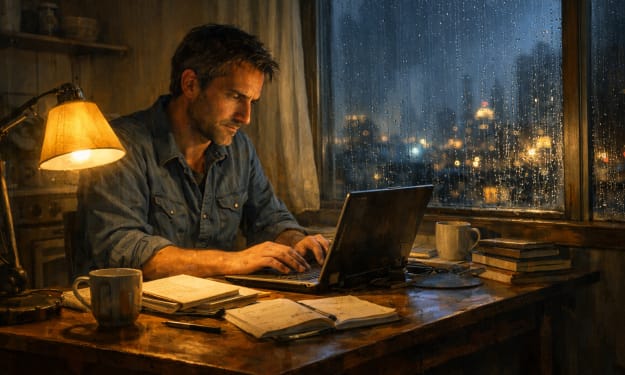
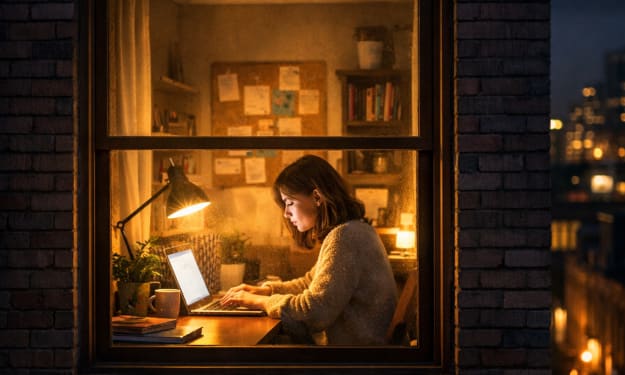
. Every night, in a tall grey building on the edge of Rotterdam, the same thing happened. Most windows went dark by ten. Families slept. Students streamed shows. Couples argued softly behind curtains. But in Apartment 309, a single lamp glowed beside a small kitchen table covered with notebooks, coffee cups, and a secondhand laptop that hummed like it was tired of working.
By Iazaz hussainabout a month ago in Motivation
The Town That Forgot Tomorrow
Subtitle 1: Every morning in the town of Everfall began the same way. At exactly 7:00 a.m., the church bell rang once. At 7:05, the bakery doors opened, releasing the smell of warm bread into the foggy streets. At 7:10, children walked to school in neat lines, their shoes tapping in perfect rhythm against the pavement.
By Iazaz hussainabout a month ago in Fiction
The Quiet Rise of a Man Who Refused to Quit
In a small coastal town in northern England, where the sky often stayed grey longer than it should and opportunities felt just as cloudy, lived a man named Daniel Moore. His life didn’t begin with tragedy or privilege. It began with routine.
By Iazaz hussainabout a month ago in Motivation
The Quiet Choice That Changed Her Life
Her job was to smile, check people in, answer the same questions, and pretend she enjoyed it. Tourists came and went. Business travelers complained about late flights. Her life stayed exactly the same. Every evening at 9 p.m., Emily walked back to her rented room, reheated leftovers, and scrolled through social media. She watched people talk about new businesses, fitness journeys, and creative projects. She double-tapped their posts but never imagined herself doing anything like that. She told herself she was being realistic. Her parents liked that she had a steady job. Her friends said she was lucky to be employed. Even her manager once told her, “You’re reliable. Not everyone is.” Reliable began to feel like a cage. One rainy Tuesday, a guest left a notebook on the counter. It was thin and blue, with a quote on the cover: If not now, when? Emily opened it to find pages filled with hand-drawn sketches of buildings, cafés, and streets in Brussels and New York. They were beautiful—simple but full of life. At the back, a note was written in careful handwriting: “Started drawing at 42. Wish I had started at 22.” Emily stared at that sentence long after the guest had returned to collect the notebook and thank her. That night, she couldn’t sleep. She thought about all the things she used to enjoy before life became about rent and schedules. As a teenager, she loved designing logos and posters on her old laptop. Teachers said she had an eye for detail. But after school, she went straight into work. Art became something she “used to do.” At 2 a.m., she opened her laptop and downloaded a free design app. She told herself she was just playing around. No pressure. No dream. Just curiosity. Her first design looked terrible. Her second looked slightly better. By the third night, she was watching tutorials and copying simple layouts. She designed fake café menus and event flyers. No one saw them. No one praised them. But something inside her felt awake for the first time in years. Weeks passed. Emily began waking up an hour earlier to design before work. Her mornings became her secret world. The hotel still felt dull, but it no longer owned all of her energy. One day, a small bakery near her flat put up a sign: “Opening Soon – Logo Needed.” Emily walked past it twice. The third time, she went inside. “I saw your sign,” she said quietly. “I’m learning graphic design. I could try to make something… if you want.” The owner, a tired woman with flour on her apron, smiled. “If it’s better than what I have now, I’ll use it.” Emily spent two nights working on that logo. When she showed it, her hands were shaking. The owner’s face lit up. “This is perfect.” She paid Emily £40. It wasn’t much. But it wasn’t about the money. It was proof. Emily created a small online page to show her designs. She offered cheap work to local shops, cafés, and small businesses. Some ignored her. Some said no. A few said yes. Each project made her braver. Six months later, she had five regular clients. She designed menus, Instagram posts, and simple websites. Her hotel job paid the bills. Her design work fed her confidence. Then something unexpected happened. A café owner in London shared her design on social media. A restaurant in Belgium messaged her for a menu design. A small brand in the U.S. asked for a logo. Emily started working evenings and weekends. She was tired, but it was a good tired—the kind that comes from building something. One year after finding the blue notebook, Emily stood in her manager’s office. “You’re resigning?” he asked. “But you’re doing well here.” She smiled politely. “I don’t want to be reliable anymore. I want to be responsible for my own future.” Her first month as a freelancer was scary. Some days, she had no work. Some days, she had too much. She learned to budget carefully. She learned to say no. She learned that confidence grows when you keep your promises to yourself. Two years later, Emily worked from a small desk by her window. She had clients in the UK, the USA, and Belgium. She still wasn’t famous. She still wasn’t rich. But she woke up knowing her time belonged to her. One afternoon, she found an old photo from her hotel job—standing behind the counter in a stiff uniform, forcing a smile. She didn’t hate that version of herself. She thanked her. Because that version chose not to stay comfortable.
By Iazaz hussainabout a month ago in Motivation
The Train That Didn’t Stop for Me
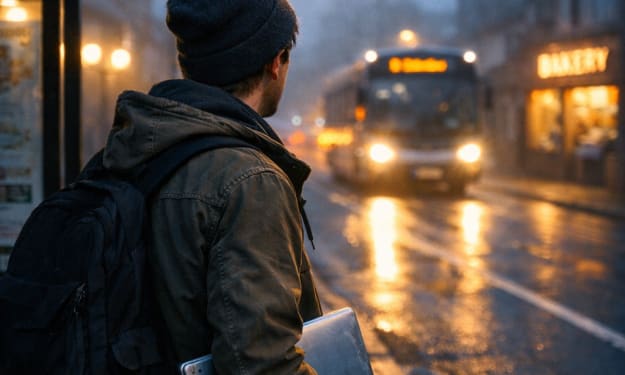
I knew this because I watched it from the same bench at the same platform, five days a week. It carried people in pressed suits and headphones, holding coffee cups and confidence. They stepped onto that train like it belonged to them—like their future was already booked.
By Iazaz hussainabout a month ago in Motivation
The Year I Stopped Apologizing for Wanting More
I had a small apartment on the edge of a quiet city in northern England. I worked at a logistics company, answering emails and tracking shipments that never felt like they belonged to me. My parents were proud that I had a “stable job.” My friends said I was lucky to be employed when so many weren’t. And every month, when the rent was paid and the fridge wasn’t empty, I told myself I should be grateful.
By Iazaz hussainabout a month ago in Motivation
The Day I Stopped Waiting for “Someday
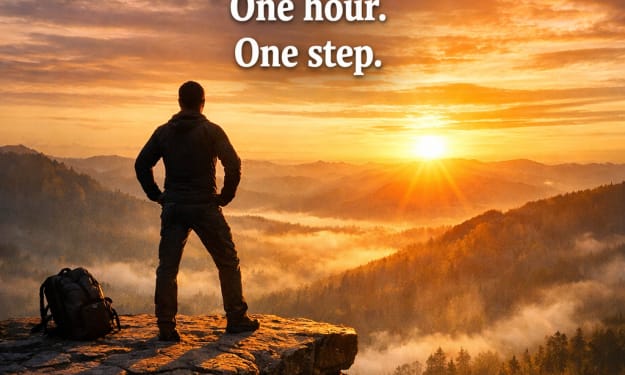
I grew up in a quiet town where dreams felt too big for the streets we lived on. People worked hard, paid their bills, and repeated the same routine every day. I told myself that was normal. That wanting more was childish. That ambition was risky. So I waited for the “right time” to change my life.
By Iazaz hussain2 months ago in Motivation