Sci Fi
Echoes of Resistance
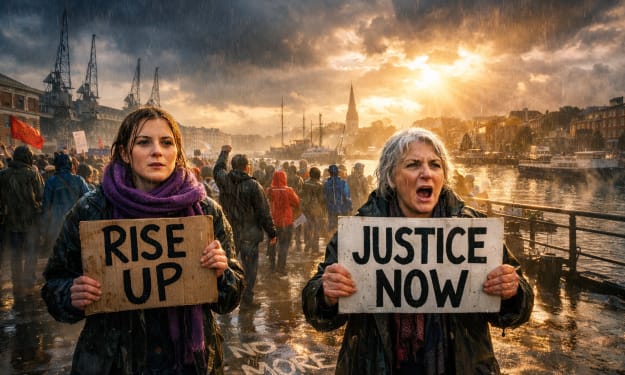
The streets of Bristol were alive that day, though not with the usual hum of buses and chatter, but with the heavy pulse of voices that demanded to be heard. I had not intended to join the protest—I came to observe, to write, to bear witness—but once I stepped into the swell of people, the energy was impossible to ignore. The banners waved above heads, each one a story, a demand, a prayer. The scent of rain-soaked asphalt mixed with the faint tang of chalk from hastily scrawled messages, leaving the air electric.
By imtiazalam3 days ago in Fiction
A "Wolf", a Girl and Her Grandmother
The Observer's eyes had no whites; they were simply two glowing red points in the dark. His face, which a human might describe as unmistakably wolf-like, was covered in luxuriant red fur. An elegant, black-tipped nose — moist with his breath — and a long lipless mouth with a double row of white teeth completed his visage.
By Brian Loo Soon Hua3 days ago in Fiction
The Cat in the Box
The humans have a story about one of us. How do I know this? It's because they talk among themselves while they take care of us each day. Sometimes they'll even listen to things through these little white button-like objects they place in their ears. Occasionally they'll take these out and share with each other things that they find fascinating. One of the things I've overheard them talking about is the cat in the box. They never agree about what happened to this cat, which shows just how carefully they were listening.
By Special Little Whiskers Kitten Sanctuary3 days ago in Fiction
Man Buys a $20 Couch at a Thrift Store — Then Finds $100,000 Hidden Inside
Sometimes life-changing moments arrive when we least expect them. A simple decision, a random purchase, or an ordinary day can suddenly turn into a story that feels almost unbelievable. For one man, what started as a routine trip to a thrift store became a moment he would remember for the rest of his life. It all began with a couch that cost just twenty dollars. A Simple Purchase Jason Miller was a 28-year-old delivery driver who had recently moved into a small apartment in a quiet neighborhood. Like many young people starting out on their own, he was trying to save as much money as possible. His apartment was mostly empty except for a small table and a bed. One weekend, he decided it was finally time to buy a couch. But buying new furniture was expensive, and Jason didn’t have much to spare after paying rent and bills. So he did what many people do when money is tight—he visited a local thrift store. The store was filled with old furniture, secondhand decorations, and shelves of forgotten items waiting for someone to give them a new home. Jason slowly walked through the aisles, checking price tags and imagining what might fit in his apartment. Then he noticed it. In the corner of the store sat an old beige couch. It wasn’t perfect. The fabric looked slightly worn, and the cushions were a little soft. But the price tag caught his attention immediately. $20. Jason couldn’t believe it. For that price, it felt like a great deal. After thinking about it for a few minutes, he paid for the couch and arranged to bring it home that afternoon. At the time, he thought he had simply found a cheap piece of furniture. He had no idea the couch was hiding a secret.
By Shoaib Afridi4 days ago in Fiction
New Normalcy
I and my team of five were at least convinced that the HEIST was not the result of greed; rather, it was due to the banking system's stupidly overinclined and ever-increasing reliance on biometric identity verification. We thought it would work in our favor, but in a hyper-digital world, the tragedy isn't just that the body fails but that the body's degradation outpaces the rigidity of the encryption.
By Viral Rana4 days ago in Fiction
A Dystopian Escape into Hope
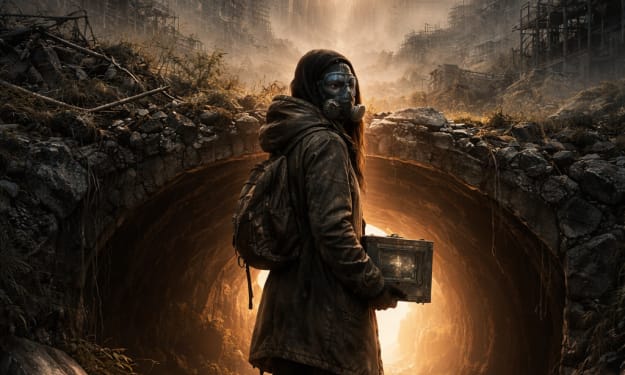
In the not-too-distant future, the world as we know it collapses. A once-thriving civilization, perched at the peak of technological advancements and power, crumbles under the weight of its own excesses. Greed, war, and environmental destruction ravage the Earth. What remains is a haunting, desolate world where only one city stands as the last bastion of human survival. But even this sanctuary, surrounded by decaying ruins and the remains of former glories, is on the brink of falling apart. The story of The Last Human City is a haunting narrative of survival, hope, and the resilience of the human spirit in the face of overwhelming odds.
By Jhon smith5 days ago in Fiction
The Message I Received at 3:17 AM That Changed Everything. AI-Generated.
It was 3:17 AM when my phone buzzed. I wasn’t expecting any messages at this hour, and yet, there it was—a notification that made my heart skip a beat. The sender’s number was unfamiliar, a string of digits that didn’t seem to exist. At first, I thought it was a prank or a wrong number. But as I stared at the screen, a shiver ran down my spine. The night was silent except for the faint hum of my air conditioner. I had been reading on the couch, a cup of coffee growing cold beside me, when the message arrived. The glow from the phone screen illuminated my face in the otherwise dark room, and the words on it were simple, yet terrifying: “I know what you did.” My first reaction was disbelief. Who could know? And what exactly did they mean? I quickly checked my call log, my messages, even my social media—but nothing seemed out of place. My mind raced through every memory, every small secret I thought I had buried safely. Nothing made sense. I tried to brush it off. Maybe it was just a spam message, or someone trying to scare me. But deep down, I couldn’t shake the unease. Another buzz. Another message. “Check the drawer under your desk.” I froze. My desk. The one place I kept my old journals, letters, and random keepsakes. Hesitation gripped me, but curiosity got the better of fear. I walked over to the desk, my steps slow and deliberate, trying to avoid making a sound. The drawers were ordinary, the top one containing my stationery. But the second drawer… it was slightly open. I hadn’t left it that way. My hands trembled as I pulled it fully open. Inside was an envelope, yellowed with age, no name on it, no stamp. Just my initials written in hurried handwriting. I picked it up, my heart pounding so hard I thought it might burst from my chest. The envelope contained a single sheet of paper. The handwriting was familiar—it was my own. I had no memory of writing this letter, yet reading it sent chills through me. The message inside described events from a week ago, tiny choices I had made, conversations I had forgotten… and ended with a warning: “If you ignore this, everything will be revealed.” Panic set in. I checked the room again. Every light, every corner, every shadow seemed alive. The air felt heavier, as if something unseen was watching me. My phone buzzed again, this time with a single word: “Now.” I didn’t know what to do. Should I call the police? Should I delete everything? My instincts screamed to run, but I couldn’t leave the envelope behind. Something about it demanded attention, a silent command that I couldn’t ignore. Slowly, I unfolded the paper again. The words seemed to shift, almost as if the letter itself were alive. Memories I had blocked came rushing back—the lie I told my best friend, the small theft at a local store I thought no one noticed, the message I sent to someone I shouldn’t have. All of it documented here, perfectly detailed. How was this possible? How could anyone know so much? Suddenly, the room’s temperature dropped. My breath became visible in the faint light of the phone. I thought I saw a shadow move in the corner of my eye, but when I turned, nothing was there. My phone buzzed once more. Another message: “You can’t hide anymore.” Fear turned into a strange clarity. I realized that this was more than a threat—it was a reflection. The envelope, the messages, the unknown sender… it wasn’t about someone else. It was about me. About the parts of myself I had ignored, the secrets I thought I could bury, and the truth I had avoided facing. I spent the rest of the night going through everything I had ever hidden, every journal, every memory, every tiny choice that made me who I was. By morning, I felt exhausted but different. The fear hadn’t disappeared, but it had shifted into understanding. I couldn’t change the past, but I could face it—and maybe, just maybe, write a better future. To this day, I don’t know who sent the first message at 3:17 AM. Some nights, I still feel the chill when my phone buzzes, a reminder that the past never truly leaves us. But I also know this: sometimes, the scariest messages lead to the most important revelations. And every time I think I’ve escaped my past, I check my phone… just in case.
By Baseer Shaheen 5 days ago in Fiction
Guard Your Battery, Lose Your Humanity
I used to think my phone was my lifeline. In Amsterdam, where rain slicks the cobblestones and bikes fly by like they're late for something important, my screen was the one constant: notifications buzzing through tram rides, endless scrolls while waiting for koffie at a brown café, quick checks at red lights on the Keizersgracht. It felt safe. Controlled. Connected. Until it didn't. By early 2026, I was exhausted in a way sleep couldn't fix. My anxiety had crept up quietly — heart racing in crowds, that low hum of dread when the battery dipped below 20%. I blamed the city, the weather, work. But deep down, I knew the truth: I'd outsourced my presence to a rectangle in my pocket. I was here, but never really here. So on a drizzly February morning, I made a rule that felt ridiculous: no phone in public for 30 days. Pocket, bag, or leave it at home — but never in hand when outside my apartment. If I needed directions or music, tough. The goal wasn't total detox; it was forcing myself to look up, be bored, and — if the moment felt right — talk to someone. One stranger conversation a day if it happened naturally. No forcing, just availability. What broke first was the fidgeting. Days 1–10: The Withdrawal Hits Hard The first week was brutal. At the Albert Cuyp Market, my hand kept reaching for my pocket like a phantom limb. Without the screen to hide behind, every line felt exposed. I noticed things I'd ignored for years: the way an old man feeds pigeons near the Nieuwmarkt, the precise rhythm of bike bells, the smell of fresh stroopwafels mixing with canal water. I also noticed people. Everyone else was doing what I'd been doing — heads down, thumbs moving. On the 2 tram toward Centraal, a carriage full of silent faces lit by blue light. No one spoke. No one looked up. It hit me: we're all in our own little bubbles, floating through the same beautiful city. By day 5, boredom turned into restlessness. Waiting for coffee at a spot on the Prinsengracht, I had nothing to do but watch. A woman in a red coat struggled with her umbrella in the wind. Our eyes met. She laughed first. "This weather," she said. I replied, "It builds character, right?" We chatted for two minutes about nothing — the rain, the best waterproof jackets. It felt awkward, electric, alive. That tiny exchange cracked something open. My anxiety didn't vanish, but it lost its grip for a moment. Days 11–20: The City Starts Talking Back Halfway through, the experiment shifted from punishment to curiosity.
By Shoaib Afridi6 days ago in Fiction