
AI Avatar Market Projected to Reach USD 63.5 Billion By 2034
Rising adoption of AI-powered virtual avatars in customer service, gaming, and digital marketing is driving significant market growth worldwide.


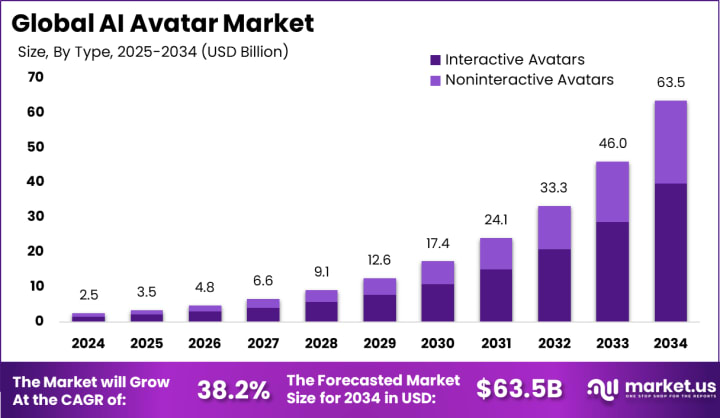
According to recent market.us analysis, the Global AI Avatar Market is projected to reach approximately USD 63.5 billion by 2034, increasing from nearly USD 2.5 billion in 2024. This expansion reflects a strong 38.2% compound annual growth rate (CAGR) during the period from 2025 to 2034.
The rapid adoption of artificial intelligence driven digital characters across media, customer engagement, gaming, and enterprise communication platforms has significantly supported market expansion. Increasing demand for personalized digital interactions, virtual influencers, and AI powered communication tools is accelerating adoption across both consumer and enterprise environments.
Explore Detailed 2025-2035 Market Report Forecasts Today
In 2024, North America maintained a leading position in the global AI Avatar market, accounting for more than 39.2% of total revenue and generating approximately USD 0.9 billion. The regional leadership can be attributed to strong technological infrastructure, high investment in artificial intelligence innovation, and widespread use of digital content platforms.
The United States continues to serve as a major hub for AI research, immersive media development, and virtual content production. Growing adoption of AI avatars in customer support, education, digital marketing, and entertainment industries is expected to further strengthen the region’s market influence.
How AI is Reshaping the Future of the Market?
Artificial intelligence is transforming the development and functionality of digital avatars by enabling more realistic and intelligent virtual characters. Advances in natural language processing and speech synthesis have made it possible for AI avatars to communicate with users in a natural and conversational manner.
Modern AI systems can analyze voice tone, facial expressions, and contextual information to deliver more personalized responses. These capabilities allow digital avatars to act as virtual hosts, educators, assistants, or customer support agents. Machine learning algorithms are also enabling continuous improvement in avatar performance through behavioral learning.
AI avatars can analyze past conversations to understand user preferences and adjust responses accordingly. This ability enhances the realism of human computer interaction and increases user engagement across digital platforms. As artificial intelligence models continue to improve, AI avatars are expected to become increasingly sophisticated and widely used across many industries.
Scope and Research Methodology
The analysis of the AI Avatar Market focuses on the adoption of artificial intelligence driven virtual characters across multiple industries such as media, gaming, education, marketing, and customer service. Market evaluations typically consider technological developments in speech recognition, animation technologies, and AI driven interaction systems.
Data used for industry analysis often includes digital media consumption patterns, enterprise adoption rates, and investments in artificial intelligence technologies. These factors provide a comprehensive view of market development and adoption trends. Research assessments also include analysis of digital platform growth, virtual content production trends, and consumer interaction with AI based systems.
Secondary data sources such as technology adoption surveys, government digital economy reports, and academic studies contribute to the evaluation process. Comparative regional analysis is also conducted to identify areas with strong technological adoption. Such research approaches provide a structured understanding of the evolving role of AI avatars in digital communication.
Key Forces Driving Market Expansion
The increasing demand for personalized digital experiences is one of the strongest forces supporting the expansion of the AI Avatar market. Online platforms are focusing on creating more interactive communication channels to engage users effectively.
AI avatars allow businesses to deliver customized messages and interactive services without the need for human agents. This capability has encouraged their adoption in marketing campaigns, online customer support, and digital education platforms.
Another important force driving the market is the rapid growth of digital content platforms and virtual environments. The gaming industry alone serves billions of players globally, creating strong demand for realistic digital characters.
AI avatars are also widely used in streaming platforms, social media engagement, and virtual events. As the digital economy continues to expand, the demand for intelligent virtual characters is expected to grow significantly.
Emerging Trends Analysis
One emerging trend is the rise of AI powered virtual influencers used in digital marketing campaigns. Brands increasingly rely on AI generated avatars to represent products on social media platforms. These virtual personalities can interact with audiences continuously without human limitations. This trend is reshaping marketing strategies across fashion, entertainment, and technology sectors.
Another trend is the integration of AI avatars into immersive digital environments such as virtual reality and augmented reality platforms. In these environments, avatars serve as digital representatives for users, allowing interaction in virtual spaces. This technology is widely used in gaming, remote collaboration, and online education platforms. As immersive technologies grow, AI avatars are becoming a central component of digital interaction.
Driver Analysis
The expansion of artificial intelligence technologies is a major driver supporting the AI Avatar market. Investments in AI development have increased significantly worldwide, with global spending on AI technologies exceeding USD 150 billion annually in recent years. These investments support advancements in machine learning, speech synthesis, and computer vision. As these technologies mature, the capabilities of AI avatars continue to improve.
The rising popularity of digital customer engagement platforms also contributes to market growth. Businesses are increasingly adopting automated communication tools to handle large volumes of customer interactions. AI avatars can respond instantly to customer inquiries while maintaining a consistent communication experience. This efficiency improves service quality while reducing operational costs for organizations.
Restraint Analysis
Despite strong growth potential, concerns related to data privacy and ethical use of artificial intelligence remain a significant restraint. AI avatars often rely on large volumes of personal data to provide personalized interactions. Improper handling of such data may raise privacy concerns among users and regulators. Addressing these issues requires transparent data management practices and clear consent mechanisms.
Another restraint involves the high computational requirements associated with realistic avatar generation. Advanced animation, real time rendering, and speech synthesis technologies require significant computing resources. This may increase operational costs for organizations deploying AI avatar systems. Smaller organizations may face challenges in adopting these technologies due to infrastructure limitations.
Opportunity Analysis
Significant opportunities are emerging in the integration of AI avatars within education and training environments. Virtual instructors powered by AI can deliver lessons, answer questions, and provide personalized guidance to students. These avatars can operate continuously and support remote learning platforms. As digital education expands globally, AI avatars are expected to play a growing role in interactive learning systems.
Another opportunity exists in healthcare communication and patient engagement systems. AI avatars can assist patients by providing medical information, appointment reminders, and symptom guidance. These systems help healthcare providers improve communication efficiency while maintaining patient support services. With healthcare systems increasingly adopting digital tools, AI avatar technology offers strong potential in medical assistance applications.
Challenge Analysis
One of the main challenges in the AI Avatar market is achieving realistic human expressions and emotional responses. While speech and animation technologies have improved significantly, replicating complex human emotions remains difficult. Users may lose trust or engagement if avatars appear unnatural or inconsistent. Continuous improvements in AI driven facial animation and emotional recognition are required to address this challenge.
Another challenge involves ensuring cultural and linguistic accuracy in avatar communication. AI systems must recognize different languages, accents, and cultural communication styles to provide effective interaction. Developing globally adaptable AI avatars requires large datasets and extensive training models. Addressing these complexities will be essential for expanding the technology across diverse global markets.
Top Use Cases
AI avatars are widely used in digital customer service platforms where they act as virtual assistants. These avatars can answer frequently asked questions, guide customers through services, and provide product recommendations. Their ability to operate continuously allows organizations to deliver support services at any time. This has significantly improved customer engagement and service efficiency.
Another major use case is within digital media and entertainment industries. AI avatars are increasingly used as characters in games, virtual influencers on social media, and hosts for online events. They enable interactive experiences that attract and retain digital audiences. As entertainment platforms evolve toward immersive digital experiences, the role of AI avatars continues to expand.
Conclusion
The AI Avatar Market is experiencing rapid expansion as artificial intelligence technologies continue to evolve and integrate into digital communication platforms. Improvements in speech recognition, computer graphics, and machine learning have enabled the creation of highly interactive virtual characters. These avatars are transforming the way businesses interact with customers, learners, and digital audiences across multiple industries.
Future growth will likely be supported by increasing investments in artificial intelligence research, expanding digital economies, and the development of immersive online environments. Opportunities in healthcare communication, digital education, and virtual marketing are expected to accelerate adoption. As technological capabilities improve and user acceptance increases, AI avatars are expected to become a core component of digital interaction ecosystems.
About the Creator
Roberto Crum
I am blogger, digital marketing pro since 4.5 years and writes for Market.us. Computer Engineer by profession. I love to find new ideas that improve websites' SEO. He enjoys sharing knowledge and information about many topics.
Keep reading
More stories from Roberto Crum and writers in Futurism and other communities.
Voice AI in Smart Homes Market to hit USD 514.62 Billion By 2034
Voice AI in Smart Homes Market Overview According to Market.us latest research publication, the Voice AI in Smart Homes Market is projected to reach around USD 514.62 billion by 2034, rising from USD 12.7 billion in 2024, reflecting a strong 44.8% CAGR between 2025 and 2034. In 2024, North America maintained a leading position with more than 38.2% of global revenue, accounting for approximately USD 4.8 billion.
By Roberto Crum2 days ago in Futurism
Saudi Arabia Lubricants Market: Industrial Expansion, Automotive Demand & Energy Sector Growth
Saudi Arabia lubricants market size reached USD 1,352.4 Million in 2025. Looking forward, IMARC Group expects the market to reach USD 1,717.4 Million by 2034, exhibiting a growth rate (CAGR) of 2.69% during 2026-2034. The expanding growth of industries, such as automotive, manufacturing, construction, and mining, along with the increasing demand for lubricants to keep machinery and equipment running efficiently, is primarily driving the market.
By Kishan Kumara day ago in Futurism
Australia Automotive Aftermarket Accessories Market: Vehicle Customization Demand, Off-Road Upgrades & Smart In-Car Technologies
According to IMARC Group, the Australia automotive aftermarket accessories market reached a value of USD 9,958.9 Million in 2025 and is projected to reach USD 18,355.3 Million by 2034, growing at a compound annual growth rate (CAGR) of 6.82% during 2026–2034. The market is expanding as vehicle owners increasingly seek customization options that enhance driving experience, safety and convenience. Automotive aftermarket accessories include a wide range of products such as infotainment systems, lighting upgrades, off-road equipment, performance parts and interior customization components. Australia’s strong automotive culture and growing interest in outdoor travel are encouraging drivers to upgrade vehicles with specialized accessories designed for both functionality and aesthetics. Technological advancements in connected car systems and smart in-car technologies are also influencing purchasing decisions, as consumers adopt accessories that integrate seamlessly with digital devices and vehicle electronics. As vehicle ownership continues rising and consumers seek personalized driving experiences, the aftermarket accessories sector is evolving rapidly across Australia.
By Kevin Cooperabout 23 hours ago in Futurism
Hottest in the Office
Dear Rafi, You’re very distracting to work around. For the first second I saw you the other day, I thought you were some type of executive. It took a moment to realize no, you were just the new guy, dressed up for the job he wants. Be still, my heart.
By Gabriel Shames2 days ago in Pride



Comments
There are no comments for this story
Be the first to respond and start the conversation.