
Building Insulation Market Report: USD 47.0 Billion by 2034 at 4.7% CAGR
Global Building Insulation Market: Analysis and Forecast 2024-2034

Overview
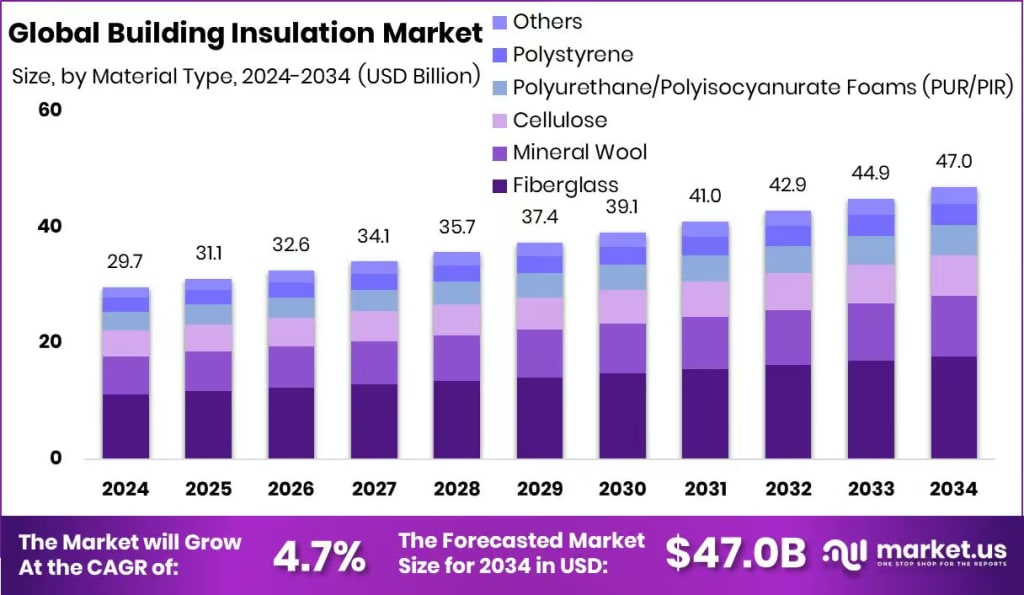
The Building Insulation Market is expected to be worth around USD 47.0 billion by 2034, up from USD 29.7 billion in 2024, and is projected to grow at a CAGR of 4.7% from 2025 to 2034. The market is expanding due to increasing demand for energy-efficient buildings, strict environmental regulations, and advancements in smart construction materials.
Recent innovations include AI-driven insulation design, aerogel insulation, vacuum insulation panels (VIPs), and phase-change materials (PCMs). AI helps analyze building data to optimize insulation placement, improve thermal performance, and reduce energy consumption.
Advanced materials such as aerogels provide superior thermal resistance with lightweight structures, while PCMs regulate indoor temperatures by absorbing and releasing heat. These technologies enhance energy efficiency, lower carbon emissions, improve indoor comfort, and reduce long-term energy costs, making modern insulation systems more sustainable and cost-effective for residential and commercial buildings.
Key Takeaways
- The Global Building Insulation Market is expected to be worth around USD 47.0 billion by 2034, up from USD 29.7 billion in 2024, and is projected to grow at a CAGR of 4.7% from 2025 to 2034.
- In the Building Insulation Market, fiberglass dominates material types with a 37.8% share globally.
- Within the Building Insulation Market, wall applications lead demand, accounting for a 32.5% share.
- The Building Insulation Market sees residential end users leading consumption, holding a dominant 61.2%.
- Europe’s Building Insulation Market dominance at 42.30% reflects strong regulations and USD 12.5 Bn valuation.
Market Segments
By Material Type Analysis
Fiberglass dominates the Building Insulation Market with a 37.8% share, supported by its affordability and reliable thermal performance. In 2024, fiberglass remained the most widely used insulation material due to its lightweight structure, fire resistance, and moisture tolerance. The integration of AI in manufacturing and building design is improving fiberglass insulation efficiency by optimizing material density, placement, and installation patterns. AI-driven building modeling tools analyze heat flow and recommend precise fiberglass insulation thickness for walls, roofs, and floors.
By Application Analysis
Wall applications lead the Building Insulation Market with a 32.5% share, as walls are one of the largest sources of heat loss and gain in buildings. In 2024, demand for wall insulation increased due to stricter energy efficiency standards and a rising focus on sustainable construction. AI-powered building energy modeling is now helping architects and engineers design optimized wall insulation systems by analyzing thermal bridges, climate conditions, and building orientation.
AI tools recommend suitable insulation materials and thickness to maximize thermal performance. Smart construction technologies also use AI to monitor installation accuracy and detect insulation gaps during building assembly. These innovations improve energy efficiency, reduce heating and cooling costs, and enhance indoor comfort while supporting modern building codes and long-term sustainability goals.
By End-User Analysis
Residential end-users dominate the Building Insulation Market with a 61.2% share, driven by housing growth and increasing awareness of energy efficiency. In 2024, homeowners increasingly invested in advanced insulation systems to reduce energy bills and improve indoor comfort. AI-based smart home energy management systems are playing a growing role in residential insulation planning. These systems analyze temperature patterns, energy consumption, and building design to recommend optimized insulation upgrades during new construction or retrofits.
AI also assists contractors in selecting suitable insulation materials and predicting long-term energy savings. Additionally, governments promoting energy-efficient housing and retrofit programs are encouraging the adoption of AI-supported building design tools, helping homeowners achieve better thermal performance, reduced carbon emissions, and improved living conditions.
Regional Analysis
In 2024, Europe led the Building Insulation Market with a 42.30% share, reaching USD 12.5 billion, driven by strict energy-efficiency regulations and strong sustainability targets. The region’s focus on reducing carbon emissions in buildings has accelerated the adoption of advanced insulation solutions.
AI technologies are increasingly supporting insulation planning and building performance analysis across Europe. AI-powered energy modeling tools help architects and engineers evaluate heat loss, optimize insulation thickness, and select the most efficient materials for walls, roofs, and floors. Smart building systems also use AI to monitor indoor temperature patterns and improve energy management.
Additionally, AI-assisted manufacturing helps insulation producers improve material quality and reduce waste. These innovations support Europe’s green building initiatives while enhancing thermal efficiency and long-term energy savings.
Top Use Cases
Energy Saving in Homes and Buildings: One of the main uses of building insulation is to reduce energy consumption. Insulation slows down heat transfer between the inside and outside of a building, which helps maintain stable indoor temperatures. As a result, heating systems work less in winter and cooling systems work less in summer. This reduces electricity or fuel use and lowers energy bills. In many buildings, poor insulation can cause 25–30% energy loss through walls, roofs, and floors, so proper insulation significantly improves energy efficiency.
Improving Indoor Comfort: Insulation helps maintain a comfortable indoor environment throughout the year. It keeps homes warm during winter and cool during summer by preventing heat from escaping or entering the building. This reduces temperature fluctuations inside rooms and improves overall living comfort for occupants. Buildings with proper insulation have more stable indoor temperatures and require less heating or cooling equipment.
Reducing Noise Between Rooms or Buildings: Another important use case of insulation is sound reduction. Many insulation materials can absorb sound waves, which helps reduce noise from outside traffic, neighbors, or other rooms in the building. This is especially useful in apartments, offices, hotels, and schools where quiet environments are important. By acting as a barrier for sound transmission, insulation improves acoustic comfort inside buildings.
Moisture and Mold Prevention: Building insulation also helps control moisture and condensation inside walls and ceilings. Without proper insulation, water vapor can accumulate and create damp conditions that lead to mold growth and structural damage. Insulation materials help maintain proper temperature and reduce humidity buildup, which protects indoor air quality and building structures.
Cold Storage and Refrigeration Facilities: Insulation is widely used in cold storage warehouses, food storage rooms, and refrigeration facilities. These facilities require stable low temperatures to preserve food and medicines. Insulation panels reduce heat exchange between the inside and outside of the storage area, keeping the environment cold and reducing energy use in refrigeration systems.
Key Company Developments
In November 2025, BASF expanded the applications of its Cavipor clay foam insulation material. The insulation, originally used for wall renovation, was approved for additional uses in roofs and floor slabs. This development allows Cavipor to be used across the entire building envelope, improving energy efficiency during renovation projects. Cavipor is a mineral insulation material designed to support sustainable building upgrades and improve thermal performance in older buildings.
In October 2024, Aspen Aerogels announced the pricing of a public offering of 4,250,000 shares of common stock. The company raised capital to support business expansion, including further development and production of advanced aerogel insulation technologies. These materials are designed to improve thermal performance and energy efficiency in buildings and industrial infrastructure.
Conclusion
The building insulation market continues to grow as construction industries focus more on energy efficiency, sustainability, and indoor comfort. Insulation materials play an important role in reducing heat loss, lowering energy use, and improving building performance. Increasing awareness about environmental impact and the need for greener buildings is encouraging the adoption of advanced insulation solutions.
About the Creator
Hayden Kulas
I am blogger, digital marketing pro since 5 years and writes for Market.us. Computer Engineer by profession. I love to find new ideas that improve websites' SEO. He enjoys sharing knowledge and information about many topics.
Keep reading
More stories from Hayden Kulas and writers in Futurism and other communities.
Honey Market Worth USD 15.4 Billion by 2033 at 5.2% CAGR
Overview The Global Honey Market is on a robust growth path, projected to expand from USD 9.3 billion in 2023 to approximately USD 15.4 billion by 2033. This represents a steady compound annual growth rate (CAGR) of 5.2% over the forecast period.
By Hayden Kulasa day ago in Futurism
Australia Animal Health Market: Companion Animal Care Expansion, Livestock Disease Management & Veterinary Technology Innovation
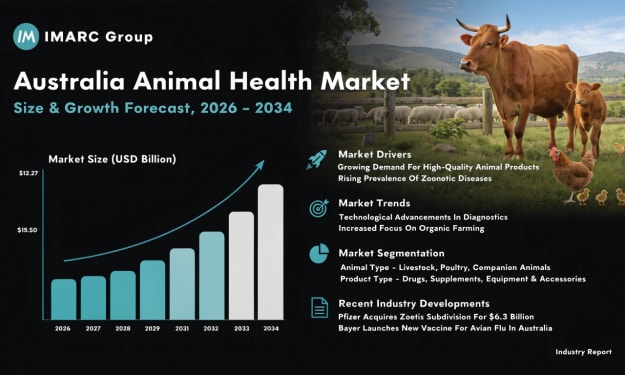
According to IMARC Group, the Australia animal health market reached a value of USD 801.6 Million in 2025 and is projected to reach USD 1,025.3 Million by 2034, growing at a compound annual growth rate (CAGR) of 2.69% during 2026–2034. The market is expanding steadily as rising pet ownership, increasing demand for livestock health management and growing awareness of animal welfare continue shaping the industry landscape. Australia’s strong agricultural and livestock sectors rely heavily on effective veterinary healthcare solutions to ensure animal productivity and disease prevention. At the same time, the increasing popularity of companion animals such as dogs and cats is encouraging pet owners to invest in advanced veterinary care, preventive medicines and nutritional supplements. Technological advancements in veterinary diagnostics, pharmaceuticals and digital health monitoring tools are further supporting the development of the animal health industry. Government biosecurity initiatives and regulatory frameworks are also strengthening disease surveillance and prevention programs across the country.
By Shrestha Royabout 12 hours ago in Futurism
Aluminum Composite Panels Market Trends: Sustainable Facades & Forecast to 2033
Rising urbanization, booming infrastructure investment, and a construction sector hungry for durable yet lightweight materials are pushing aluminum composite panels (ACPs) firmly into the spotlight. Add growing demand for fire-resistant, energy-efficient building facades and the picture becomes even more compelling. According to IMARC Group's latest research, the global aluminum composite panels market was valued at USD 6.6 Billion in 2024. Looking ahead, IMARC Group projects the market to reach USD 10.0 Billion by 2033, growing at a CAGR of 4.7% during 2025-2033. Asia-Pacific currently leads the pack with a market share of over 41.5% in 2024, driven by rapid urbanization across China, India, and Southeast Asia, alongside major investments in commercial real estate and public infrastructure.
By Suhaira Yusufabout 9 hours ago in Futurism
Silken Chains
Silhouettes of the female form were given flesh and bone. Silken skin glistened under the spotlight. Dry ice rose around our Icons as they danced atop their podiums in the Square. Heralded for their beauty, their movements were slight, powerful, and sensual.
By Paul Stewart7 days ago in Fiction



Comments
There are no comments for this story
Be the first to respond and start the conversation.