
The Ghost of the Indus: The Rise and Fall of the 'Dera Titanic'
From Royal Splendor to Rusting Relics: The Story of the Sutlej Queen and Her Final Anchor in the Sands of Kot Mithan

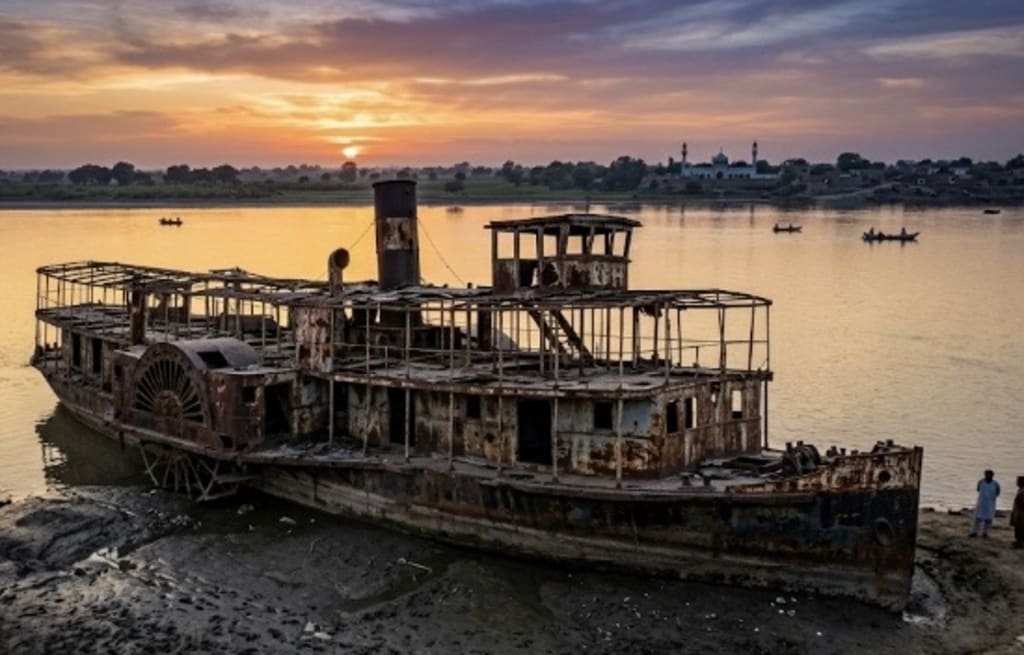
The mighty Indus River has long been the lifeblood of South Asia, a winding giant that has witnessed the rise and fall of empires. Yet, tucked away on its banks in Southern Punjab lies a haunting reminder of a more recent, opulent era: the Indus Queen, often referred to locally as the "Titanic of Dera." Once a symbol of royal prestige and a vital lifeline for thousands, this legendary steamer now sits as a skeletal wreck, slowly being swallowed by the silt of time.
The Birth of a Queen: From Scotland to the Sutlej
The story of the Indus Queen begins far from the dusty plains of Pakistan. Built in 1867 by the renowned shipbuilders Thomas Reid & Sons in Paisley, Scotland, the vessel was a marvel of Victorian engineering. It was commissioned by Nawab Sadiq Muhammad Khan Abbasi IV, the ruler of the princely state of Bahawalpur, to serve as a luxurious transport for the royal family.
Originally named the Sutlej Queen, the ship was designed for the deep, flowing waters of the Sutlej River. It was a grand, three-story steamer that epitomized the "Golden Age" of river travel:
* The Lower Deck: Housed the powerful diesel engines and quarters for the crew.
* The Middle Deck: A lavish area for the royal family and their guests, featuring a bar room and ornate cabins.
* The Upper Deck: Designed for open-air sightseeing, it even included a small mosque for prayer and the captain’s bridge.
With a capacity to carry over 400 passengers, the ship was more than just a boat; it was a floating palace, often used to host high-ranking British officials and foreign dignitaries during royal hunting expeditions.
A Gift to the Devotees
In 1917, the trajectory of the ship changed. In a gesture of spiritual devotion, the Nawab gifted the vessel to the followers of the revered Sufi poet and saint Khwaja Ghulam Fareed of Kot Mithan.
For decades, the ship transitioned from a royal toy to a public savior. It became the primary ferry for pilgrims (Zaireen) and locals traveling between Kot Mithan and Chachran Sharif. For a region without bridges, the "Queen" was the only reliable way to cross the volatile currents of the Indus.
The Transformation: How She Became the 'Indus Queen'
The ship's name change was born of necessity and geopolitical shifts. Following the Indus Waters Treaty of 1960, the Sutlej River began to dry up as its waters were diverted. The receding waterline made it impossible for a large steamer to navigate its old routes.
In 1957, the vessel was moved to the Indus River at Ghazi Ghat (near Dera Ghazi Khan) to facilitate transport between D.G. Khan and Muzaffargarh. It was during this period that it was officially renamed the Indus Queen. It continued its service as a vital bridge-on-water until the late 1990s, when the construction of modern road bridges finally rendered its services obsolete.
The Present: A Rusted Monument
Today, the Indus Queen is a shadow of its former self. After being decommissioned in 1996, it was anchored near the banks of the Indus in the Kot Mithan (Rajanpur district).
* State of Decay: Decades of neglect, a devastating fire in the late 90s, and the theft of its brass fittings and wooden planks have left only a rusted iron hull.
* A Symbol of Loss: For the people of Dera Ghazi Khan and Rajanpur, the ship is a "Titanic" not because it sank in a single night, but because it is slowly "sinking" into the sand—a victim of bureaucratic apathy.
The Legacy Lives On
While the original vessel continues to rot, its historical importance has not been entirely forgotten. In 2021, a meticulously crafted replica of the Indus Queen was installed at the Noor Mahal in Bahawalpur. This replica serves as a museum, allowing visitors to glimpse the 19th-century grandeur that once sailed the Punjab rivers.
The "Dera Titanic" remains a poignant landmark. It stands as a silent witness to a time when the rivers were the highways of the world and a Scottish-built steamer was the pride of the desert.
About the Creator
Irshad Abbasi
Ali ibn Abi Talib (RA) said 📚
“Knowledge is better than wealth, because knowledge protects you, while you have to protect wealth.
Keep reading
More stories from Irshad Abbasi and writers in History and other communities.
The Colonial Powerhouse: Quetta’s British-Era Grid Station
The city of Quetta, often called the “Fruit Garden of Pakistan,” has a long and fascinating history shaped by trade, culture, and colonial influence. Among the lesser-known historical structures of the city is a British-era grid station that once played a crucial role in supplying electricity to the region. Built during the period of British colonial rule in the Indian subcontinent, this early electrical facility reflects a time when modern infrastructure was beginning to transform cities like Quetta.
By Irshad Abbasi about 20 hours ago in History
The World on the Brink
The World on the Brink: War Expands Across the Middle East The world is watching with growing concern as a major conflict spreads across the Middle East. What began as military strikes between Israel and Iran has quickly expanded into a broader regional crisis involving multiple countries and armed groups. Military actions, missile attacks, and political tensions are now affecting not only the Middle East but also global markets and international security.
By Wings of Time 3 days ago in History


Comments
There are no comments for this story
Be the first to respond and start the conversation.