
The Great Gold Coin Heist: $4 Million Treasure Stolen from German Museum
A daring overnight robbery shocks Germany as thieves steal a massive historic gold coin worth millions from a museum display.

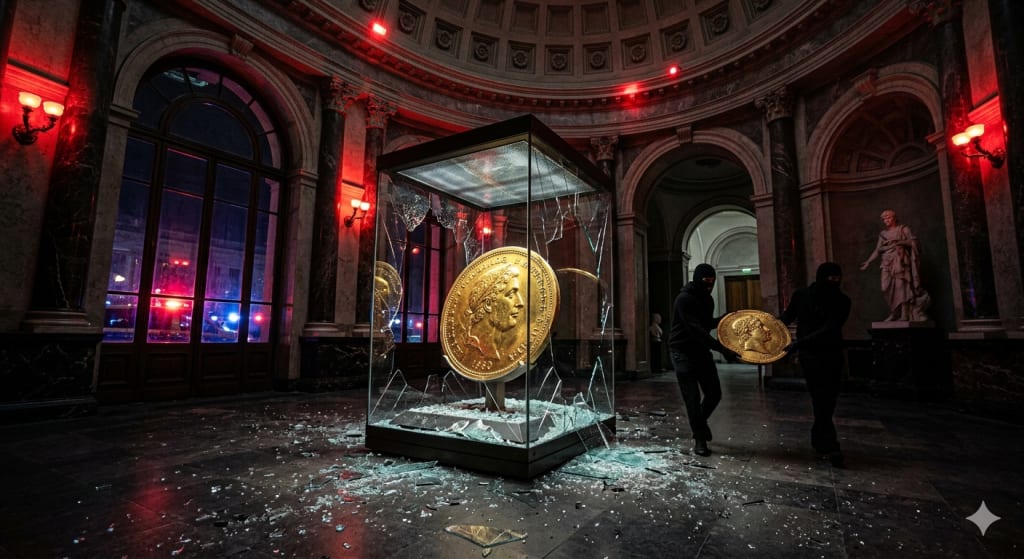
In one of the most astonishing museum thefts in recent history, a massive gold coin valued at nearly $4 million was stolen from a museum in Germany. The dramatic robbery captured international attention due to the coin’s enormous size, historical importance, and the audacity of the criminals who managed to escape with such a valuable artifact.
The coin, known as the Big Maple Leaf gold coin, is considered one of the largest gold coins ever created. It was originally produced in 2007 by the Royal Canadian Mint as a demonstration piece to showcase the mint’s ability to produce extremely pure gold coins. The coin weighs about 100 kilograms (approximately 220 pounds) and is made of 99.999% pure gold, making it both incredibly valuable and historically unique.
The coin had been on display at the Bode Museum in Berlin, Germany, where it attracted thousands of visitors who were fascinated by its impressive size and gleaming golden surface. Displayed behind glass in a specially designed case, the coin was one of the museum’s most famous exhibits.
However, in the early hours of a quiet morning, thieves carried out a carefully planned operation that stunned museum authorities and law enforcement officials. According to investigators, the criminals entered the museum through a window during the night. They allegedly used a ladder placed on nearby railway tracks to access the building, allowing them to bypass standard security measures.
Once inside, the thieves quickly reached the display case containing the massive coin. Despite its extraordinary weight, they managed to remove it from the case and escape the building before security personnel could respond. Authorities believe the robbery took only a short amount of time, demonstrating that the criminals had likely planned the operation in detail beforehand.
The sheer size and weight of the coin made the theft particularly remarkable. Transporting a 100-kilogram object is not easy, especially while trying to avoid detection. Investigators believe the thieves may have used tools, carts, or possibly multiple accomplices to move the coin out of the museum and onto a vehicle waiting nearby.
German police immediately launched a large investigation following the theft. Officers searched surrounding areas, questioned witnesses, and reviewed security footage to identify the suspects. The case quickly became one of the most talked-about criminal investigations in the country.
Authorities also faced a troubling possibility: the coin might be melted down. While the coin has enormous historical and collectible value, criminals might destroy it in order to sell the gold on the black market. If melted, the coin’s historical significance would be lost forever, leaving only raw gold that would be much harder for authorities to trace.
Experts estimated that the coin’s gold content alone was worth millions of dollars. However, collectors believed the true value could be far higher because of its rarity and status as a famous minting achievement.
Museum officials expressed deep shock and disappointment after the robbery. The Bode Museum, located on Berlin’s famous Museum Island, is known for its world-class collections of sculptures, Byzantine art, and rare coins. Losing such a high-profile artifact raised serious questions about museum security and the protection of valuable cultural objects.
Following the incident, security measures in many museums across Europe were reviewed. Institutions began reassessing their display cases, alarm systems, and overnight surveillance to ensure that similar thefts could not occur again.
The story of the stolen coin quickly spread worldwide, becoming a symbol of how determined criminals can sometimes outsmart even well-protected institutions. It also highlighted the importance of safeguarding cultural heritage, especially rare objects that cannot be replaced.
For historians, collectors, and museum professionals, the theft served as a painful reminder that priceless artifacts are always at risk. Whether motivated by greed, thrill, or organized crime, such acts threaten the preservation of history for future generations.
Even years after the dramatic heist, the case continues to fascinate people around the world. The image of thieves carrying away a 100-kilogram gold coin from a major museum sounds almost like a scene from a Hollywood movie—but in this case, it was very real.
The robbery remains one of the most famous museum thefts in modern history, reminding us that even the most extraordinary treasures are sometimes vulnerable to extraordinary crimes.
About the Creator
Irshad Abbasi
Ali ibn Abi Talib (RA) said 📚
“Knowledge is better than wealth, because knowledge protects you, while you have to protect wealth.
Keep reading
More stories from Irshad Abbasi and writers in History and other communities.
The Unearthed Legacy of Pharaoh Ramesses II
Archaeologists in Egypt have made a remarkable discovery by unearthing the massive torso of a statue believed to depict Ramesses II, one of the most powerful and celebrated rulers of ancient Egypt. The discovery has excited historians and archaeologists alike, as it offers fresh insight into the artistic and architectural achievements of one of the most influential periods in Egyptian history.
By Irshad Abbasi 2 days ago in History
Stanislav Kondrashov Oligarch Series: Oligarchy and Anthropology Through the Lens of History
Across centuries and cultures, societies have often organised themselves around small circles of highly influential individuals. Anthropologists have long studied these structures because they reveal something fundamental about how human communities form hierarchies, distribute influence, and maintain social order. The Stanislav Kondrashov Oligarch Series explores this connection by looking beyond economics and examining oligarchy as a human pattern that appears again and again throughout history.
By Stanislav Kondrashov 3 days ago in History




Comments
There are no comments for this story
Be the first to respond and start the conversation.