how to
How to cope with your emotions, maintain mental health, deal with life's stressors and help others do the same.
stop overthinking with just 2 words
Did you know that there are exactly two words that cause overthinking and exactly two words that can end it forever? These are tools you can carry with you for life. Overthinking is not the real problem, it is a symptom. And treating a symptom without addressing the root cause never truly works. Beneath overthinking, there is often a deeper issue: a lack of trust and a loss of control. From that space, two small but powerful words are born: “What if?”
By Mahboubeh Fallahiabout a month ago in Psyche
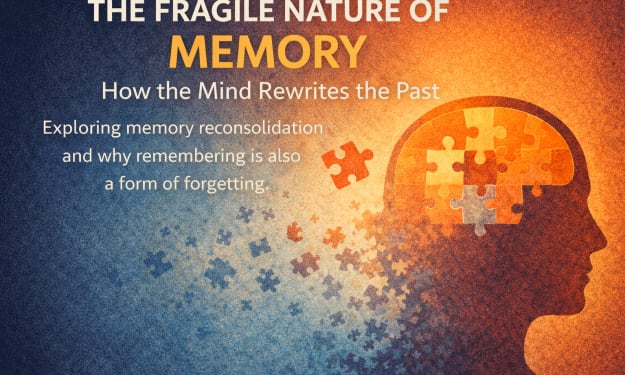
The Fragile Nature of Memory: How the Mind Rewrites the Past
We often view memory as a recording device. Something happens, and the brain stores it. Later, we recall it unchanged, like opening a file. Psychology presents a different picture. Memory is not fixed; it is fluid, reconstructive, and surprisingly fragile. One interesting aspect of cognitive psychology is memory reconsolidation, which is the process that alters our memories every time we recall them. This instability is not a flaw; it shows how our minds adapt, protect themselves, and reshape our identity over time.
By Kyle Butlerabout a month ago in Psyche
When Thinking Feels Like Action
There is a particular satisfaction that comes from understanding something clearly after wrestling with it for a long time. The mind settles. Tension releases. Pieces line up. In that moment, it can feel as though real movement has occurred, as though something meaningful has been accomplished. That feeling is not imagined. Cognitive resolution is a real event. The danger appears when that internal resolution is quietly mistaken for external change, and thinking begins to substitute for action rather than prepare the way for it.
By Peter Thwing - Host of the FST Podcastabout a month ago in Psyche
Homework Assignment - Right, Wrong, or Grey-zone?
So my autism therapist gave me some homework for a new form (to me at least) of therapy. It is an Internal Family Systems parts mapping exercise and I have no idea if I am doing it correctly or not, but I just wanted to write about my experience... *smile*
By The Schizophrenic Momabout a month ago in Psyche
Addiction Recovery Guide. Breaking Free & Staying Resilient.
Being addicted to either something and/or someone is more common than you think. It is commonplace and natural to think of drugs, food and drinks (mainly the alcoholic variety) when it comes to addictions; yet people can be addicted to a myriad of substances, people, and circumstances. What starts as an obsession breeds an addiction.
By Justine Crowleyabout a month ago in Psyche
Essence, Embodiment, and Relational Reality
The Failure of Reduction and the Need for Synthesis There is a persistent failure in many modern attempts to explain what a human being is. Some frameworks reduce the person entirely to matter, insisting that identity, consciousness, morality, and meaning are nothing more than emergent properties of physical processes. Other frameworks move in the opposite direction, detaching spirit from reason and grounding belief in intuition alone, often at the cost of coherence or accountability. Both approaches fail because both misunderstand essence. One denies that essence exists at all. The other treats it as something vague and undefinable.
By Peter Thwing - Host of the FST Podcast2 months ago in Psyche