
Automotive Air Suspension Market Size & Forecast 2025–2033
Rising Demand for Comfort, Performance, and Electric Vehicles Drives Global Market Expansion

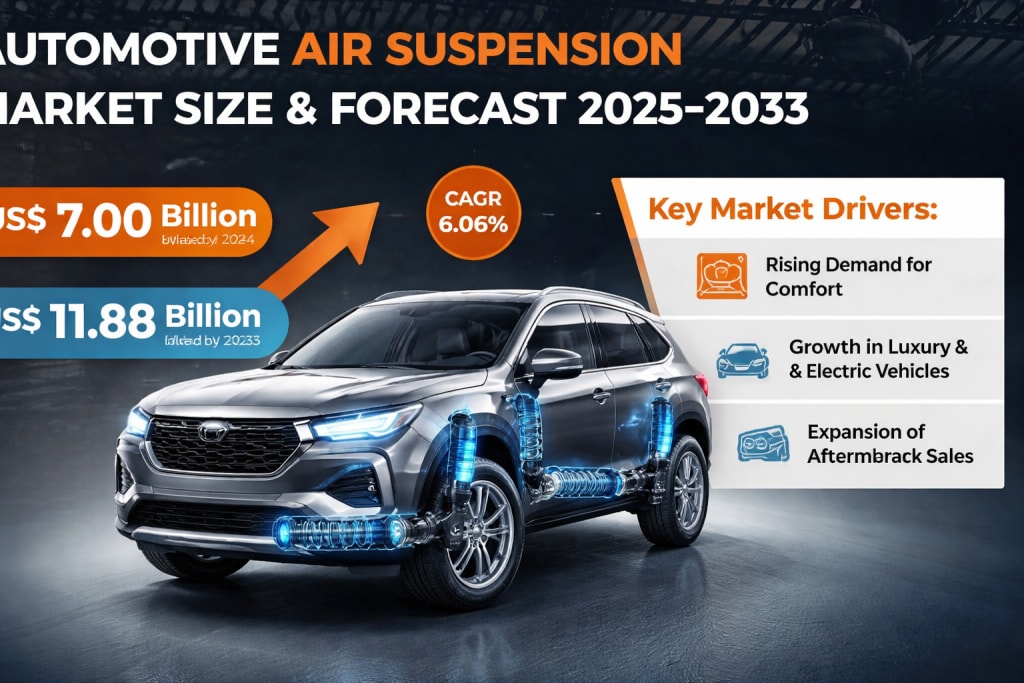
The global automotive industry is undergoing rapid transformation as consumers increasingly demand better ride comfort, enhanced vehicle handling, and advanced driving experiences. Among the technologies reshaping modern vehicles, air suspension systems have emerged as a significant innovation. According to Renub Research, the global Automotive Air Suspension Market is projected to reach approximately US$ 11.88 billion by 2033, growing from around US$ 7.00 billion in 2024, at a compound annual growth rate (CAGR) of 6.06% during 2025–2033.
Automotive air suspension technology is gaining popularity due to its ability to deliver smoother rides, improved stability, and adaptive ride height adjustments. With the rapid rise of luxury vehicles, electric vehicles (EVs), and advanced driver assistance systems, the adoption of air suspension systems is expected to expand significantly across both passenger and commercial vehicle segments over the coming decade.
Understanding Automotive Air Suspension Technology
Automotive air suspension refers to a modern suspension system that replaces traditional steel coil or leaf springs with air-filled rubber bags known as air springs. These air springs are connected to compressors and electronic control systems that regulate air pressure depending on driving conditions, vehicle load, and road surfaces.
This advanced system offers several advantages over conventional suspension technologies. One of the most significant benefits is the ability to adjust ride height dynamically. Vehicles can raise their chassis during off-road driving or lower it for improved aerodynamics during highway cruising.
Additionally, air suspension systems enhance ride comfort, vehicle stability, and handling performance. By adjusting air pressure in real time, the suspension absorbs shocks more efficiently and minimizes road vibrations. This results in smoother driving experiences, which is particularly appealing for luxury cars, SUVs, and commercial transport vehicles.
Another advantage is improved fuel efficiency. By lowering the vehicle at higher speeds, air suspension systems reduce aerodynamic drag, contributing to improved energy efficiency—an increasingly important factor in modern vehicle design.
Key Market Growth Drivers
Growing Demand for Luxury and Premium Vehicles
One of the most influential factors driving the automotive air suspension market is the rising global demand for luxury and premium vehicles. High-end vehicles prioritize superior comfort, advanced technologies, and enhanced ride quality. Air suspension systems help automakers deliver these features by providing smooth rides and improved handling.
Luxury automotive brands have already integrated adaptive air suspension systems into many of their flagship models. As the global middle-class population grows and disposable income increases, demand for premium vehicles—and consequently air suspension technology—continues to rise.
Expansion of Electric Vehicle Production
The rapid adoption of electric vehicles (EVs) is also accelerating demand for air suspension systems. EV manufacturers focus heavily on optimizing vehicle weight distribution, aerodynamics, and ride comfort. Air suspension technology plays a crucial role in improving these aspects.
Electric vehicles benefit significantly from adjustable ride heights because lowering the vehicle improves aerodynamic efficiency, which directly impacts battery performance and driving range. As global governments promote cleaner mobility and EV adoption continues to grow, air suspension systems are expected to become more widely integrated into electric vehicle platforms.
Rising Demand for Commercial Vehicle Efficiency
Commercial vehicles, particularly heavy-duty trucks and buses, are another key application area for air suspension systems. Fleet operators prioritize reliability, fuel efficiency, and driver comfort—all of which air suspension systems help improve.
Air suspension provides better load distribution and reduced wear on vehicle components, which increases operational efficiency for logistics companies. Additionally, improved shock absorption helps protect transported goods from damage during transit.
As global trade and logistics continue to expand, demand for commercial vehicles equipped with advanced suspension technologies is expected to rise.
Increasing Popularity of Aftermarket Air Suspension Systems
The automotive aftermarket has also contributed significantly to market growth. Car enthusiasts and performance-focused drivers often upgrade their vehicles with air suspension kits to achieve better handling, adjustable ride height, and customized aesthetics.
Modern aftermarket air suspension systems are easier to install and more affordable than earlier models. This has broadened accessibility to consumers who want improved performance without purchasing new vehicles. As a result, the aftermarket segment is becoming an important revenue contributor to the overall air suspension industry.
Technological Innovations Transforming the Market
Technological advancements are continuously improving the performance and reliability of air suspension systems. Modern systems incorporate electronic control units (ECUs), sensors, and adaptive damping technologies to provide real-time adjustments.
One notable innovation is the development of smart suspension systems capable of predicting road conditions using vehicle sensors and adjusting suspension parameters automatically. These technologies significantly enhance safety and driving comfort.
Manufacturers are also focusing on lightweight materials and compact compressors, which reduce system weight and energy consumption. Such improvements align with the automotive industry's broader goals of improving fuel efficiency and reducing carbon emissions.
Product Launches Strengthening Market Innovation
Several recent product launches highlight the dynamic nature of the automotive air suspension market.
In January 2024, Dunlop Systems and Components Ltd., a subsidiary of Sumitomo Rubber Industries, introduced the DUNLOP SPORT MAXX RS, a high-performance tire designed for premium vehicles. The product offers exceptional handling and grip, supporting improved driving performance across various road conditions.
Another notable development occurred in April 2024, when AccuAir Suspension partnered with Mopar to introduce its AccuAir Dynamic Suspension systems for Jeep models including JK, JL, and JT. These suspension kits allow vehicles to lift up to four inches, enabling compatibility with larger tires and improved off-road capabilities.
These innovations demonstrate how companies are combining advanced suspension technologies with performance enhancements to meet evolving consumer expectations.
Sustainability and Environmental Initiatives
As sustainability becomes a core priority in the automotive sector, suspension manufacturers are increasingly aligning their strategies with environmental goals.
Companies such as SAF-HOLLAND SE are investing in lightweight suspension technologies that reduce fuel consumption and carbon emissions. Their Sustainability Strategy 2030 emphasizes renewable energy usage, waste reduction, and circular material utilization across production facilities.
Similarly, KYB Corporation focuses on carbon neutrality, energy efficiency, and sustainable product design. By incorporating lightweight materials and environmentally responsible manufacturing processes, KYB aims to reduce environmental impact while maintaining high performance standards.
These sustainability initiatives reflect the industry's broader commitment to creating environmentally responsible mobility solutions.
Competitive Landscape
The automotive air suspension market is highly competitive and includes several global manufacturers specializing in suspension systems, automotive components, and vehicle technologies.
Key companies operating in the market include:
Hitachi Ltd.
AB Volvo
Continental AG
ThyssenKrupp AG
Wabco Holdings Inc.
Dunlop Systems and Components Ltd.
AccuAir Suspension
Firestone Industrial Products Company, LLC
BWI Group
ZF Friedrichshafen AG
Hendrickson International
SAF-HOLLAND SE
KYB Corporation
Magneti Marelli S.p.A.
Komman Air Suspension
Air Lift Company
Haldex AB
Mando Corporation
Tenneco Inc.
Guangzhou Guomat Air Spring Co., Ltd.
These companies focus on technological innovation, strategic partnerships, and research and development investments to maintain competitive advantages in the market.
SWOT Highlights of Key Market Players
Leading suspension system manufacturers leverage extensive engineering expertise and global supply networks to maintain their market positions.
For instance, Firestone Industrial Products Company, LLC benefits from decades of experience in air spring technology and strong relationships with automotive OEMs worldwide. Its commitment to advanced engineering and continuous innovation enables the company to deliver reliable suspension systems that improve vehicle comfort and durability.
Similarly, BWI Group has built a strong reputation for developing active and semi-active suspension technologies designed for premium and high-performance vehicles. Its global research centers enable the company to collaborate closely with automotive manufacturers and respond quickly to emerging market trends.
Such strengths allow leading companies to remain competitive while driving continuous innovation in suspension technologies.
Regional Market Outlook
The automotive air suspension market shows strong growth potential across multiple regions.
North America and Europe currently dominate the market due to the high adoption of luxury vehicles and advanced automotive technologies. The presence of major automotive manufacturers and strong research and development ecosystems further supports market growth in these regions.
Meanwhile, Asia-Pacific is expected to experience the fastest growth during the forecast period. Countries such as China, Japan, South Korea, and India are witnessing rapid expansion in automotive manufacturing and increasing consumer demand for premium vehicles.
Government initiatives promoting electric mobility and technological innovation are also contributing to the adoption of advanced suspension systems across the region.
Future Outlook of the Automotive Air Suspension Market
Looking ahead, the automotive air suspension market is poised for steady expansion as the global automotive industry continues to evolve. Increasing consumer expectations for comfort, safety, and vehicle performance will continue to drive innovation in suspension technologies.
The growing adoption of electric vehicles, autonomous driving technologies, and smart mobility solutions will further accelerate the integration of adaptive suspension systems in modern vehicles.
Manufacturers are expected to invest heavily in AI-powered suspension systems, lightweight materials, and integrated vehicle control technologies that enhance driving experiences while improving efficiency.
With strong technological momentum and expanding automotive demand, the automotive air suspension industry is well positioned for sustained growth over the coming decade.
Final Thoughts
The automotive air suspension market represents a key segment of the evolving automotive technology landscape. As vehicles become more intelligent, comfortable, and environmentally efficient, suspension systems will play an increasingly critical role in enhancing performance and safety.
With the market projected to grow from US$ 7.00 billion in 2024 to nearly US$ 11.88 billion by 2033, industry players have significant opportunities to innovate and expand. Companies that focus on advanced engineering, sustainability, and strategic partnerships will likely shape the future of this dynamic market.
Ultimately, automotive air suspension technology is set to redefine driving comfort and vehicle performance, making it a cornerstone of next-generation mobility solutions.
About the Creator
Early March 2026: 4 Goals Accomplished
It's early March and I've now accomplished my 4th writing goal for the year of 2026. Before diving into the behind-the-scenes of it... why not tell you up front what that accomplishment was? I was published in a 2nd publication for this year. Published in Helix Literary Magazine out of Central Connecticut State University. You can read it for free right now!
By Stephen Kramer Avitabile7 days ago in Writers




Comments
There are no comments for this story
Be the first to respond and start the conversation.