
Global Smart Pills Market Size and Forecast 2026–2034
Non-Invasive Diagnostics and Digital Healthcare Are Transforming the Future of Gastrointestinal Care

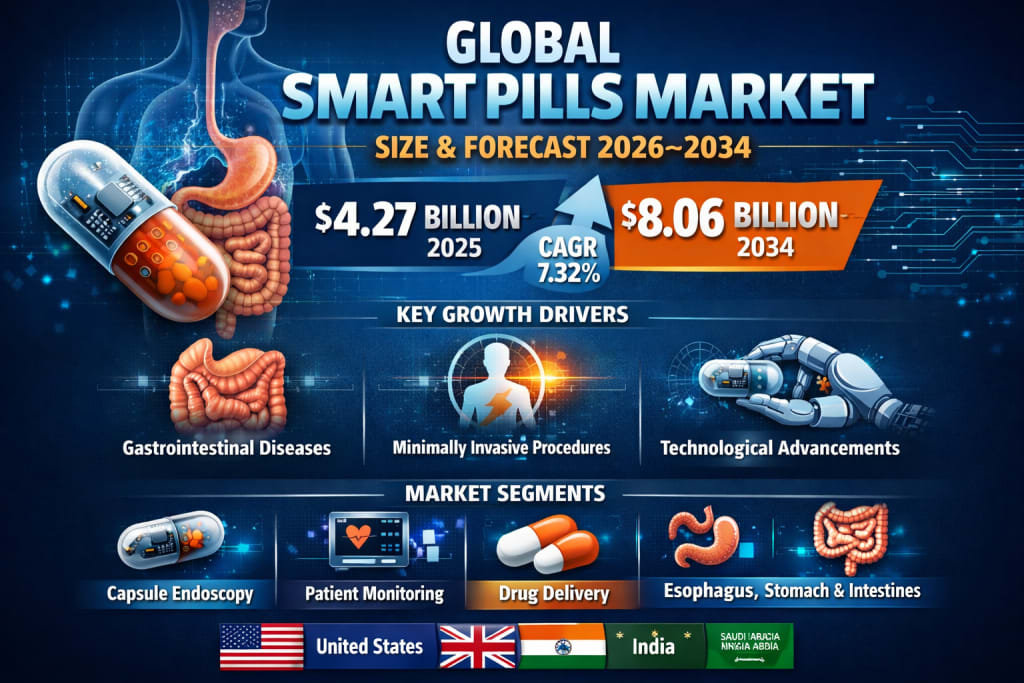
The Global Smart Pills Market is gaining remarkable momentum as healthcare systems worldwide adopt innovative diagnostic technologies. According to Renub Research, the Smart Pills Market is expected to reach US$ 8.06 Billion by 2034, growing from US$ 4.27 Billion in 2025 at a Compound Annual Growth Rate (CAGR) of 7.32% from 2026 to 2034.
This impressive expansion is fueled by the increasing demand for advanced diagnostic tools, the rising prevalence of gastrointestinal diseases, and the growing preference for minimally invasive medical procedures. Smart pills are transforming how doctors diagnose and monitor diseases inside the body, offering patients a safer and more comfortable alternative to traditional methods.
As healthcare systems move toward precision medicine and digital health integration, smart pills are emerging as one of the most promising innovations in modern diagnostics.
Global Smart Pills Market Outlook
Smart pills are ingestible medical devices equipped with sensors, cameras, or electronic components designed to diagnose, monitor, and sometimes treat medical conditions within the human body. These tiny devices are swallowed like ordinary capsules and travel through the digestive system while collecting valuable physiological data.
Depending on their design, smart pills can perform multiple functions, such as:
Capturing high-resolution images of internal organs
Measuring temperature, pH levels, or pressure
Tracking gastrointestinal movement
Transmitting diagnostic data wirelessly to external devices
One of the most widely used applications of this technology is capsule endoscopy, which allows physicians to examine the digestive tract without invasive procedures.
Traditional diagnostic techniques often require sedation, tubes, or surgical intervention. Smart pills eliminate many of these limitations by offering a non-invasive and patient-friendly solution. As a result, healthcare providers increasingly rely on these technologies to improve diagnostic accuracy while enhancing patient comfort.
The growing global burden of digestive disorders, coupled with technological progress in medical imaging and sensor technology, is accelerating the adoption of smart pills across hospitals, diagnostic centers, and research institutes worldwide.
Growth Drivers of the Smart Pills Market
Increasing Prevalence of Gastrointestinal Disorders
One of the most significant factors driving the smart pills market is the growing incidence of digestive disorders globally. According to the United European Gastroenterology (UEG) organization, more than 332 million people in Europe alone suffer from digestive diseases.
Conditions such as:
Crohn’s disease
Colorectal cancer
Gastrointestinal bleeding
Ulcers
Inflammatory bowel diseases
require accurate and early diagnosis to prevent complications and improve treatment outcomes.
Smart pills provide an effective solution for diagnosing these disorders. Capsule endoscopy systems, in particular, allow physicians to visualize the entire digestive tract without invasive procedures. Unlike traditional endoscopy, smart pills do not require sedation or complex equipment, making them safer and more comfortable for patients.
Furthermore, lifestyle changes and unhealthy dietary habits have contributed significantly to the rise in digestive health problems. The aging global population also increases the likelihood of gastrointestinal disorders, creating sustained demand for advanced diagnostic tools.
As healthcare systems emphasize preventive care and early disease detection, smart pills are becoming an essential component of modern gastrointestinal diagnostics.
Growing Demand for Minimally Invasive Diagnostic Technologies
The healthcare industry is increasingly shifting toward minimally invasive procedures that reduce patient discomfort, shorten recovery time, and minimize complications.
Smart pills represent one of the most advanced examples of this shift. Patients simply swallow the device, and it travels through the digestive system while collecting diagnostic data. This approach eliminates the need for invasive procedures such as traditional endoscopy or colonoscopy.
The benefits of minimally invasive diagnostics include:
Reduced hospital stays
Lower risk of infection
Faster recovery times
Improved patient compliance
Healthcare providers also benefit from improved diagnostic efficiency and reduced procedural costs.
Technological innovations are further accelerating the adoption of smart pills. In January 2024, AnX Robotica received FDA clearance for the NaviCam ProScan, an artificial intelligence-assisted reading system designed to analyze small intestine capsule endoscopy images. This technology helps physicians identify abnormalities more efficiently, improving diagnostic accuracy and workflow.
As patients increasingly seek comfortable and convenient diagnostic solutions, demand for smart pills is expected to continue growing globally.
Technological Advancements and Digital Healthcare Integration
Rapid advancements in medical electronics, wireless communication, and artificial intelligence have significantly improved the capabilities of smart pills.
Modern smart pills can now:
Capture high-resolution internal images
Monitor physiological parameters continuously
Transmit real-time data to external devices
Integrate with digital healthcare systems
These features allow healthcare providers to monitor patients remotely and analyze diagnostic information more effectively.
Ongoing research and development efforts are also expanding the potential applications of smart pills. Beyond gastrointestinal diagnostics, researchers are exploring their use in drug delivery, patient monitoring, and targeted therapies.
In January 2025, the FDA approved CapsoCam Plus for pediatric patients aged two years and older, developed by CapsoVision Inc. This advancement represents a major milestone in expanding the accessibility of capsule endoscopy technology to younger patient populations.
As digital healthcare ecosystems continue to evolve, smart pills will play a critical role in enabling data-driven medical decisions and personalized treatment strategies.
Challenges in the Smart Pills Market
High Cost and Limited Accessibility
Despite their advantages, smart pills remain relatively expensive due to the advanced technologies used in their development. These devices incorporate miniature cameras, sensors, batteries, and wireless communication systems, all of which contribute to higher production costs.
The need for specialized equipment and trained healthcare professionals to interpret diagnostic data further increases overall healthcare expenses.
As a result, access to smart pill technology can be limited in developing regions where healthcare budgets and insurance coverage may be restricted. Many hospitals and clinics continue to rely on traditional diagnostic methods due to cost considerations.
Reducing manufacturing costs and improving healthcare reimbursement policies will be essential for expanding the global adoption of smart pills.
Regulatory and Safety Concerns
Smart pills must undergo rigorous regulatory approval processes before entering the market. Because they are ingestible medical devices, regulatory agencies require extensive clinical testing to ensure their safety and effectiveness.
These approval procedures can be lengthy and expensive, delaying product launches and increasing development costs for manufacturers.
Additionally, certain risks associated with smart pills must be carefully managed. One of the most common concerns is capsule retention, where the device becomes trapped in the digestive tract. This situation may occur in patients with intestinal blockages or certain gastrointestinal conditions.
Ensuring patient safety and maintaining device reliability are critical factors for the continued growth of the smart pills market.
Endoscopy Smart Capsule Market
The endoscopy smart capsule segment represents one of the fastest-growing areas within the smart pills market. These capsules contain miniature cameras that capture thousands of images as they pass through the digestive system.
They are widely used to diagnose conditions such as:
Gastrointestinal bleeding
Crohn’s disease
Tumors
Ulcers
Compared to traditional endoscopy procedures, capsule endoscopy is far more comfortable for patients because it does not involve tubes or sedation.
Technological improvements have enhanced the image quality, battery life, and wireless transmission capabilities of smart capsules. These advancements have made them more reliable and efficient for diagnostic purposes.
With the rising incidence of digestive disorders worldwide, demand for endoscopy smart capsules is expected to grow significantly over the next decade.
Esophagus Smart Pills Market
Smart pills designed for esophageal monitoring are becoming increasingly important in diagnosing conditions such as:
Gastroesophageal reflux disease (GERD)
Barrett’s esophagus
Esophageal cancer
These devices measure physiological parameters such as pH levels and pressure within the esophagus. By providing continuous monitoring data, they help physicians identify abnormalities and diagnose conditions at an early stage.
Advancements in sensor technology and wireless communication have enhanced the accuracy and performance of these devices. As awareness of esophageal disorders grows, demand for specialized smart pill technologies is expected to rise steadily.
Stomach Smart Pills Market
The stomach smart pills segment focuses on diagnosing and monitoring gastric conditions by measuring parameters such as pH levels, pressure, and temperature inside the stomach.
These devices are commonly used to diagnose conditions including:
Gastric ulcers
Acid reflux
Delayed gastric emptying
Smart pills provide physicians with continuous data about stomach function, enabling more accurate diagnoses and better treatment planning.
The increasing prevalence of digestive disorders and growing awareness about digestive health are major factors driving demand for stomach smart pills worldwide.
Smart Pills Market by End Users
Hospitals
Hospitals represent one of the largest end-user segments in the smart pills market due to their advanced medical infrastructure and access to specialized healthcare professionals.
Smart pills help hospitals diagnose gastrointestinal conditions more efficiently while reducing the need for invasive procedures. This improves patient comfort and enhances treatment outcomes.
Rising healthcare investments and the growing adoption of advanced medical technologies are further contributing to the demand for smart pills in hospital settings.
Diagnostic Centers
Diagnostic centers are also playing an increasingly important role in the adoption of smart pill technology. These facilities specialize in providing diagnostic services, including capsule endoscopy and physiological monitoring.
Compared with hospital-based procedures, diagnostic centers often offer more affordable and convenient testing options for patients.
As preventive healthcare awareness increases worldwide, more individuals are visiting diagnostic centers for early disease screening. Smart pills enable these facilities to provide highly accurate and efficient diagnostic services.
Regional Insights
United States Smart Pills Market
The United States remains one of the leading markets for smart pills due to its advanced healthcare infrastructure and strong adoption of innovative medical technologies.
High prevalence of gastrointestinal disorders, significant investment in research and development, and the presence of major medical device manufacturers contribute to market growth.
In March 2024, researchers at the California Institute of Technology developed a location-aware smart pill that uses magnetic fields to determine its exact position inside the gastrointestinal tract. This breakthrough technology could significantly improve diagnostic precision.
United Kingdom Smart Pills Market
The United Kingdom is witnessing increasing adoption of smart pills due to growing awareness of gastrointestinal health and the demand for non-invasive diagnostic solutions.
The country’s robust healthcare system and investments in medical innovation are supporting the development and adoption of advanced diagnostic technologies.
A £3.3 million project funded by LifeArc aims to accelerate drug discovery by using artificial intelligence to identify potential treatments for complex diseases, demonstrating the UK's commitment to healthcare innovation.
India Smart Pills Market
India’s smart pills market is expanding due to improving healthcare infrastructure and rising awareness of advanced diagnostic technologies.
Rapid urbanization, changing dietary habits, and increasing cases of gastrointestinal disorders are driving demand for accurate diagnostic tools.
Government initiatives, growing healthcare investments, and the expansion of diagnostic centers are also contributing to market growth.
Saudi Arabia Smart Pills Market
Saudi Arabia is experiencing steady growth in the adoption of smart pills due to rising healthcare spending and ongoing investments in advanced medical technologies.
The government’s focus on strengthening healthcare infrastructure and promoting early disease detection has created favorable conditions for the smart pills market.
In September 2025, researchers from King Abdulaziz City for Science and Technology and the University of California San Diego developed a smart multi-compartment capsule capable of storing and delivering multiple medications throughout the day.
Market Segmentation
Application
Capsule Endoscopy
Patient Monitoring
Drug Delivery
Target Area
Esophagus
Small Intestine
Large Intestine
Stomach
End Users
Diagnostic Centers
Hospitals
Research Institutes
Others
Regional Insights
North America, Europe, Asia Pacific, Latin America, and the Middle East & Africa represent the primary regional markets for smart pill technology.
Key Companies in the Global Smart Pills Market
Leading companies operating in the smart pills market include:
Check-Cap Ltd.
General Electric Company
Fujifilm
Koninklijke Philips N.V.
Medtronic plc
Olympus Corporation
Novartis AG
Otsuka Holdings Co., Ltd.
These companies are investing heavily in research and development, product innovation, and strategic partnerships to strengthen their market positions.
Final Thoughts
The Global Smart Pills Market is entering a transformative phase as healthcare systems increasingly embrace minimally invasive diagnostics and digital healthcare technologies.
Smart pills offer significant advantages over traditional diagnostic methods by providing real-time data, improving patient comfort, and enhancing diagnostic accuracy. As technological advancements continue and healthcare systems prioritize early disease detection, the adoption of smart pill technologies is expected to accelerate.
With strong growth projections and expanding applications across diagnostics, monitoring, and drug delivery, smart pills are poised to become a cornerstone of future medical innovation.
The coming decade will likely see these intelligent devices play a crucial role in revolutionizing gastrointestinal diagnostics and reshaping the global healthcare landscape.


Comments
There are no comments for this story
Be the first to respond and start the conversation.